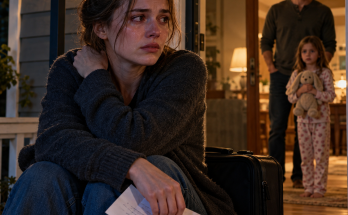
Sarah didn't move after I put the telephone down. She stood beside the window, watching the dark reflection of our living room in the glass, while I tried to decide whether Daniel's warning had made us safer or simply given our fear a new direction.
“Someone wants us to find something,” I said. “That doesn't mean we should do exactly what they want.”
Sarah turned toward me. “You don't understand what happened back then.”
“Then help me understand.”
She looked at the empty space on the coffee table where the photograph had been. “Michael believed there were people who would do almost anything to keep certain records from becoming public. Daniel believed him. I wasn't sure what to believe, but I knew Emily was caught in the middle.”
“And you decided silence was the answer.”
“I decided it was the only answer I had.”
I wanted to remind her that those were not the same thing. Instead, I gathered the remaining photographs and placed them in a drawer, leaving the small handwritten note and the anonymous letter on the table. We would not throw anything away, and we would not let another telephone call decide what we did next.
Sarah went upstairs to change. I called our daughter and asked whether she could keep our granddaughter overnight if necessary. I did not give her a reason beyond saying that Sarah and I needed to deal with a difficult family matter. She agreed, although I could hear the questions she was choosing not to ask.
When Sarah returned, she carried a small handbag and wore her dark coat. She had made up her mind about something, but I couldn't tell whether it was to leave the house or finally confront the past.
“There's a place we should go,” she said.
“Where?”
“The house in the photograph. I think I can find it.”
I stared at her. “You told me you didn't know the address.”
“I don't remember the address. I remember how to get there.”
We drove just after dawn, taking the road that led toward the older part of town. The morning was cold enough to fog the windshield at the edges, and Sarah sat with both hands folded in her lap. She gave directions in short phrases, sometimes correcting herself at the last moment.
We passed the railway station, now closed and fenced off, then followed a narrow road between neglected fields and low brick houses. At a junction, Sarah asked me to turn left. A few minutes later, she pointed toward a line of trees beyond a stone wall.
“That was the entrance,” she said.
The house stood behind an overgrown garden. Its red brick had darkened with age, and several windows were boarded up. The iron gate hung crookedly from one hinge, while weeds pushed through the cracks in the path. It looked abandoned, though a fresh tire track marked the muddy ground beside the drive.
I parked near the road rather than blocking the entrance. Neither of us got out immediately.
“Is this where the photograph was taken?” I asked.
Sarah nodded. “Michael's family used it when they needed somewhere away from town.”
“Who lives here now?”
“I don't know.”
We approached the gate together. A metal plate beside the entrance bore a name, but the lettering had been worn nearly smooth. I could make out only the first letter and the faint outline of the final one. Sarah touched the gate with her fingertips, then withdrew her hand as if the cold iron had burned her.
“I haven't been here since the year Michael died,” she said.
“Why come back now?”
“Because I need to know whether the second copy was ever kept here.”
She pushed the gate gently. It opened with a long, rusty groan.
The front door stood slightly ajar. Sarah stopped on the threshold and looked back at me.
“Michael's father kept a key under the loose stone beside the steps,” she said. “He thought nobody knew about it.”
I examined the stones along the wall until I found one that shifted beneath my fingers. Underneath lay a small brass key, dark with age. Sarah stared at it, then shook her head.
“I can't believe it's still there.”
I fitted the key into the lock. It turned, though the mechanism resisted before the door opened inward.
The smell reached us first: damp plaster, old wood, and the stale air of a building that had been closed for years. Dust lay across the floorboards, disturbed only by a narrow trail of footprints leading toward the back of the house.
I pointed them out to Sarah.
She crouched to examine the marks. “Those weren't here before.”
“How can you be sure?”
“Because I remember the dust. When we came here after Michael died, the rooms were clean. His family had someone maintaining the place.”
The footprints were too recent to have settled beneath a thick layer of dust. Whoever had entered had walked carefully, keeping close to the wall.
We followed the trail into a narrow corridor. On our left stood a door with a brass handle. Sarah recognized it as the entrance to Michael's office.
The room had been emptied of most of its furniture. A desk remained near the window, its drawers pulled out and left open. Against the opposite wall stood a filing cabinet with one door hanging crookedly.
I stepped inside and looked at the desk.
“Is this where the metal box was kept?”
Sarah nodded. “Underneath, on the left.”
I knelt and examined the floor. Four pale squares showed where the desk's feet had stood for years. Beside one of them, the boards bore a fresh scrape.
Someone had moved the desk recently.
We searched the room without touching anything that appeared fragile. The filing cabinet contained only a few rusted clips and scraps of paper. Behind the desk, however, I found a small rectangular mark in the dust, as though a box had rested there before being removed.
Sarah leaned over my shoulder.
“That was where Michael kept it,” she whispered.
I ran my fingers along the edge of the desk. A narrow panel beneath the writing surface shifted when I pressed it. Inside was a shallow compartment, empty except for a folded piece of paper.
Sarah covered her mouth when I opened it.
The paper contained a handwritten address and a telephone number. Beneath them was a name: Margaret.
I compared the address with the one in my old notebook. It was different from the address we had known, but the town was the same.
“Perhaps she moved there,” I said.
Sarah shook her head. “That address is the old clinic.”
I looked at her.
“What clinic?”
“The place where Emily was taken after she became ill. Margaret used to volunteer there.”
The paper was dated only a few weeks before Michael's death.
I folded it carefully and placed it in my coat pocket. Whatever the second copy was, someone had apparently returned to this room looking for it. The disturbed desk and fresh footprints made that difficult to dismiss as coincidence.
A sound came from upstairs.
Sarah seized my arm.
We stood perfectly still, listening. A floorboard creaked above us, followed by the soft scrape of something being moved across the floor.
“Is there another entrance?” I whispered.
“There's a back door near the kitchen.”
I took Sarah's hand and led her toward the corridor. We did not run, but we moved quickly enough that my shoes struck the floorboards harder than I intended.
The back door opened onto a small yard enclosed by a crumbling brick wall. Beyond it, a narrow passage led to the road.
No one was there.
When we returned to the front of the house, the gate stood open wider than before. A dark vehicle was parked farther down the road, its engine running.
The driver turned his head toward us.
I could not see his face clearly through the windshield, but I saw the pale rectangle of a phone held near his ear.
Then the vehicle pulled away.
Sarah watched it disappear around the bend.
“Do you recognize the car?” I asked.
“No.”
I wanted to call the police, but I hesitated. We had no evidence of a break-in beyond the footprints and the disturbed desk, and I did not want to turn an uncertain suspicion into an accusation. Still, I took photographs of the marks and the open door with my phone.
Sarah stood in the garden, staring toward the road.
“Michael always said someone would come back for the records,” she said.
I turned to her. “You never told me that.”
“He said it once, after an argument with his father. I thought he was talking about a family dispute. I didn't understand what he meant.”
“And now?”
She looked at the empty house.
“Now I think he knew he was in trouble.”
We left the building and locked the door behind us. I kept the brass key, the address, and the photographs of the disturbed room. Before getting into the car, I called Daniel and told him what we had found.
He listened without interrupting.
When I mentioned Margaret's name, he drew a sharp breath.
“Don't go to that address,” he said.
“Why?”
“Because Margaret hasn't worked there in years.”
“Then where is she?”
“I don't know where she lives now. But I know who used to visit that clinic.”
“Who?”
Daniel hesitated.
“Michael's father.”
I looked toward the road where the dark vehicle had disappeared.
“Then we're going to find him,” I said.
Sarah turned toward me, alarm spreading across her face.
“Please,” she whispered. “If his father is still alive, you don't know what he might do.”
I held her gaze.
“Neither do you. That's why we're done guessing.”
Click here to continue reading: PART 6: The Old Clinic Had Closed Long Ago, but One Name in Its Records Connected Emily to the Man Sarah Had Tried to Forget
The Night My Granddaughter Reached for the Telephone and Exposed a Secret Our Family Had Buried for Years
Part 5 of 20