The story did not end in a courtroom.
It did not end when Nolan was sentenced.
Or released.
Or apologized.
It did not end when Rachel sold the old house, threw away the padlock, fell in love again, or learned to disagree without doubting her own mind.
If I had to choose an ending, I would choose a Saturday morning years after the garage.
Nothing important was scheduled.
That was precisely why it mattered.
Rachel called at nine.
“Are you busy?”
“I was considering becoming busy.”
“Come over.”
“Why?”
“I made too much breakfast.”
“You’ve inherited your father’s inability to estimate portions.”
“I’m hanging up.”
I arrived twenty minutes later.
Daniel’s car was gone.
He had gone cycling with friends.
Rachel stood in the kitchen wearing the faded blue cardigan.
The mismatched button remained.
She had flour on one sleeve.
“What happened?”
“Pancakes.”
“That doesn’t explain the flour.”
“I’m an expressive cook.”
The back door stood open.
Morning air moved through the kitchen.
From outside came the sound of Rachel’s radio in the garage.
I looked toward it.
Garage door open.
Side door open too.
Not intentionally symbolic.
The weather was pleasant.
Rachel handed me coffee.
“Daniel wants to move in.”
I nearly dropped it.
She laughed.
“That reaction is why I waited until you were holding something.”
“You said wants.”
“Yes.”
“What do you want?”
Rachel smiled.
Good.
I had learned.
“I think I want it too.”
“Think?”
“I’m allowed to think.”
“Absolutely.”
She sat opposite me.
They had been together long enough that the question was not surprising.
Still, living together meant practical entanglement.
Bills.
Keys.
Furniture.
Mail.
Routines.
Financial access.
All the ordinary things Nolan had once transformed into instruments of control.
Rachel knew that.
So did Daniel.
“We talked about money.”
“Of course.”
“Separate accounts. One shared household account if we decide we need it.”
“Passwords?”
“Separate.”
“Property?”
“House stays mine.”
“Expenses?”
“Written agreement.”
I smiled.
“What?”
“Nothing.”
“You think I’m treating cohabitation like a corporate merger.”
“A well-governed corporate merger.”
“Exactly.”
Rachel did not confuse trust with absence of boundaries anymore.
That was perhaps the deepest change.
She could love someone without handing over every key.
She could share a home without surrendering ownership of information.
She could accept help without granting authority.
Daniel understood.
If he had not, he would not have been moving in.
“What about the garage?” I asked.
Rachel narrowed her eyes.
“What about it?”
“Shared?”
“No.”
I laughed.
“Seriously?”
“He can use tools. He does not get organizational authority.”
“Wise.”
“He puts screwdrivers in the wrong drawer.”
“Unforgivable.”
We ate pancakes.
Halfway through breakfast, someone knocked at the front door.
Three times.
Rachel and I both stopped.
It happened automatically.
Our eyes met.
Neither pretended otherwise.
Three knocks would probably always carry something.
Rachel stood.
“I’ll get it.”
I remained seated.
She walked through the hall.
Opened the door.
A delivery driver stood outside holding a long cardboard package.
“Rachel Pierce?”
“Yes.”
She signed.
Carried the box inside.
No fear.
No performance.
Just a package.
“What is it?” I asked.
“Table legs.”
“You ordered table legs?”
“I’m building something.”
“What?”
“A table.”
“I gathered that.”
She carried the box toward the garage.
I followed.
Sunlight crossed the concrete.
The restored chair stood near the wall.
The old radio played.
Her father’s red toolbox sat open on the bench.
Rachel cut the package tape.
Four wooden legs.
She examined each one.
“Good.”
“You sound surprised.”
“Online ordering is a gamble.”
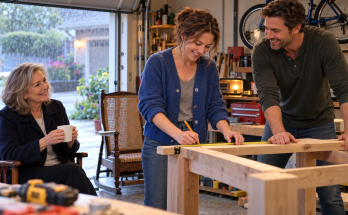
The table project had started because Daniel wanted a larger dining table.
Rachel had refused to buy one.
Apparently this meant building one from scratch.
“You know furniture stores exist.”
“Coward.”
She placed the legs on the bench.
Then pointed to a stack of boards.
“That’s the top.”
I ran my hand over the wood.
Rough.
Unfinished.
“Looks like work.”
“That’s the point.”
She began measuring.
I sat in the restored chair.
The same one that had once contained Nolan’s hidden drive.
Now it contained nothing.
Just wood, cane and repaired joints.
Rachel marked a line with pencil.
Erased it.
Measured again.
Changed the mark.
No panic about being wrong.
Just correction.
Her phone buzzed on the bench.
She checked.
Daniel.
She read the message and smiled.
“What?”
“He says he’ll be back by noon.”
“Does he know you started the table without him?”
“He has no useful skills.”
“Harsh.”
“Documented.”
She returned to measuring.
Watching her, I remembered the hospital.
Rachel asking whether the door was open.
Her cracked lips.
Bruised cheek.
The way she kept waking and checking.
I remembered wanting to promise that nothing like it could ever happen again.
I was grateful I had not.
No one can promise that.
Safety is not a permanent state granted by love.
It is built from choices, boundaries, systems, attention, relationships and the ability to act when something feels wrong.
Sometimes it fails.
Sometimes people we trust exploit it.
Sometimes the law arrives late.
Sometimes a mother does too.
That truth still hurt.
Rachel looked up.
“You’re doing the face again.”
“What face?”
“The one where you turn my furniture into philosophy.”
I laughed.
“You know me too well.”
“Unfortunately.”
She measured another board.
Then said, “I’ve been thinking about something.”
“What?”
“The first night in the apartment.”
After the hospital.
The beige walls.
Mismatched lamps.
Green sofa.
Rachel had insisted on staying somewhere that belonged to neither Nolan nor me.
“You asked if I wanted you to stay.”
“I remember.”
“I said no.”
“You did.”
“I was terrified after you left.”
That surprised me.
“You never told me.”
“I know.”
“Why didn’t you call?”
“I almost did.”
She marked another line.
“But I wanted to know I could be scared without immediately giving someone else control of what happened next.”
I absorbed that.
“You could have called me without giving me control.”
“I know that now.”
Fair.
Rachel continued.
“I think I confused independence with doing everything alone for a while.”
“You did.”
She looked up sharply.
“What?”
“You want me to lie?”
“No.”
“Then yes. You did.”
She smiled.
“Eventually I figured out the difference.”
“Which is?”
“Choice.”
Simple.
Almost irritatingly simple.
Dependence can be chosen.
Help can be chosen.
Privacy can be chosen.
Company can be chosen.
So can solitude.
The opposite of coercion was not isolation.
It was agency.
Rachel put down the pencil.
“Do you know what I think the three knocks saved?”
I looked at her.
“Your life.”
She shook her head.
“Maybe.”
The word startled me.
She explained.
“I don’t know what Nolan would have done if you hadn’t come back. Maybe moved me. Maybe kept me somewhere else. Maybe eventually let me go. Maybe something worse.”
She waited.
“We don’t know.”
“No.”
“I’m done inventing the part we don’t know.”
Good.
“So what did they save?”
“The next decision.”
I said nothing.
Rachel touched the edge of the board.
“When you heard me, everything he was controlling stopped being entirely his. Police came. The door opened. Doctors asked me questions. Chen asked me questions. You believed me.”
Her voice remained steady.
“The knocks didn’t magically save the rest of my life.”
No.
“They gave me another decision.”
Leave the hospital.
Choose an apartment.
Give a statement.
Refuse Tessa.
Meet Levin.
Attend court.
Testify.
Return to work.
Travel.
Sell the house.
Buy another.
Read Nolan’s letter.
Throw away the padlock.
Date Daniel.
Give him a key.
Maybe let him move in.
Thousands of decisions after one locked door opened.
Rachel picked up the pencil.
“That’s what I think they saved.”
The future.
Not as a guaranteed good outcome.
As the right to participate in it.
I felt tears coming.
Rachel saw.
“No.”
“I’m allowed.”
“You’re turning this into a moment.”
“It is a moment.”
“It’s lumber.”
I laughed through the tears.
“Your father would have been proud of you.”
That silenced her.
She looked down.
For a moment I worried I had said too much.
Then Rachel nodded.
“I think so too.”
No false modesty.
No refusal.
She believed it.
Daniel returned before noon.
He entered through the open garage door carrying his bicycle helmet.
He stopped when he saw the lumber.
“You started.”
Rachel said, “You were late.”
“We said noon.”
“It’s eleven forty-eight.”
“Exactly.”
She smiled.
“Help Mom move the chair.”
He looked at me.
“Historical artifact relocation?”
“Furniture,” Rachel and I said together.
Daniel raised his hands.
“Understood.”
We moved the chair closer to the wall.
Then the three of us spent an hour arguing about the table.
Daniel wanted it longer.
Rachel said it would overwhelm the dining room.
I agreed with Rachel.
Daniel accused us of forming a coalition.
Rachel told him he was welcome to file a minority report.
Eventually we settled on dimensions.
No one won.
No one lost.
We measured again.
Then cut the first board.
The saw filled the garage with noise.
Rachel wore safety glasses.
Daniel held the far end.
I stood back because apparently retirement had also removed my authority around power tools.
When the cut finished, Rachel inspected it.
“Good.”
Daniel said, “My contribution was essential.”
“You held wood.”
“Essentially.”
Rachel laughed.
The sound filled the garage.
Not triumphantly.
Not as proof of healing.
Just laughter.
Later we carried the boards inside.
Rachel closed the garage door because rain had started.
A soft autumn shower.
Nothing like the storm in my memory.
Or perhaps exactly like it.
Weather repeats without meaning.
At the kitchen table, Rachel checked her phone.
A routine supervision notice.
Nolan had completed another required reporting period without violation.
No action needed.
Rachel read it.
Deleted it.
Daniel did not ask.
Neither did I.
She looked toward the window.
Rain moved across the glass.
Somewhere, Nolan was living the consequences and possibilities of his own choices.
Tessa had hers.
Celia, Maya, Hannah, Leah and everyone else had lives beyond what we knew of them.
The justice system had done what it could prove, corrected one mistake, imposed consequences, and eventually released a man under rules.
It had not repaired Rachel.
Rachel had done that work herself—with help, but by choice.
The central truth had become simpler over time.
She had not imagined the financial deception.
She had not agreed to be confined.
Her anxiety did not authorize anyone to take her phone, drug her, lock her behind a door, impersonate her, or decide when she was allowed to leave.
Her anger did not make captivity reasonable.
Throwing a mug did not transfer ownership of her freedom.
Tessa’s fear explained some of her failures without erasing them.
Nolan’s eventual insight did not undo his choices.
And uncertainty about the worst thing that might have happened did not reduce the seriousness of what actually did.
Rachel did not need exaggeration.
The truth was enough.
She stood.
“I need to check something.”
She walked to the garage.
For a moment, some old reflex in me wanted to follow.
I did not.
A minute later Rachel returned carrying the tape measure.
“Left this out there.”
Daniel pointed.
“There’s another one in the drawer.”
“That one lies.”
“A tape measure cannot lie.”
“This one can.”
He looked at me.
“See what I live with?”
I smiled.
“Document everything.”
Rachel threw a dish towel at me.
The afternoon continued.
By evening, the first pieces of the table frame were assembled.
Crooked.
Rachel insisted they were temporarily crooked.
Daniel said crooked was binary.
They argued about geometry until I left.
At the front door, Rachel hugged me.
“Text when you get home.”
I raised an eyebrow.
“Safety.”
“Monitoring?”
“Courtesy.”
“Fine.”
I walked toward my car.
Behind me, the door remained open while Rachel watched.
I reached the driveway.
Then turned.
She was still there.
Blue cardigan.
Bare feet.
One hand resting against the doorframe.
For an instant, I saw every version of her at once.
My child.
The exhausted woman on the hospital stretcher.
The witness answering carefully under oath.
The woman signing papers for her own house.
The daughter correcting me when my fear became surveillance.
The person standing there now.
None erased the others.
Rachel lifted a hand.
“Go home, Mom.”
I laughed.
Then I did.
At home I sent:
Made it.
Her reply came a minute later.
Good.
Nothing else.
I put down the phone.
Outside, rain tapped lightly against the windows.
Once.
Then twice.
Then three times in quick succession.
My body noticed.
Of course it did.
I listened.
Only rain.
I did not need to forget the sound.
I did not need to stop remembering that garage.
Memory could remain without becoming command.
Across town, Rachel’s new garage was closed because of the weather.
The lock worked from both sides.
The key was hers.
Inside waited unfinished wood, a radio, tools, a restored chair, and a table not yet built.
In the morning, Rachel would open the door herself.
The End
Read more original stories on Feel Every Story.
Seven days without my daughter turned one polished explanation, a borrowed blue cardigan, and a new padlock into something far darker
Part 46 of 46