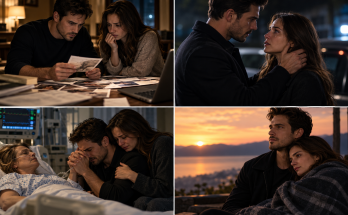
The cemetery looked smaller than I remembered.
Perhaps grief had made it enormous nine years earlier.
On the morning Robert was exhumed, the sky was pale and windless. I stood outside the restricted area with Emily while officials worked beyond temporary screens.
I had been told I did not need to come.
I came anyway.
There are moments when absence feels worse than pain.
Emily held my arm.
“You don’t have to stay.”
“Neither do you.”
“I know.”
Neither of us left.
We did not watch the physical work.
I was grateful for that.
I looked instead at the maple tree near Robert’s grave and remembered choosing the plot because he had liked shade.
Ridiculous, perhaps.
The dead do not need shade.
The living need reasons.
When the medical examiner’s vehicle left, I finally cried.
Not dramatically.
No collapse.
Tears simply began, and I let them.
Emily put both arms around me.
“I’m sorry.”
“So am I.”
“For what?”
“I should have known.”
She pulled back.
“No.”
“I lived with him.”
“That doesn’t mean you should have known somebody might poison him.”
The word struck harder when she said it.
Poison.
Not cardiac event.
Not medication interaction.
Poison.
“We don’t know that yet.”
“You’re doing it again.”
“Doing what?”
“Protecting the facts.”
“Yes.”
She wiped her face.
“Dad would approve.”
That made me laugh through tears.
“Yes. He would.”
Testing took time.
Too much time.
While we waited, the financial investigation accelerated.
The hard drive from Harold Carter’s garage contained backups of Northbridge records.
Encrypted folders.
Scanned identification.
Trust documents.
Insurance applications.
Spreadsheets tracking families.
The word suitable appeared repeatedly.
So did another word.
Transition.
I asked Donnelly what it meant.
“We think it referred to movement of control after a death, incapacity or inheritance event.”
“Human beings reduced to transitions.”
“Yes.”
“How many families?”
“At least thirty-one.”
“How many lost money?”
“We’re still determining that.”
“How many people died?”
Donnelly looked at me.
“That question is now being reviewed.”
It frightened me more than any number could.
Richard Bell had hired an attorney.
He declined voluntary questioning.
Martin Keene disappeared from his usual residence before investigators could interview him.
His accounts showed unusual transfers.
Thomas Carter remained in Arizona under legal advice.
Linda Mercer surrendered through her attorney two days later.
She brought records.
That surprised everyone.
She admitted participating in the childcare reimbursement fraud.
She denied knowing anything about Robert’s death.
She also identified Martin as the person who ordered her to create the life-insurance application on me.
“Ordered?” I asked when Cho summarized the statement.
“That’s her word.”
“Did Derek know?”
“She says no.”
“Do you believe her?”
“We’re corroborating.”
“What was the purpose?”
“To frighten Derek.”
“How does insuring me frighten him?”
“Martin sent him a copy.”
I understood.
Not a threat stated aloud.
A demonstration.
We can reach her.
We have her identity.
We can create documents.
We can make death profitable.
“What did Martin want from Derek?”
“The trust amendment.”
“Mine.”
“Yes.”
“And Derek refused?”
“According to Linda.”
That did not erase his crimes.
But it answered one question.
The insurance policy had not been Derek preparing for my death.
It had been Martin reminding him what the old operation was capable of doing.
“What about the anonymous call?”
“Linda says it wasn’t her.”
“Martin?”
“Possibly.”
I almost smiled at the word.
It had become our investigation’s permanent companion.
A week after the exhumation, Detective Cho came to my house.
She did not call me to the station.
That told me the news before she spoke.
Emily was there.
The children were at school and daycare.
Cho sat at my kitchen table.
The same table where Sophie had asked how much I cost.
“Preliminary toxicology is back.”
I folded my hands.
“Tell me.”
“They detected preserved evidence consistent with the cardiac medication prescribed to Robert.”
“That was expected.”
“Yes.”
“They also detected the second compound found in the bottle.”
I stopped breathing normally.
“Enough to matter?”
“The concentrations cannot be reconstructed perfectly after nine years.”
“But?”
“The medical examiner believes the combination could have caused a fatal ventricular arrhythmia.”
Emily gripped the table.
“Could have.”
“Yes.”
“Can they say it did?”
Cho looked at me.
“The manner of death is being changed.”
I heard the refrigerator hum.
A car passed outside.
“What to?”
“Pending further investigation.”
“That isn’t an answer.”
“No.”
“Cause?”
“Fatal cardiac arrhythmia associated with drug interaction is now considered probable.”
“Was the second drug prescribed to him?”
“No.”
“Would he have knowingly taken it?”
“We cannot determine that.”
Emily whispered, “Dad was poisoned.”
Cho remained careful.
“We can say he had a medication in his body that was not prescribed to him and that its interaction with another drug may have caused his death.”
“That is poisoning.”
“It may be.”
I looked at her.
“What would make you say yes?”
“Evidence of administration.”
“Someone giving it to him.”
“Yes.”
“What about Bell?”
“We’re investigating.”
“His label was inside the bottle.”
“Yes.”
“He met Robert that day.”
“Yes.”
“He was paid twenty-five thousand dollars eleven days after Robert died.”
“Yes.”
“What else do you need?”
“Enough to prove what happened beyond reasonable doubt.”
I understood.
I hated it.
But I understood.
Cho took another document from her folder.
“This may help.”
It was a pharmacy audit.
Investigators had traced Richard Bell’s prescriptions.
The second drug had been prescribed to Bell personally shortly before Robert’s death.
He had filled sixty tablets.
His insurance records showed no refill for months.
“How many should he have used?”
“Based on directions, roughly one per day as needed.”
“And?”
“We don’t know how many he actually took.”
“So still not enough.”
“No.”
Then she showed me something else.
Robert’s cardiac prescription had been written for thirty tablets.
The recovered bottle contained no intact pills.
But pharmacy inventory records showed a discrepancy on the day it was picked up.
“What discrepancy?”
“The technician entered a manual correction.”
“For what?”
“Quantity.”
I leaned closer.
“The system originally recorded sixty tablets dispensed.”
“Then?”
“Changed to thirty.”
“Who authorized the correction?”
“Richard Bell.”
Emily stared.
“Why would the doctor be changing pharmacy inventory?”
“He shouldn’t ordinarily.”
“Did he go to the pharmacy?”
“Security video no longer exists.”
Of course.
Nine years erased cameras.
It had not erased paperwork.
Cho continued.
“One former pharmacist remembers Bell coming in occasionally because he knew the owner.”
“Does she remember that day?”
“No.”
I looked at the timeline.
“Robert met Bell and Charles Thursday morning.”
“Yes.”
“He came home.”
“Yes.”
“He took a pill after dinner.”
“Yes.”
“And died.”
“Yes.”
“What happened to Charles?”
“He died five years ago.”
No interrogation.
No trial.
No confession.
That angered me more than I expected.
“Convenient.”
Cho did not disagree.
“What killed him?”
“Cancer.”
At least one death in this story remained ordinary.
“What about Martin?”
“Still missing.”
“Do you think he ran?”
“Yes.”
That was the strongest answer Cho had given me about him.
“Why?”
“His passport was used.”
“Where?”
“Canada.”
“When?”
“Two days ago.”
Emily looked at me.
“He left the country.”
“Apparently.”
“Can you bring him back?”
“If charges support extradition.”
“What charges?”
“Fraud, conspiracy, identity theft and potentially others.”
Potentially.
Again.
That evening, Derek called Emily from his attorney’s office.
She almost ignored him.
Then answered.
I left the kitchen.
Ten minutes later she called me back.
“Stay.”
I sat.
Derek’s voice came through speakerphone.
“I heard about Robert.”
“How?” Emily asked.
“My lawyer.”
“What exactly did you hear?”
“That the death certificate may change.”
Emily looked at me.
“Yes.”
Derek was silent.
Then he said, “There’s something I never told the police.”
I closed my eyes.
Every sentence like that now made me tired.
“What?”
“The night before Robert died, my father called me.”
Emily sat straighter.
“What did Thomas say?”
“He was drunk.”
“About what?”
“Northbridge.”
“Specifically?”
“He said Charles had a problem with an old client.”
My skin prickled.
“Robert?”
“I didn’t know then.”
“What else?”
“He said Bell was going to ‘settle the heart issue.’”
The kitchen seemed to lose all warmth.
Emily whispered, “Those words?”
“Yes.”
“Why didn’t you tell anyone?”
“I didn’t connect it until years later.”
“When?”
“When I saw Robert’s letter in the garage.”
“And then you still stayed quiet.”
“Yes.”
“Why?”
“Because my father was involved.”
She laughed bitterly.
“You always have a reason.”
“I know.”
I leaned toward the phone.
“Did Thomas explain what ‘settle the heart issue’ meant?”
“No.”
“Did you ask?”
“No.”
“Did he say Charles?”
“Yes.”
“Bell?”
“Yes.”
“Martin?”
“No.”
“What about your grandfather Harold?”
“He knew Northbridge was criminal. That’s why he stole the records.”
“Was he involved?”
“At first.”
Of course.
Another person who had begun inside the crime and later decided his conscience mattered.
“What changed him?”
Derek paused.
“Robert.”
I stared at the phone.
“What?”
“Grandpa met Robert.”
“When?”
“A week before Robert died.”
“How?”
“Robert tracked Thomas’s signature to the Carter family. He found Grandpa instead.”
“Why didn’t Harold warn him?”
“He tried.”
“About what?”
“Charles.”
“Bell?”
“I don’t know.”
“Did Harold know Robert died?”
“Yes.”
“What did he do?”
“He took the records.”
“Why not go to police?”
“My father threatened him.”
“With what?”
“Prison. Grandpa had helped build Northbridge.”
So Harold chose evidence as leverage.
Not justice.
A family habit.
Emily asked, “Is Grandpa’s account written anywhere?”
“Yes.”
“Where?”
“In a notebook.”
“Was it in the crawlspace?”
“No.”
“Where is it?”
Derek hesitated.
Then he said, “I have it.”
Cho was at my house within forty minutes.
Derek’s attorney arranged the handover.
The notebook was small, black and cracked along the spine.
Harold Carter’s handwriting filled most pages.
The final section described Robert.
Robert Wallace came to me frightened but angry. Had copies. Said Bennett used daughter’s name. Told him Bennett dangerous. Told him Bell worse because Bell makes things look natural.
I stopped reading.
Emily continued.
Three pages later came the entry dated the day after Robert died.
Wallace dead. Thomas says heart. Don’t believe coincidence.
Then another.
Bell paid after. Charles says problem finished.
The final relevant entry was written weeks later.
Kept bottle Thomas told me to burn. If Bell ever comes after family, bottle proves connection.
There it was.
The bottle had not accidentally ended up in Harold’s garage.
Thomas had given it to his father.
And told him to destroy it.
Harold had refused.
Detective Cho immediately called Arizona investigators.
Thomas Carter was no longer merely a distant participant in financial fraud.
He had possessed physical evidence connected to Robert’s death.
And he had attempted to make it disappear.