I did not die that year.
Or the next.
Doctors are sometimes right about danger and wrong about timing.
I made it to eighty-seven.
Carol called that “stubborn survival.”
My son called it “refusing to finish paperwork.”
Both accurate.
By then, walking required a cane.
Pepper had died.
Carol said no more dogs.
Then adopted another six months later.
This one was named June.
I stopped arguing.
My heart eventually weakened enough that treatment became mostly comfort.
No dramatic final hospitalization.
I chose home.
That decision mattered because Anna had wanted the same.
Not because I needed to copy her.
Because I understood why.
Familiar chair.
Kitchen noises.
Carol’s bad bread.
My son stealing leftovers.
Clara dropping by with recording equipment I refused to let her turn on.
Samuel fixing things nobody asked him to fix.
Life around illness instead of illness becoming the only life.
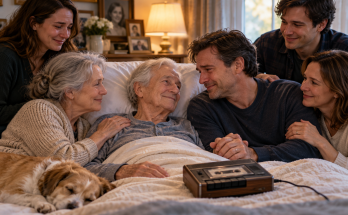
One morning, my son arrived carrying the cassette player.
I laughed.
“No.”
He smiled.
“You don’t even know why.”
“I know that object.”
He sat beside my bed.
Carol opened the curtains.
Winter light.
Thin.
Bright.
“You want to hear it?”
“Why?”
He shrugged.
“I was listening yesterday.”
“That’s your problem.”
He laughed.
Then became quiet.
“I thought maybe you wanted to.”
I looked at the cassette.
Original.
Cracked clear case replaced by archival protection.
Anna’s handwriting still visible.
Twenty-seven years since the wedding.
Nearly four decades since she recorded it.
That little strip of magnetic tape had outlived people who tried to use it.
Malcolm.
Thomas.
Eleanor.
Robert.
Edward eventually died in prison.
Martin too.
Jonathan survived longer and disappeared into ordinary old age after release, stripped of public power.
Helen gone.
Rachel still alive but forgetful.
History moved people from active conflict into records.
Anna’s voice remained.
“Play it.”
My son inserted the cassette.
Mechanical click.
Hiss.
Then:
“Hello, my boy.”
He was fifty-four.
Still her boy.
His face changed.
Mine too.
We listened.
Not the full forty-seven minutes at first.
He paused occasionally.
We talked.
At the wet-towel joke, I told him:
“You still do that.”
“I don’t.”
His wife shouted from the hall:
“He does.”
We laughed.
At the advice to his future wife, he shook his head.
“She knew me.”
“Yes.”
At the mother-son song, he did not cry immediately.
Then he did.
Nothing wrong with that.
At the line about peace and silence, Carol entered the room.
She stood near the door.
My son looked at her.
She smiled.
No shame.
Not anymore.
History remained.
But shame no longer owned the room.
Anna told him not to make the person he loved feel like a visitor in their own life.
I thought about my son at nineteen.
Carol in our house.
Anna’s photographs moving.
My own avoidance.
All the ways belonging had been made conditional.
Then I looked around.
Carol’s knitting near the chair.
Clara’s book on the table.
Samuel’s tools on a shelf he built.
Anna’s photograph.
My medications.
June’s dog hair everywhere.
A crowded life.
Nobody had to disappear to make room.
The tape reached the portion about the walnut box.
That object still existed.
My son kept it.
Not locked.
His wife stored sewing buttons inside it.
Anna’s pearls came out for family weddings and occasionally fancy dinners.
No shrine.
Useful things.
Living things.
The recording continued.
When Anna told my son she hoped he had built a noisy home, he laughed.
“We did.”
He had.
Clara called constantly from airports.
Samuel arrived without warning.
Grandchildren ran through rooms.
His wife argued with him about recycling.
Noise.
Exactly enough.
Near the end, Anna said:
“Whatever happens after today…”
My son stopped the tape.
“What?”
I asked.
He stared at the machine.
“For years that line scared me.”
“Why?”
“Because a lot happened.”
“Yes.”
“I thought she somehow knew.”
“No.”
“I know.”
He smiled.
“She meant marriage.”
“Probably.”
“She was just talking about marriage.”
“Yes.”
That was almost funny now.
We had spent decades attaching conspiracy to ordinary sentences.
Sometimes words meant exactly what they said.
He restarted.
Anna told him marriage was many small promises.
My son’s wife entered and sat beside him.
They had been married twenty-seven years.
Not perfect.
Still there.
Then Anna’s final line:
“And please go enjoy your wedding. Your mother has talked long enough.”
The tape ended.
Static.
My son reached to stop it.
I said:
“Wait.”
“Why?”
I listened.
Nothing.
Pure tape hiss.
No hidden Malcolm track on this original.
No secret conversation.
No instruction.
Just blank magnetic space.
Forty-seven minutes and twelve seconds had ended.
I smiled.
“That’s good.”
“What?”
“Nothing after.”
He understood.
He stopped the machine.
Carol sat beside me.
I looked at my son.
There was one thing I needed to say.
Not instruction.
Not control.
“Your wedding was yours.”
He frowned.
“I know.”
“No. I mean the day.”
I breathed.
“The tape took it over. The case took it over. We all talk about your wedding like it belongs to what happened afterward.”
He looked at his wife.
She nodded.
I continued.
“You got married that day.”
“Yes.”
“That’s the true thing.”
He smiled.
“It is.”
No crime changed that.
No forged signature.
No hidden trust.
No dead woman’s message.
The marriage survived not because the wedding became important evidence.
It survived because two people kept choosing each other after the evidence left.
I looked at his wife.
“Thank you.”
“For what?”
“Staying when you had reasons not to.”
She shook her head.
“I stayed because I wanted to.”
Exactly.
No debt.
No sainthood.
Choice.
I rested.
Later Clara came.
She brought no recorder.
I noticed.
“You forgot your equipment.”
“On purpose.”
“Growth.”
She rolled her eyes.
Samuel arrived with soup.
Too salty.
Nobody told him.
Then his mother did.
“Samuel, this could preserve meat.”
He complained.
Ordinary.
That evening, my family filled the house.
Not because anyone announced it was the end.
Because people came.
Clara sat on the floor.
Samuel repaired a drawer.
My son’s wife washed dishes despite Carol telling her not to.
Grandchildren argued over a game.
June barked at nothing.
I listened.
Anna had once asked for a noisy home.
Not prophecy.
Preference.
Still.
We had one.
The next morning, I woke early.
Carol slept beside me.
My son had stayed overnight in the guest room despite my complaints.
I heard him in the kitchen.
Cabinet.
Coffee.
The familiar sounds of someone trying not to wake others.
I got up slowly.
He saw me.
“What are you doing?”
“Coffee.”
“You’re not supposed to walk alone.”
“I have a cane.”
“You’re impossible.”
“Genetic.”
He helped anyway.
We sat at the table.
No one else awake.
The cassette lay there.
He had forgotten to put it away.
I touched the case.
“Take this home.”
“I will.”
“Today.”
“Why?”
“Because this isn’t where it belongs.”
He nodded.
No argument.
I asked:
“What are you going to do with it after you die?”
He stared.
“Cheerful breakfast.”
“Answer.”
“I don’t know.”
“Good.”
He laughed.
“You don’t want instructions?”
“No.”
“Archive?”
“Your choice.”
“Clara?”
“Your choice.”
“Samuel?”
“Your choice.”
He smiled.
“You’ve become useless.”
“Finally.”
He picked up the cassette.
Then said:
“I think I know.”
“What?”
“When I’m gone, Clara and Samuel decide together.”
“Reasonable.”
“If they fight?”
“They will.”
“What then?”
“Lawyers.”
He laughed hard enough to wake Carol.
She entered the kitchen furious.
“What is funny?”
“Dad recommends lawyers.”
“Then he’s dying.”
We laughed.
Even me.
That was the last morning I remember clearly.
Not because I died that day.
I did not.
But afterward, time became softer.
More sleep.
Less conversation.
Fragments.
Hands.
Voices.
One afternoon rain against windows.
Carol reading.
My son sitting quietly.
No dramatic final speech.
I had said enough over eighty-seven years.
When I eventually died, my son was there.
So was Carol.
He later told Clara I opened my eyes once near the end and said:
“Did you lock the garage?”
Apparently those were my final coherent words.
Disappointing.
Clara loved them.
She said:
“Perfect.”
My funeral was small.
No cassette played.
That was my request.
Not because Anna’s voice did not belong.
Because my funeral did not need hers to explain me.
My son spoke.
Briefly.
He said I spent much of my life trying to keep people safe from pain and learned late that safety without truth becomes another kind of danger.
Then he added:
“He also worried about the garage door too much.”
People laughed.
Good.
Carol lived four more years.
Clara visited constantly.
My son too.
When Carol died, she left the blue mug to my son.
He gave it to Clara.
Clara used it.
Chip and all.
The wedding cassette stayed with my son until he was old enough to think seriously about death.
Then he called Clara and Samuel.
They met at his kitchen table.
Same family habit.
He placed the cassette between them.
“Your grandparents spent decades learning not to tell people what to do after they die.”
Clara smiled.
“So naturally you’re about to tell us what to do after you die.”
“Exactly.”
Samuel groaned.
My son continued.
“You decide together.”
“What?”
“The tape.”
Clara touched the case.
“Archive?”
“Maybe.”
“Family?”
“Maybe.”
“Destroy?”
He hesitated.
Then:
“If you both want.”
They stared.
That surprised them.
The object had once seemed untouchable.
But memory is not the same as material.
Anna’s voice existed in authenticated digital copies.
The plastic cassette did not need immortality.
Samuel asked:
“What do you want?”
My son smiled.
“I want you two to stop asking dead people to make every decision.”
Clara laughed.
“That sounds rehearsed.”
“It took me fifty years.”
He gave them one condition.
Listen once before deciding.
Not because Anna demanded it.
Because he wanted them to hear their grandmother.
They agreed.
Years later, after my son died peacefully with his wife beside him, Clara and Samuel met.
They played the cassette.
Forty-seven minutes and twelve seconds.
Their children listened too.
Some paid attention.
One fell asleep.
One laughed at the towel joke.
One asked why old recordings hissed.
Anna spoke through time again.
No hidden meaning needed.
When it ended, Clara asked:
“What do we do?”
Samuel held the cassette.
The archive already had the digital copy.
Family had copies too.
The original plastic was fragile.
He said:
“Keep it.”
Clara asked:
“For how long?”
Samuel shrugged.
“Until someone doesn’t want to.”
No permanent command.
No sacred burden.
No rule beyond choice.
They placed it in a plain archival box.
Label:
ANNA TURNER — WEDDING MESSAGE — 47 MINUTES.
Nothing else.
No mention of Malcolm.
No mention of the trust.
No mention of murder.
Those histories lived elsewhere.
This label described what the tape actually was.
A mother’s message.
That was the true outcome of everything.
Malcolm lost his ability to define it.
The courts restored money where they could.
Miriam’s name returned to the family record.
Robert’s death was recognized as murder.
Elaine’s death was recognized as the result of a criminal conspiracy.
Anna’s remains rested in the grave her family chose.
The central fraud network collapsed.
Victims recovered pieces of what had been taken.
Some losses remained permanent.
Some relationships did too.
Carol faced responsibility and rebuilt what could be rebuilt.
Edward admitted his choices.
Jonathan faced his.
Martin faced his.
Malcolm died having confessed enough to expose the structure he once controlled.
And my son lived long enough to become older than every fear his mother had tried to plan around.
He had a marriage.
Children.
Arguments.
Money he used without worshiping.
Grief he carried without obeying.
A mother he remembered without making perfect.
In the end, the forty-seven minutes did not belong to criminals, lawyers, reporters, archives, or inheritance claims.
They belonged to one woman who knew she was dying and wanted her son to hear her voice on his wedding day.
Everything else came later.
The hiss.
The click.
The words.
“Hello, my boy.”
And finally, after decades of people trying to make silence mean fear, guilt, control, or secrecy, the tape reached its end.
There was nothing hidden after it.
Only quiet.
And this time, everyone who mattered knew the difference.
The End
Read more original stories on Feel Every Story.