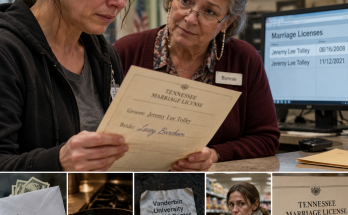
The first sign that something was wrong came from a woman behind a government counter who looked at my driver’s license, looked at her computer, and then looked at me as though she wished somebody else had called my number.
I had gone to the county clerk’s office expecting inconvenience, not catastrophe. The folder tucked beneath my arm contained tax papers, a copy of our mortgage statement, my Social Security card, and enough identification to prove I was Jill Marie Tolley. What I did not have was the one document the woman said she needed: a certified copy of my marriage record.
“My husband and I have been married twenty-two years,” I told her.
She gave me the patient smile of someone who had heard every variation of that sentence.
“I’m not questioning that, ma’am. I just need the certified record.”
“Fine. Then print one.”
Her fingers paused above the keyboard.
That pause was small enough that another person might have missed it. After twenty-two years of marriage, though, I had become good at noticing the spaces between words. Jeremy had taught me that without meaning to. His silences could say he was tired, irritated, worried about money, or pretending not to know who had finished the coffee.
The clerk’s silence said something else.
“What?” I asked.
“Nothing yet.”
Yet.
That word lodged beneath my ribs.
Her nameplate said BONNIE. She typed again, frowned at the screen, and asked me to confirm my husband’s full legal name.
“Jeremy Lee Tolley.”
“Date of birth?”
I told her.
She asked for mine next, then our marriage year.
“2004.”
“County?”
“This one.”
Her eyes moved over the screen.
I leaned closer despite the glass between us. “Is there a problem?”
“I’m trying to make sure I have the right record.”
“There shouldn’t be many Jeremy Lee Tolleys married to Jill Marie Tolley.”
“No,” she said quietly. “There shouldn’t.”
My stomach tightened.
Bonnie disappeared through a door behind the counter and stayed gone long enough for me to become aware of everything around me: the fluorescent lights humming overhead, the old man filling out a property form, a toddler banging a plastic cup against a chair, the courthouse clock clicking toward noon.
I checked my phone.
No message from Jeremy.
That should not have mattered.
It did.
For almost three years, Tuesdays had belonged to some part of Jeremy’s life that did not include me.
He called them Nashville days.
The explanation had changed slightly over time. At first, a contractor friend needed help with estimates. Later, Jeremy said he was supervising work for a customer who could only meet on Tuesdays. Once, when I asked why the arrangement had lasted so long, he kissed the side of my head and said the extra money was helping us.
I had accepted that.
Marriage teaches you when to ask questions. It also teaches you how easily trust can become habit.
Jeremy left before sunrise most Tuesdays. He returned after dark, usually exhausted, sometimes smelling faintly of hospital disinfectant beneath the familiar odors of sawdust and truck upholstery.
I had noticed.
I had even asked once.
“Job near a hospital?”
He had been taking off his boots in the mudroom.
“What?”
“You smell like one.”
He laughed.
“Maybe I’m dying and forgot to mention it.”
“Not funny.”
“I stopped to see somebody.”
“Who?”
“A guy from one of the crews.”
He had bent to untie his other boot.
That was all.
I had let it be all.
Now, standing in the courthouse, I remembered that conversation with uncomfortable clarity.
Bonnie returned carrying no paper.
“Mrs. Tolley?”
“Yes?”
“I’m going to need a little time.”
“For what?”
“There’s an indexing issue.”
“What kind?”
“I don’t know yet.”
“Is my marriage record there or not?”
“It’s there.”
Relief came too quickly.
“Then print it.”
“I can.”
She glanced toward the door behind her.
“But I’d like to verify something first.”
I stared at her.
“Verify what?”
Bonnie lowered her voice.
“Another filing came up under your husband’s information.”
The room seemed to tilt by half an inch.
“What filing?”
“I don’t want to give you incorrect information.”
“What filing?”
A woman waiting behind me shifted impatiently.
Bonnie looked past me and then back at her monitor.
“Could you come back tomorrow?”
“No.”
“Mrs. Tolley—”
“I drove forty minutes.”
“I understand.”
“No, you don’t. You just told me another filing came up under my husband’s information and now you want me to go home.”
“I’m trying to protect your privacy.”
“My privacy from whom?”
She didn't answer.
I gripped the edge of the counter.
“Is it a divorce?”
Her expression changed.
That frightened me more than a yes would have.
“Am I divorced?”
“Not according to the record I’m looking at.”
“Then what is it?”
“I need to confirm that before I say anything else.”
I stood there long enough for embarrassment to turn into anger.
“Fine.”
Bonnie wrote her extension on the back of a courthouse business card.
“Call me tomorrow morning before you drive over.”
I took it.
Outside, sunlight struck the courthouse steps so hard I had to squint. I stood beside my car, staring at the card.
Another filing.
It could have been anything.
Property.
A lien.
A business document.
A name correction.
Some administrative mistake made by somebody whose job involved typing hundreds of names into a computer.
I told myself that all the way home.
By the time I turned onto our road, I almost believed it.
Our house sat behind two old maples Jeremy had planted the year after we married. The place was nothing fancy—brick ranch, two-car garage, vegetable beds behind the shed—but twenty-two years had filled it with the evidence of us.
Jeremy had replaced the porch railing himself.
I had painted the kitchen twice.
We had argued over the bathroom tile and laughed about it afterward.
There were grooves in the pantry door from measuring nieces and nephews as they grew.
Our life was ordinary.
Ordinary suddenly seemed precious.
Jeremy’s truck was gone.
Tuesday.
Of course.
I went inside and set the courthouse folder on the kitchen table.
Then I saw the envelope.
It was half-hidden beneath a stack of mail Jeremy had left beside the fruit bowl.
The return address was from Nashville.
I would like to say I respected his privacy.
I did not.
The envelope was already open.
Inside was a billing notice from a parking garage.
Vanderbilt University Medical Center.
I read the date.
Tuesday.
Three weeks earlier.
I checked another line.
The vehicle identification included Jeremy’s license plate.
My fingertips went cold.
He had told me that Tuesday had been spent at a renovation project across town from the hospital.
I sat down.
For several minutes, I did nothing except listen to the refrigerator.
Then I called him.
He answered on the fourth ring.
“Hey, Jill-girl.”
That nickname had once made me smile automatically.
This time it did not.
“Where are you?”
“Nashville.”
“I know that.”
A pause.
“Everything okay?”
“What are you doing there?”
“Working.”
“What kind of work?”
Another pause.
Shorter.
More careful.
“The same project I’ve been helping with.”
“Where?”
“Why?”
“Just wondering.”
“You never care about addresses.”
“I care today.”
I heard traffic behind him.
Then a turn signal.
“Jill, I’m driving.”
“So pull over.”
“What’s going on?”
I looked at the parking notice.
“Nothing.”
The lie came easily.
That frightened me.
“I needed the marriage certificate today.”
“What for?”
“The paperwork I told you about.”
“Oh. Right.”
“They had trouble finding something.”
This time his silence lasted long enough to become an answer.
“Jeremy?”
“I’m here.”
“Did you hear me?”
“Yeah.”
“They said another filing came up under your name.”
Nothing.
“Do you know what that means?”
“No.”
Too fast.
I closed my eyes.
“You sure?”
“Of course I’m sure.”
A horn sounded behind him.
“Look, I need to go. We’ll talk tonight.”
“Jeremy—”
“Love you.”
The call ended.
He had said love you.
He had not said I don't know what filing they mean.
He had not laughed.
He had not called the courthouse incompetent.
Jeremy was a man who complained for twenty minutes when the hardware store charged him twice for screws. If a courthouse had confused him with somebody else, outrage should have been immediate.
Instead, he had escaped.
I went to the garage.
His workbench was covered with the familiar mess of clamps, drill bits, pencils, receipts, and coffee cans full of screws.
I did not know what I was looking for.
That was the ugliest part of searching your spouse’s belongings. Suspicion gives every ordinary object a second meaning.
A receipt became evidence.
A phone number became a threat.
A locked drawer became an accusation.
Jeremy had one locked drawer.
I stared at it.
I had known about it for years. He kept contracts, cash for jobs, and old documents there.
I had never cared.
Now I tried the handle.
Locked.
I searched the workbench until I found the small spare key taped beneath the back edge, exactly where he had once told me he kept it.
The drawer opened.
Contracts.
An old passport.
A box containing his father’s watch.
Nothing scandalous.
I nearly laughed at myself.
Then I found a photograph.
It was tucked inside an old envelope at the bottom.
Jeremy looked about twenty-three.
His hair was longer. His face was thinner. He stood beside a young woman outside a grocery store.
I knew her immediately.
Lacey Burcham.
Twenty-two years vanished.
I could smell the Kroger bakery where I had worked that summer.
I could remember Lacey arriving at the store to meet Jeremy after his shift.
I could remember thinking she was too quiet for him.
I could remember deciding I could make him laugh harder.
Jeremy and Lacey had been serious.
Everybody knew it.
They were the couple people assumed would marry.
Then I began staying late when Jeremy worked.
I called him.
I flirted.
I told myself nothing could happen unless he wanted it too.
That part was true.
It was also a convenient truth.
Eventually Jeremy ended things with Lacey.
She moved to Nashville.
Six months later, he and I were engaged.
For twenty-two years, I had lived with the uncomfortable knowledge that the happiest part of my life had begun inside somebody else’s heartbreak.
I turned the photograph over.
A date was written on the back.
2004.
Under it, in Jeremy’s handwriting, were four words.
Should have told her sooner.
I sat on the garage floor.
Which her?
Lacey?
Me?
My phone rang.
I nearly dropped the photograph.
Jeremy.
I answered.
“Hey.”
His voice had changed.
No warmth now.
“Were you in the garage?”
I looked toward the ceiling as though he might somehow see through it.
“Why?”
“I got an alert.”
Of course.
The security camera.
“I needed something.”
“What?”
I stared at Lacey’s face.
“Why are you at Vanderbilt?”
Silence.
There it was again.
The space where truth should have been.
“Jill.”
“Who are you seeing?”
“Come on.”
“Who?”
“It’s complicated.”
My grip tightened around the phone.
“Is it Lacey?”
He stopped breathing.
I knew before he answered.
“How do you know that name?”
My eyes filled.
Not because he had confirmed it.
Because after twenty-two years, he had asked how I knew instead of telling me I was wrong.
“Come home.”
“I can’t.”
“Then tell me.”
“I can’t do this right now.”
“Are you having an affair?”
“No.”
The answer came instantly.
I wanted to believe him.
“Then what are you doing?”
“I’ll explain.”
“When?”
“When I can.”
“You have tonight.”
“Jill—”
“Tonight.”
I ended the call.
Jeremy did not come home that night.
At 11:47, he texted.
Emergency. Staying in Nashville. Please trust me one more night.
I read the message until the screen dimmed.
One more night.
Trust was apparently something he believed he could request in twenty-four-hour increments.
I slept badly.
At seven the next morning, I called Bonnie.
She answered after two rings.
“County clerk’s office.”
“This is Jill Tolley.”
A silence.
Then, “I was hoping you’d call.”
My stomach dropped.
“Did you find out what the other filing was?”
“Yes.”
“What is it?”
“I’d rather show you.”
“Tell me.”
“Mrs. Tolley, please come in.”
“Bonnie.”
Her voice softened.
“Bring identification.”
“Why?”
“And if you have your original marriage certificate, bring that too.”
I looked toward the drawer where ours had sat for twenty-two years.
“Am I still married?”
“Yes.”
“Then why do I need to bring proof?”
Bonnie took a breath.
“Because there is another marriage record attached to Jeremy Lee Tolley’s legal information.”
The kitchen disappeared around me.
“Another what?”
“I’m sorry.”
I could barely hear myself.
“Who did he marry?”
Bonnie hesitated.
I already knew.
Still, hearing the name made the past come alive.
“Lacey Marie Burcham.”
Click here to continue reading: PART 2: The Woman From Our Past Had His Name on a New Marriage Record, but the Date Made the Betrayal Worse
A Routine Question About My Marriage Sent Me Looking for One Paper I Never Thought I Would Need
Part 1 of 43