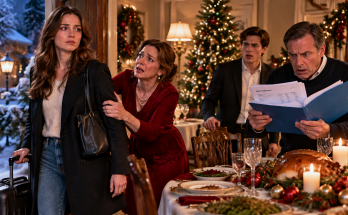
Lily invited seven people to dinner.
Not because the court required it.
Not because the trust required it.
Because she wanted to.
Me.
Michael.
Jake.
Evelyn.
Margaret.
Claire by video.
And Leonard.
The last name surprised me.
“Are you sure?”
“No.”
That had become almost reassuring.
“Why Leonard?”
“He asked to apologize.”
“You don’t owe him the opportunity.”
“I know.”
“Why Margaret?”
“She raised me.”
“Why Evelyn?”
“She held me when I was born.”
“Why Claire?”
“She’s your daughter.”
“Genetically.”
“You know what I mean.”
“And Harris?”
“No.”
“Daniel?”
“No.”
“William?”
“Not yet.”
Her boundaries were specific.
That mattered.
She was not creating reconciliation as a moral performance.
She was choosing a room she could tolerate.
Dinner happened at our house.
The same house where Michael and I had spent eighteen years moving around each other.
Now the table barely fit everyone.
Claire appeared on a laptop at one end.
Emma was sleeping after treatment.
Her early blood counts were beginning the slow process doctors hoped to see.
No promises.
Good signs.
We had learned to live with both.
Margaret arrived first.
She brought a casserole.
Lily stared at it.
“You still cook that?”
“You used to like it.”
“I was twelve.”
Margaret looked stricken.
Lily sighed.
“I probably still like it.”
Not forgiveness.
Not rejection.
Ordinary negotiation.
Evelyn arrived next.
She and Margaret stood awkwardly in the kitchen.
They had known each other for years through secrecy.
Now neither knew what relationship remained.
Finally Evelyn said:
“Hello, Margaret.”
“Hello.”
That was enough.
Leonard arrived last.
No investigator’s bag.
No hidden recorder.
Reyes had made very clear that he was not to record anything.
He looked at Lily.
“I’m sorry.”
She raised one hand.
“I know.”
He stopped.
“Sit.”
He did.
Jake poured water.
Michael served food.
For the first twenty minutes, no one discussed the program.
That was Lily’s rule.
We talked about Emma.
Jake’s job.
Claire’s garden.
Margaret’s casserole.
Michael’s inability to understand why anyone needed six streaming subscriptions.
Evelyn complained that all passwords were too complicated.
For one brief stretch, the family was defined by trivial irritation.
It was wonderful.
Then Lily put down her fork.
“Okay.”
Everyone quieted.
“I want to answer Harris’s question.”
No one interrupted.
“What kind of family do I want now?”
She looked at Margaret first.
“I want one where I can love the person who raised me without pretending what she did was okay.”
Margaret’s eyes filled.
Lily continued.
“I don’t know whether I’ll ever trust you completely.”
“I understand.”
“You don’t get to tell me Susan abandoned me again.”
“I won’t.”
“You don’t get to decide what contact I have with her.”
“I won’t.”
“You don’t get to ask me to call you Mom.”
Margaret swallowed.
“Okay.”
Lily looked at me.
“I want a family where Susan doesn’t act like she has to earn eighteen years back in six months.”
I smiled weakly.
“I may need reminders.”
“You will.”
She looked at Michael.
“I want one where you stop apologizing for being related to David.”
Michael nodded.
“Working on it.”
“Jake.”
He straightened.
“I want you to continue being annoying.”
“Finally recognition.”
She smiled.
Then Claire’s screen.
“I want to know you if you want.”
Claire nodded.
“I do.”
“Slowly.”
“Definitely.”
Lily looked at Evelyn.
“I want you to tell me stories about Susan that have nothing to do with the foundation.”
My mother laughed through tears.
“I have many.”
“No embarrassing baby stories without permission.”
“No promises.”
“Then you’re out.”
The table laughed.
Finally Lily looked at Leonard.
His expression tightened.
“I don’t know what I want from you.”
He nodded.
“That’s fair.”
“You threatened me.”
“Yes.”
“You tried to grab me at the hotel.”
“Yes.”
“You told yourself it was necessary.”
“Yes.”
“Do you still believe that?”
Leonard thought.
“No.”
“Why not?”
“Because if I needed to terrify you to get the outcome I wanted, then I was still using you.”
Lily’s face softened slightly.
“Good answer.”
“It took too long.”
“Yes.”
“Do you want me in your family?” he asked.
She shook her head.
“That’s not how I think about it.”
He waited.
“You’re Susan’s brother.”
“Yes.”
“You’re Evelyn’s son.”
“Yes.”
“You’re Samuel’s son.”
His eyes filled.
“Yes.”
“You’re related to me.”
“Yes.”
“But family isn’t a membership card.”
Leonard smiled sadly.
“No.”
“So maybe we figure it out.”
“I’d like that.”
“Slowly.”
“Very.”
That was Lily’s answer.
Not a diagram.
Not a lineage.
A set of relationships, each chosen separately.
No automatic rights.
No erased histories.
After dinner, Margaret asked whether she could wash dishes.
Lily rolled her eyes.
“You always do that when you’re nervous.”
Margaret almost laughed.
“I’m very nervous.”
“Fine.”
They stood side by side at the sink.
I watched from the doorway.
There was grief in it.
And love.
And damage.
No single word solved the picture.
I stopped trying to find one.
Two weeks later, Keene entered his plea.
The agreement required substantial cooperation.
It did not erase prosecution.
He admitted to conspiracy involving unauthorized medical procedures, falsified medical and custodial records, obstruction, illegal retention and use of genetic material, and financial fraud tied to foundation assets.
Other counts remained subject to sentencing decisions.
Victims were permitted to submit statements.
Not everyone wanted to.
That was important.
Samuel wrote forty pages.
Leonard wrote two.
Rachel wrote none.
“I’m done giving Keene my words.”
Valid.
Margaret wrote one paragraph.
Harris prepared testimony as part of his own case.
Daniel’s statement addressed only conduct he personally witnessed.
Claire declined entirely.
“My life doesn’t need his courtroom.”
Also valid.
Michael wrote a letter.
He showed it to me only after filing it.
Thomas Keene took facts from my marriage and used them as instruments.
He used my wife’s betrayal to hide his own crimes.
He used my son as leverage.
He used my brother’s biological material without honoring the limits David placed on it.
He used my father’s research after Robert rejected its purpose.
I do not ask the court to punish him for my pain. I ask the court to understand that his crimes worked because he repeatedly converted ordinary human relationships into tools.
I cried reading it.
“That’s very good.”
“I had help.”
“Who?”
“Jake.”
“Explains the grammar.”
He rolled his eyes.
I wrote my own statement.
Shorter than expected.
I did not describe every procedure.
The prosecution already had those facts.
I wrote:
For years, the people involved in this program argued that they were protecting patients, children, research, family reputations, or future generations. Again and again, those explanations required one thing: that the person most affected not be allowed to choose.
I was denied information about my body.
My husband was denied the truth about our son’s conception.
My daughter was denied knowledge of her parents.
Other people were denied knowledge of where they came from, how their genetic material was used, and what medical risks they carried.
The harm was not only what was done.
It was the belief that someone else had the authority to decide what truth we were permitted to own.
I stopped there.
No demand for maximum punishment.
No plea for mercy.
The sentence belonged to the court.
My words belonged to me.
Lily did something different.
She attended sentencing.
She did not submit a written statement beforehand.
When the judge asked whether she wished to speak, she stood.
Keene looked toward her.
For the first time, he seemed afraid.
Lily faced the judge, not him.
“My name is Lily Harris.”
Then she paused.
“Actually, I’m still deciding whether I want that surname.”
A faint stir moved through the courtroom.
She continued.
“I was born because people wanted a biological key.”
Keene lowered his gaze.
“They planned my conception around a trust. They hid my mother from me. They hid me from her. They treated my birthday like a legal event.”
Her voice stayed steady.
“I spent a lot of time wondering whether being born that way made me belong to what they built.”
She looked toward Keene only once.
“It doesn’t.”
Then back to the judge.
“I don’t want a sentence because I hate him.”
Silence.
“I want a sentence that recognizes people were not documents in his system.”
She stepped away.
That was all.
The judge later imposed a lengthy prison sentence under the plea framework and applicable law.
Not enough for some survivors.
Too much for a few who credited Keene’s late cooperation.
Justice did not produce unanimous emotion.
Samuel said:
“He’ll die in prison.”
Leonard answered:
“Maybe.”
Rachel said nothing.
Lily asked:
“Does knowing that make anybody feel better?”
No one answered.
For me, the sentence felt smaller than the truth.
Necessary.
But smaller.
Because no term of years could return 1987.
Or 2008.
Or childhoods.
Or parents.
Or knowledge withheld.
Justice could mark wrongdoing.
It could not reverse chronology.
The other cases continued.
Harris received a separate sentence and permanent professional sanctions, though his cooperation and later protection of Lily were considered.
He asked to see me before reporting to custody.
I declined.
Then changed my mind.
Not because he was my biological father.
Because I wanted one question answered face to face.
We met in a supervised room.
He looked very old.
“Susan.”
“Leonard.”
He flinched slightly.
Not Dad.
Good.
I sat.
“Why didn’t you tell me you were my father when I was an adult?”
He looked down.
“Cowardice.”
No medical explanation.
No threat.
No noble framing.
“Was William against it?”
“Yes.”
“Evelyn?”
“Yes.”
“Would you have told me if they agreed?”
“I don’t know.”
I appreciated that answer.
“What did you want?”
“To be near you without disrupting your life.”
“You became my doctor.”
“Yes.”
“That is not being near me. That is placing yourself inside my private medical care.”
He closed his eyes.
“I know.”
“Did you choose that role because you were my father?”
“Yes.”
“Did you ever alter treatment before the fertility procedures?”
“No.”
“Do you expect me to believe you?”
“No.”
That hurt.
Because he understood what his lies had cost.
“Do you love me?”
His eyes filled.
“Yes.”
I nodded.
“I believe that.”
He looked up.
“You do?”
“Yes.”
His face crumpled.
Then I added:
“And it doesn’t absolve you.”
“I know.”
“Good.”
I stood.
He whispered:
“Will I ever see you again?”
I thought.
“Maybe.”
He nodded.
No demand.
No promise.
As I reached the door, he said:
“I’m glad you survived us.”
I turned.
“That is a terrible thing for a father to have to say.”
“Yes.”
Then I left.
Daniel’s case ended differently.
He pleaded guilty to offenses connected to deception and reproductive coercion.
His cooperation reduced some exposure.
Karen did not attend.
Emily did not meet him.
Lily attended once, quietly, then left before the hearing ended.
When I asked why, she said:
“I realized I didn’t need to hear the sentence.”
Fair.
Daniel wrote me a letter from custody.
I read this one.
Unlike Keene’s.
Because I wanted to.
He admitted that he had chosen every early step.
Approaching me.
Listening strategically.
Lying.
Tampering with contraception.
He wrote that discovering Keene had also manipulated him did not make his conduct less his own.
That mattered.
At the end, he wrote:
I am sorry that one of the truest things in my life came from one of the worst things I did: I cared about you eventually, and by then caring could not make what I had done decent.
I folded the letter.
Did not answer.
Maybe someday.
Maybe never.
That too was mine.
Emma’s transplant progressed cautiously.
Engraftment signs appeared.
Then a fever.
A terrifying week.
Then improvement.
Her doctors warned us recovery would take months.
No celebration yet.
Claire called after one good lab result.
“Her counts rose.”
“How much?”
“Enough for the doctor to smile.”
“That sounds good.”
“It is.”
We cried.
Again.
“What does Emma say?”
“That hospital pudding violates international law.”
“She’s recovering.”
“Yes.”
I laughed.
Claire looked at me.
“Sister.”
“Yes?”
“Thank you.”
I shook my head.
“You don’t owe me.”
“I know.”
Good.
Then one morning Lily came downstairs carrying Harris’s letter.
“What?”
“I decided.”
“About family?”
“Yes.”
I waited.
She took a breath.
“I want to change my last name.”
“Okay.”
“Not Miller.”
I smiled.
“Okay.”
“Not Carter.”
“Okay.”
“Not Harris.”
“Understandable.”
“Not Vollen.”
“Very.”
She looked nervous now.
“I want Margaret’s original surname.”
I did not know it.
“What is it?”
“Rowan.”
Lily Rowan.
She said it aloud.
“Lily Rowan.”
I repeated it.
“It sounds like you.”
She smiled.
“That’s why.”
“Does Margaret know?”
“Not yet.”
“What do you think she’ll say?”
“She’ll cry.”
“Almost certainly.”
“Do you mind?”
“No.”
She looked at me carefully.
“Really?”
“Really.”
“You don’t feel rejected?”
“No.”
I thought.
“Maybe a tiny part.”
She laughed.
“Thank you for being normal.”
“But that part is mine to handle.”
Her eyes softened.
“That’s the family I want.”
“What?”
“One where people have feelings without making them someone else’s responsibility.”
I stared at her.
“That is annoyingly wise.”
“I’m eighteen.”
“Exactly.”
She smiled.
Then handed me the paperwork.
“Witness?”
I looked at the signature line.
Not consent.
Not authorization.
Just witness to her chosen name.
I signed.
Susan Miller.
And Lily signed beneath it.
Lily Rowan.
No one had selected it for lineage.
No trust required it.
No scientist predicted it.
She chose it because she liked who it connected her to, while still separating herself from what that connection had done.
Her name belonged to her.
Click here to continue reading: PART 43: Eighteen Years After Michael Stopped Touching Me, We Finally Learned the Truth Could Not Restore Our Old Life—Only Give Us a New One
Eighteen Years After My Marriage Went Silent, One Routine Question From My Doctor Made Michael’s Distance Look Completely Different
Part 42 of 43