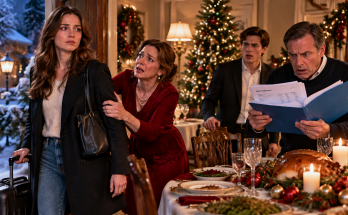
The recording ended.
No one spoke.
The refrigerator hummed in the kitchen. A car passed outside. Somewhere upstairs, an old pipe clicked as the heating system came on.
Dara stared at Mom’s phone.
“You weren’t supposed to play that.”
Mom’s hand trembled.
“You weren’t supposed to ask me to lie.”
Dara looked toward Dad.
“Are you going to let this happen?”
He frowned. “Let what happen?”
“She’s destroying me.”
Dad glanced at the unsigned statement.
“No. We’re hearing what happened.”
Dara looked around the table as though searching for the person who would restore the old rules.
Aunt Linda looked down.
Ben folded his payment receipt.
Alicia stayed beside me.
Joel looked exhausted.
There was nobody left to rescue her from the facts.
Finally Dara turned to me.
“You have everything.”
I almost laughed.
“My apartment?”
“You know what I mean. You have your career. You have money. You have forty acres and a cabin you barely use. You don’t know what it’s like to be drowning.”
“You could have told me.”
“You would have judged me.”
“You never gave me the opportunity not to.”
Her face tightened.
“I knew you would say no.”
The sentence landed more heavily than the voicemail.
Patricia did not move.
Neither did I.
Dara seemed to realize what she had admitted.
“You knew,” I said.
She began crying again.
“I thought once it was arranged—”
“You thought I wouldn’t undo it.”
She looked away.
“You thought if everyone had paid, if Mom and Dad believed I needed help, if contractors were booked, I’d be too embarrassed to tell everyone no.”
“Stop.”
“You thought calling me selfish would be enough.”
“Please.”
For a moment I remembered the older sister who braided my hair before school.
The girl who once stood between me and a barking dog.
The teenager who sat beside my bed when I had a fever.
Those memories were real.
So was the woman who had copied my signature.
Love did not require me to erase either truth.
Joel stood.
“We should go.”
Dara turned on him.
“You too?”
“We need to go home and work out what we can sell.”
He looked at the papers.
“And I need legal advice of my own.”
She grabbed her handbag.
At my chair, she stopped.
“If this keeps going, we won’t come back from it.”
I looked up.
“You had a lot of opportunities to stop before now.”
She waited.
Nobody asked me to withdraw the report.
Nobody told us to hug.
Dara walked out.
Joel stayed long enough to give Dad copies of household records, then followed.
The front door closed.
Mom placed her phone in front of Patricia.
“Tell me how to preserve that voicemail.”
I looked at her.
“I’m not deleting it,” she said.
That was when I cried.
Not because everything was fixed.
Nothing was.
I cried because for the first time my mother was not asking me to make the truth smaller so Dara could live with it.
Mom moved toward me, then stopped.
“May I?”
I nodded.
She hugged me.
She did not mention forgiveness.
She did not say Dara was still my sister.
She let the moment belong to me.
The investigation moved slowly after that.
The lender preserved its correspondence.
Daniel Mercer supplied the contractor records.
My parents turned over the false mortgage notice and bank transfers.
Relatives supplied agreements containing the copied signature.
Mom gave investigators the voicemail and the unsigned statement Dara had asked her to sign.
Warren withdrew from representing Dara after the matter moved far beyond the historical property question for which she had originally retained him.
Dara found another attorney.
I stopped communicating with her directly.
The cabin remained legally mine.
No lien had been recorded.
The private lender closed the application.
The contractor canceled the grading work.
The six trees marked for removal remained standing.
I installed a gate.
I added cameras covering the driveway.
The first evening the system became active, my phone sent a motion alert.
My stomach tightened.
I opened the camera feed.
A deer stood beside the gate, sniffing one of the posts.
I laughed.
It was the first time in weeks that surprise did not feel dangerous.
Life at the cabin gradually became ordinary again.
The faucet dripped.
Leaves filled the gutters.
A porch hinge squeaked.
One afternoon I spent forty minutes fixing a cabinet door that refused to hang straight.
I found myself smiling afterward.
Those small annoyances belonged to me too.
That winter Dara and Joel put their house on the market.
Dad told me, carefully, without turning the information into a request.
They planned to move somewhere smaller.
Joel sold his motorcycle.
The refundable portion of the contractor deposit was returned.
Relatives began receiving repayments.
Not quickly.
Not completely.
But the money was documented.
My parents refused Dara’s request to call their thirty-two thousand dollars a gift.
Dad told me the conversation had been awful.
“I’m sorry,” I said.
He was quiet.
Then he said, “Awful doesn’t mean wrong.”
I thought about that after we hung up.
For most of my life, avoiding discomfort had been treated as a family virtue.
Someone yielded.
Someone changed the subject.
Someone apologized simply because another person was crying.
We had called that peace.
It was really postponement.
The legal case lasted far longer than I expected.
Months became a year.
Records were examined.
Statements were taken.
The copied documents were traced.
Financial transfers were reconstructed.
Eventually Dara entered a plea to charges arising from the false documents and money obtained through them.
I went to court.
I did not go because I wanted to see her punished.
I went because I had spent too much of my life being absent from conversations where she spoke for me.
I wanted to be present for this one.
Dara looked smaller than I remembered.
When the judge asked whether she understood what she was admitting, she said yes.
Nobody interrupted to explain what she meant.
Nobody softened the answer.
The sentence included custody, probation, and restitution for the losses still outstanding after the repayments already made.
I listened with my hands folded.
There was no satisfaction in it.
Mostly I thought about the number of exits Dara had passed.
She could have asked me for money.
She could have told our parents the truth.
She could have stopped after taking their thirty-two thousand.
She could have refunded the family contributions.
She could have canceled the contractor.
She could have abandoned the lender application.
She could have admitted everything at my kitchen table.
She could have stopped before asking Mom to lie.
Every new choice had been an attempt to protect the previous one.
When I was permitted to speak, I stood.
The paper in my hand shook.
I put it down.
I said I had bought the cabin with my own money and debt I had willingly assumed.
I said I had maintained it because I wanted a peaceful place.
I said what happened had forced me to prove things my family should simply have asked me directly.
Then I said the part that mattered most.
I wanted people repaid.
I wanted my signature kept off documents I had not signed.
And I wanted the right to say no without someone treating my refusal as an obstacle they were entitled to overcome.
Then I sat.
Outside court, Dad asked whether I wanted lunch.
“I want to go to the cabin.”
“Want company?”
“Not today.”
“All right.”
No disappointment.
No guilt.
Just an answer.
Several weeks later, Patricia called.
“A letter came from Dara’s attorney.”
I nearly told her to return it unread.
Instead I asked her to send it.
The letter was three pages.
At first Dara wrote about debt, fear, and shame.
I had heard those explanations before.
Then I reached a paragraph that made me stop.
She admitted she had believed that if she could get enough people committed to her plan, the wrongness of what she was doing would somehow disappear.
Later she addressed the reunion.
She admitted leaving me off the list deliberately.
She had been angry that I moved away and seemed to be doing well.
Finding the cabin had intensified that resentment.
She had looked at my property and decided it represented excess.
She had never asked what it cost me to buy.
There was no request for money.
No demand that I change anything.
No reminder that blood obligated me to reconcile.
She apologized.
Then she said she understood if I never answered.
I read the letter twice.
Wanting to believe someone had changed was not the same as trusting them again.
Two days later I wrote a short reply.
I said I had read her letter.
I hoped she continued the work she described.
I was not ready for a relationship.
I asked her to respect that.
Then I signed my name.
I stared at the signature afterward.
For months, the sight of my own handwriting had reminded me of the copied version on those agreements.
This time it was only mine.
The following summer Alicia organized another reunion.
She called me before adding my name anywhere.
“Would you like to come?”
I smiled.
“Where is it?”
“The same lodge.”
“You’re not asking about the cabin?”
“No.”
“Why?”
She sounded confused.
“Because it’s your home.”
I closed my eyes.
“Yes,” I said. “I’d like to come.”
I stayed for one afternoon.
I brought peach pie.
Aunt Linda hugged me and apologized without adding an excuse.
Ben told me he had received the last of his repayment.
Mom asked about work.
Dad asked whether the creek had risen after recent rain.
Nobody asked me for money.
Nobody asked for keys.
Nobody asked whether next year could be held on my land.
At six, I said I was leaving.
Someone wrapped a piece of chicken for me.
Then I drove into the mountains.
The cabin was dark when I arrived.
I switched on the kitchen light.
The green sofa remained exactly where I wanted it.
A small smear of dried paint still marked one wooden leg from when I had painted the baseboards years earlier.
I had meant to remove it.
I decided not to.
Two weeks later I invited Mom, Dad, and Alicia to the cabin for lunch.
The invitation mattered because it was mine to give.
Mom called that morning.
“I made potato salad. Is that okay?”
“Yes.”
“I also have an old tablecloth I thought might look nice outside, but you don’t have to use it.”
I smiled.
“Bring it.”
They arrived before noon.
Dad carried the food.
Alicia brought lemonade.
Mom stood on the porch admiring the yellow flowers.
Nobody evaluated how many cars could fit in the meadow.
Nobody discussed bunk beds.
Nobody suggested improvements.
We ate behind the cabin.
Dad told a story everyone had heard at least ten times.
Alicia interrupted before the ending.
Mom laughed.
For several hours, the place held my family without becoming family property.
That distinction had once seemed impossible to explain.
Now nobody needed it explained.
After lunch, Dad carried dishes inside.
Alicia helped him.
Mom remained beside the railing.
“I understand why you kept this secret,” she said.
“The cabin?”
She nodded.
“I used to think being your mother meant I should know everything about your life.”
“And now?”
She looked toward the creek.
“Now I’m grateful when you choose to share something.”
I stood beside her.
“I wanted you here today.”
Her eyes filled.
“I know.”
For once, she really did.
They left before sunset.
I watched their car disappear around the bend.
Then I walked down to the oak beside the creek.
The ground was soft beneath my shoes.
The tree still stood because I had learned about Dara’s plan barely in time.
No machines had cut through its roots.
No parking lot covered the meadow.
No lender held a claim against the cabin.
For a while I listened to the water.
Then I went inside, cut the last piece of peach pie, and carried it to the porch.
The strange symmetry occurred to me there.
First Dara had removed my name from something because she decided I did not belong.
Later she had put my name on things because she needed what belonged to me.
Both acts came from the same assumption.
That she could decide what my name meant.
She had been wrong.
The kitchen light glowed behind me.
The ridge faded blue as evening settled across the valley.
My phone buzzed.
Mom had sent a photograph from lunch.
The four of us sat around my small outdoor table.
Her message beneath it contained only a few words.
Thank you for inviting us.
I smiled.
That was the difference.
They had been invited.
The cabin was not a fortress against my family.
It was not proof that I loved them less.
It was simply mine.
I could open the door.
I could close it.
I could welcome people for lunch and wave goodbye before sunset.
I could attend a reunion and leave when I was ready.
I could answer a question with yes.
I could answer it with no.
None of those choices required permission.
I set the phone beside me and looked across the meadow Dara had once planned to change without asking.
There would be consequences from what happened for years.
Repayment did not erase betrayal.
An apology did not rebuild trust automatically.
Even accountability could not return us to the family we had been before.
I no longer wanted to return to it.
That family had required too much silence.
What came next would have to be different.
Mom would have to ask instead of assume.
Dad would have to speak before problems became unbearable.
I would have to resist the old reflex to make myself smaller whenever somebody called a boundary selfish.
And Dara, wherever our relationship eventually went, would have to live with the fact that love could not be forged into consent.
The sun disappeared behind the ridge.
I finished the pie.
Then I carried the plate into the kitchen and left the porch light burning over the door I had finally learned belonged to me in every sense that mattered.
Click here to continue reading: PART 5: The First Quiet Summer After Dara’s Case Ended Brought an Unexpected Visitor Who Knew Something About My Cabin’s Original Owner
My Sister Planned a Family Reunion Without Me, but the Secret I Kept Made Her Exclusion Suddenly Much More Complicated
Part 4 of 40