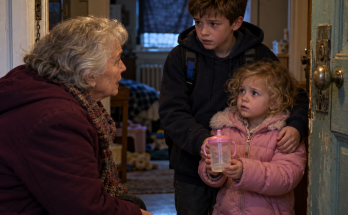
“Kitchen,” I told Bentley.
He did not move.
“Now.”
Maddie was already asleep in the guest room.
Doug had gone with police earlier and had not yet returned.
An unmarked officer sat behind our house, but the approaching cars were closer than any help I could see.
Bentley backed away from the window.
I locked the front door.
The first vehicle slowed beside the maple tree.
Dark sedan.
The second stopped twenty yards behind it.
Truck.
Brenner’s.
Or one he had acquired.
The sedan door opened.
Gerald Pike stepped out.
I recognized him from photographs.
Older.
Silver hair.
Dark overcoat.
He looked toward Amber’s apartment.
Then mine.
The same kind of calm Travis had tried to imitate.
But Pike’s was older.
Practiced.
A man accustomed to believing danger belonged to other people.
The truck remained closed.
Pike walked to the maple tree.
Bentley whispered, “What’s he doing?”
“Looking.”
“For the box?”
“Maybe.”
Samuel had told Pike the music box was connected to the tree.
A lure.
Pike crouched near the roots.
Then the truck door opened.
Thomas Brenner stepped out.
No uniform.
Jeans.
Heavy jacket.
Gun visible in his right hand.
Pike stood.
Even through the window I could see surprise.
Brenner said something.
Too far to hear.
Pike answered.
Brenner raised the gun.
I pulled Bentley farther from the glass.
“Down.”
We crouched behind the kitchen wall.
My phone vibrated.
Harris.
DO NOT MOVE. UNITS 90 SECONDS.
Ninety seconds is short until someone outside has a gun.
Then it becomes a season.
Voices carried.
Brenner louder.
“You brought me here.”
Pike answered.
“I didn’t call you.”
“Samuel did.”
“Then you’re stupider than I thought.”
Brenner stepped closer.
“Where’s the list?”
Pike laughed.
“You lost control of it thirty years ago.”
“Where?”
“Ask Raymond.”
“Raymond’s talking.”
“So are you, apparently.”
The contempt between them was almost worse than anger.
These men had protected one another because it benefited them.
Not because they liked one another.
Now benefit was gone.
Brenner pointed toward our duplex.
“The boy has it.”
Pike looked at the house.
Bentley’s fingers dug into my sleeve.
“No,” I whispered.
“Stay down.”
Pike said, “The boy has nothing.”
“How do you know?”
“Because Raymond wouldn’t trust a child.”
Bentley looked at me.
We both knew how wrong that was.
Then a third voice came from darkness near the opposite sidewalk.
“Raymond trusted children more than he trusted either of you.”
Samuel.
Pike spun.
Brenner raised his gun.
Samuel stepped from behind a parked van.
Bandaged hand.
Bruised face.
No visible weapon.
Police had apparently allowed him closer than I would ever have approved.
Later Harris would insist that was not the plan.
Samuel had slipped away from the perimeter officer.
Also, apparently, a Collins habit.
Brenner shouted, “Hands!”
Samuel lifted them.
“Thomas.”
“Where is it?”
“Which thing?”
“The list.”
Samuel smiled.
“Gone.”
Brenner’s gun moved toward him.
“Wrong answer.”
“No. Accurate answer.”
Pike remained near the maple tree.
His eyes moved toward escape routes.
Samuel noticed.
“Don’t, Gerald.”
Pike looked at him.
“You survived.”
“Disappointing?”
“I told them not to kill you.”
Brenner laughed.
Samuel turned slightly.
“Yes. Thomas decided differently.”
Pike stared at Brenner.
For the first time, genuine surprise crossed his face.
“You ordered that?”
Brenner said nothing.
Pike’s expression hardened.
“You idiot.”
“He had the list.”
“He had copies.”
“He knew about Keene.”
“So did half the people who mattered.”
Samuel interrupted.
“Judge Keene is cooperating.”
Both men reacted.
Good.
That was why Samuel said it.
Not information.
Pressure.
Brenner looked toward his truck.
Pike toward the cross street.
Samuel kept talking.
“Garner’s body is recovered.”
Pike’s face barely changed.
“Recording authenticated.”
That changed it.
Brenner looked at Pike.
Samuel continued.
“Raymond is cooperating.”
Pike said, “Raymond cooperates with whoever stands closest to the exit.”
“Claire has the financial files.”
Another reaction.
“Federal investigators have the children’s list.”
Brenner’s gun lowered slightly.
Not relief.
Defeat.
Pike whispered something I could not hear.
Samuel stepped closer.
“What?”
Pike looked at him.
“You think truth fixes anything?”
Samuel stopped.
“No.”
“Your family lost thirty years.”
“Yes.”
“Garner is dead.”
“Yes.”
“Emily Rhodes is dead.”
Samuel’s face tightened.
“Yes.”
“You don’t get them back because somebody authenticates a recording.”
“No.”
“Then what exactly do you think you won?”
Samuel answered quietly.
“The next child.”
Nobody spoke.
Even from inside the house, I felt the sentence.
Not restoration.
Prevention.
The past could not be repaired into innocence.
But the machine could be stopped before it chose someone else.
Brenner suddenly moved.
Not toward Samuel.
Toward Pike.
He grabbed Pike’s coat and shoved the gun against his side.
“You’re coming with me.”
Pike remained astonishingly calm.
“You won’t make the highway.”
“Then you won’t either.”
Samuel backed away.
Police commands erupted from both ends of the street.
“DROP THE WEAPON!”
Lights flooded houses.
Brenner dragged Pike toward the truck.
Pike stumbled.
Then did something none of us expected.
He struck Brenner’s gun arm with both hands.
The weapon fired.
Glass shattered somewhere.
I pulled Bentley to the floor.
Maddie screamed from the bedroom.
Another shot.
Then shouting.
I covered Bentley’s head with my arms.
“Stay down.”
“I am!”
Outside, tires squealed.
Someone yelled that a suspect was running.
Then silence broke into overlapping police commands.
My phone buzzed.
Harris.
STAY INSIDE.
As if I intended anything else.
Maddie cried.
Bentley tried to rise.
“I need her.”
“I’ll get her.”
“She’ll want me.”
He was right.
I let him crawl with me toward the hallway.
We reached the guest room.
Maddie stood in the bed clutching her stuffed dog.
“Bentley!”
He climbed beside her.
“It’s okay.”
“Bang.”
“I know.”
“Bad man?”
He looked at me.
Then answered.
“Police are here.”
Not a lie.
Not an explanation too large for her.
Just enough truth.
I sat beside them until Harris knocked.
Three times.
Then called my name.
I opened the door only after seeing his face.
“What happened?”
“Brenner’s in custody.”
“Pike?”
“Also.”
“Samuel?”
“Fine.”
“Who was shot?”
“Nobody.”
“The shots?”
“One into a parked car. One into the air.”
My knees weakened.
Harris caught my elbow.
“I’m fine.”
“You’re seventy.”
“I’m aware.”
Bentley appeared behind me.
“Samuel?”
Harris looked at him.
“Annoying everyone.”
Bentley smiled.
“Can I see him?”
“In a minute.”
Outside, Brenner sat handcuffed beside a cruiser.
His face had lost the authority photographs gave him.
Pike stood farther away with federal agents.
Hands cuffed behind him.
He looked toward my house once.
No menace.
No smile.
Just an old man discovering that systems eventually stop recognizing the people who built them.
Samuel stood beside an ambulance.
Bentley approached slowly.
The resemblance was not immediate.
Samuel was older, weathered, carrying decades Bentley could not understand.
But their eyes were similar.
Samuel saw him.
“You’re Bentley.”
“You’re Samuel.”
“That’s what they tell me.”
Bentley stopped several feet away.
“You watched me.”
Samuel’s expression changed.
“Yes.”
“Why didn’t you come help?”
There it was.
No greeting could avoid the real question.
Samuel looked toward Donna.
Then back.
“I thought your mother was home.”
“She wasn’t.”
“I know.”
“You saw me miss the bus.”
“Yes.”
“You knew something was wrong.”
“Yes.”
“Why didn’t you come?”
Samuel could have said danger.
Surveillance.
Brenner.
Pike.
Operational risk.
He did not.
“I made the wrong choice.”
Bentley stared.
Samuel continued.
“I thought watching from far away kept you safer.”
“It didn’t.”
“No.”
“Maddie was hungry.”
“I know.”
“Water was off.”
Samuel closed his eyes briefly.
“I know.”
Bentley waited.
No excuse came.
That seemed to matter.
Finally he asked, “Are you really my uncle?”
Samuel almost smiled.
“Yes.”
“Mom thinks you’re dead.”
“I know.”
“She’s going to be mad.”
“I expect so.”
Bentley considered him.
“Good.”
Samuel laughed.
A tired, startled laugh.
Then Bentley stepped forward and hugged him.
Only for a second.
Then pulled away.
“Don’t disappear again.”
Samuel’s face changed.
“I’ll try.”
Bentley frowned.
“That’s not a promise.”
“No.”
“Why not?”
“Because I’m done making promises I don’t know I can keep.”
Bentley nodded slowly.
That answer passed whatever test he had created.
Harris interrupted.
“Samuel.”
“Yes?”
“We need you.”
Samuel looked toward Pike.
“For what?”
“Pike says the settlement file is fake.”
Samuel smiled faintly.
“Of course.”
“He says Raymond manufactured it.”
“Of course.”
“He says the children’s trusts were legitimate protective arrangements.”
“Of course.”
Harris became impatient.
“Do you have something beyond copies?”
Samuel looked toward the maple tree.
“Yes.”
“Where?”
“The place Bentley taught me to look.”
Everyone stared.
Samuel walked to the tree.
Police followed.
At its base, he crouched beside an old metal utility cover.
Not roots.
A telecommunications access box.
He opened it with a small key.
Inside was a waterproof pouch.
Harris stared at him.
“You put evidence in an active utility box?”
“Disconnected line.”
“When?”
“Four days ago.”
“What’s inside?”
“The original Keene orders.”
“You said you had them.”
“I did.”
“What else?”
Samuel handed him the pouch.
“Pike’s handwritten instructions.”
Pike, standing near the cruiser, turned his head.
For the first time, fear showed.
Harris opened the pouch carefully.
Documents.
Old.
Signed.
Gerald Pike’s handwriting.
Names matching the children’s list.
Amounts.
Instructions beside several:
MOVE.
PRESSURE FATHER.
B. HANDLES REPORT.
KEENE ORDER.
And beside Samuel Collins:
KEEP BOY UNTIL R.C. COMPLIES.
Physical proof tying Pike directly to the leverage system.
Brenner.
Keene.
Raymond.
Children.
All in one document.
Harris looked at Samuel.
“Why hide it here?”
Samuel turned toward Bentley.
“Because everybody watched the house.”
Then the maple tree.
“Nobody watched the place a scared kid stood every morning pretending his life was normal.”
Bentley looked at the utility box.
His hiding place had once represented everything he was carrying alone.
Now it had become the place where evidence ended decades of adult secrecy.
Harris closed the pouch.
Pike was led toward a federal vehicle.
Brenner toward another.
Samuel watched them go.
Bentley stood beside him.
“Is it over?”
Samuel did not insult him with certainty.
“The part where they can keep doing this is.”
“And the rest?”
“Courts. Questions. People telling the truth badly.”
Bentley sighed.
“That sounds long.”
“It is.”
Then my phone rang.
Amber.
Bentley answered.
“Mom?”
Her voice shook.
“Are you safe?”
“Yes.”
“Maddie?”
“She’s okay.”
“Miss Arlene?”
“Here.”
Then silence.
Bentley looked at Samuel.
“Mom.”
“What?”
“I found somebody.”
Samuel closed his eyes.
Amber heard his voice before Bentley could explain.
“Amber.”
Nothing came from the phone.
Then a sob.
Not fear.
Recognition.
“Michael?”
Samuel’s face broke.
“No.”
A pause.
“It’s Samuel.”
The silence that followed carried almost an entire lifetime.
Then Amber whispered:
“You’re alive.”
Samuel looked at Bentley.
At Maddie standing in my doorway.
At the duplex where his father once lived, where his sister later hid, where his nephew had survived nine impossible days.
“Yes.”
Amber began crying.
Samuel did too.
Neither tried to make the moment prettier than it was.
After thirty years of false deaths, forged letters, hidden children, and people deciding that silence was protection, one simple fact finally traveled directly from one person to another without Raymond controlling it.
Samuel was alive.
And Amber heard it from him.
Click here to continue reading: PART 29: Amber Finally Faced Samuel and Noah Together, but One Question About Raymond Forced Her to Choose Between Anger and the Truth
Every Morning at 7:10, Bentley Knocked on My Door With the Same Polite Request and a Different Excuse
Part 28 of 40