The first anniversary of the trust arrived quietly.
There was no celebration planned.
I almost forgot the date.
Then Ella called.
“Do you know what today is?”
I looked at the calendar.
“Yes.”
“Are you doing anything?”
“No.”
“Good.”
She laughed.
“Why is that good?”
“Because I'm coming over.”
Jonah arrived twenty minutes later.
He brought a cake.
It was crooked.
The icing had slid toward one side.
“What happened?”
“It survived the drive.”
“Barely.”
Ella laughed.
We put it on the table.
Three candles.
One for each of us.
I stared at them.
A year earlier, we had been strangers.
Now the thought seemed impossible.
We talked about ordinary things.
Ella had changed jobs.
Jonah was expanding the repair shop.
I had begun volunteering at the library.
Life had moved forward.
That was the strangest part.
After all the years spent searching for the truth, the truth itself had not stopped time.
It had simply allowed us to continue honestly.
After lunch, Jonah asked whether I still kept the old letters.
“Yes.”
“Can I see them?”
We went to the archive room.
He looked through the folders.
Then stopped at Thomas's final letter.
“Do you still blame him?”
The question was gentle.
I did not answer immediately.
“I did.”
“And now?”
“I still wish he had told me.”
“That isn't what I asked.”
“I know.”
I sat down.
“I don't blame him the same way.”
“Why?”
“Because I understand his fear.”
Jonah nodded.
“Understanding isn't forgiveness.”
“No.”
“Are you forgiving him?”
I looked at the letter.
“I think I'm trying.”
He sat beside me.
“So am I.”
We were quiet.
Forgiveness had once sounded like something simple.
Now I knew it wasn't.
It did not mean pretending the lies had not mattered.
It did not erase the years we had lost.
It did not make every choice acceptable.
It simply meant I did not want anger to remain the final thing connecting me to the past.
That was enough.
Later that afternoon, Ella joined us.
We told her what we had been discussing.
She thought for a while.
“My adoptive mother once told me something.”
“What?”
“She said forgiveness isn't giving someone permission to hurt you again.”
I nodded.
“That sounds right.”
“She said sometimes forgiveness means refusing to let an old wound decide what kind of person you become.”
I looked at her.
“That sounds like her.”
Ella smiled.
“She was good at saying things I didn't understand until years later.”
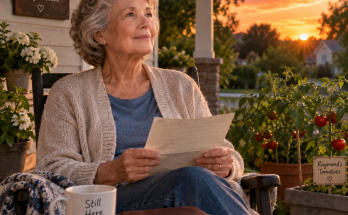
We returned to the porch.
The sun was low.
The three of us sat in the same chairs we had used when we first discovered the trust.
The difference was enormous.
There were no documents between us.
No maps.
No legal arguments.
Just three cups of coffee.
Ella looked toward the plaque.
“Do you still like the name?”
“The Second Chapter?”
“Yes.”
“I do.”
“Why?”
“Because it doesn't pretend the first chapter never happened.”
Jonah smiled.
“That might be the best part.”
We sat quietly.
Then a car appeared at the end of the driveway.
Sarah.
She stepped out alone.
I stood.
She approached slowly.
“I hope I'm not interrupting.”
“You're not.”
She looked at Ella and Jonah.
“Can I sit?”
“Yes.”
She sat on the porch.
For several minutes, she said nothing.
Then she looked at me.
“I've been thinking about the past.”
“That can be dangerous.”
She smiled.
“I know.”
She took a breath.
“My father is selling the house.”
I looked at her.
“His decision?”
“Yes.”
“Are you okay with it?”
“I think so.”
She looked toward the creek.
“He doesn't talk about the company anymore.”
“Maybe that's good.”
“He says he wishes he'd done things differently.”
I nodded.
“I believe him.”
Sarah looked surprised.
“You do?”
“Yes.”
“But you don't forgive him.”
“That's his work.”
She nodded.
“I think I understand.”
Then she handed me an envelope.
I looked at it.
“What is this?”
“Something he asked me to give you.”
Inside was a copy of a letter Richard had written years earlier.
It was addressed to Thomas.
He admitted that he had known about the children.
He admitted that he had helped move documents.
He admitted that fear had controlled him.
But there was one sentence that mattered.
“I hope one day they understand that silence was never meant to punish them.”
I folded the letter.
“That doesn't excuse it.”
“No.”
“But it explains it.”
Sarah nodded.
We sat quietly.
Then she said, “I used to think you were angry because you wanted the family to suffer.”
I looked at her.
“I was angry because I didn't want to disappear inside someone else's version of my life.”
She looked down.
“I understand now.”
That was enough.
No dramatic embrace.
No declaration that everything was repaired.
Just understanding.
After Sarah left, Ella asked, “Are you okay?”
“Yes.”
“Really?”
“Yes.”
I watched the car disappear.
“Some things don't need to be fixed.”
“What do they need?”
“To be understood.”
Jonah nodded.
The following spring, we planted three trees near the creek.
One for each of us.
We chose young maples.
They were thin.
Barely taller than a person.
Jonah dug the first hole.
Ella planted the second.
I planted the third.
We marked them with small wooden stakes.
No names.
No dates.
Just three simple numbers.
One.
Two.
Three.
The trees would grow slowly.
Long after we were gone, they might still be there.
That thought comforted me.
Not because I wanted to be remembered.
Because I wanted something to continue without needing us.
That had been Evelyn's hope.
Not that the family would preserve her story forever.
That the family would stop repeating it.
Years passed.
The cottage remained.
The archive grew.
The children became teenagers.
Then adults.
The three trees grew taller.
Sometimes people asked why the house mattered so much.
I never told the whole story immediately.
I told them that it had once been part of a family dispute.
Then I told them that three children had been separated.
Then I showed them the photographs.
The truth became easier to tell with time.
Not because it hurt less.
Because it no longer controlled us.
On one autumn morning, I found Ella standing beside the archive.
She held the photograph of the three children.
“They look so young.”
“They were.”
“Do you ever wish we could tell them what happened?”
I smiled.
“They'd probably think we're making it up.”
She laughed.
“They'd think we're ridiculous.”
“Definitely.”
Jonah entered.
“What are you two laughing about?”
“The photograph.”
He looked at it.
Then smiled.
“Three troublemakers.”
“We were babies.”
“Exactly.”
We laughed.
That moment stayed with me.
Not because it was profound.
Because it was normal.
Normal had become precious.
The family reunion that year was smaller.
Some people had moved away.
Some had died.
New children had been born.
The table was longer.
The conversations were louder.
The old argument was never mentioned.
The cottage was simply home.
After dinner, I walked outside.
The three maples moved gently in the wind.
I touched the trunk of the smallest one.
It had grown since spring.
I thought about Evelyn.
Thomas.
My mother.
The people who had made mistakes.
The people who had tried to repair them.
The people who had remained silent.
The people who had finally spoken.
There was no perfect ending.
Real families rarely had one.
There was only a choice about what happened next.
I chose the cottage.
Ella chose the cottage.
Jonah chose it too.
Not because we were trapped by the past.
Because we had finally made the place ours.
Together.
I returned to the porch.
The brass plaque was still there.
THE SECOND CHAPTER.
I touched it.
The words no longer felt like a title.
They felt like an answer.
The first chapter had contained secrets, fear, separation, and loss.
The second contained truth.
Not perfect truth.
Not painless truth.
But enough.
Enough to know where we came from.
Enough to know who belonged beside us.
Enough to decide what would happen next.
I opened the front door.
The kitchen smelled faintly of coffee.
Someone had left three cups on the table.
Ella's.
Jonah's.
Mine.
I smiled.
Years earlier, I had believed a home was a place where nobody could take anything from you.
Now I knew better.
A home was a place where people could come back.
A place where the truth could survive.
A place where the door could remain open without fear.
I stepped inside.
Behind me, the trees moved in the evening wind.
The creek kept running.
And for the first time, the house at the edge of the water held no unanswered question that needed to frighten us.
Only a family that had finally learned how to stay.
Click here to continue reading: PART 17: The Years Grew Quieter at the Cottage, Until a New Generation Began Asking Questions About the Story We Had Tried to Preserve
The Invitation Never Came, and the Empty Place at the Family Table Told Me More Than Anyone Would Say Aloud
Part 16 of 27