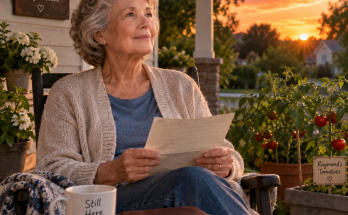
The next morning, we sat on the porch with coffee.
No one rushed.
There was nowhere to be.
For once, the truth was not chasing us.
We had found it.
Now we had to decide what to do with it.
Margaret arrived shortly after breakfast.
She brought a draft of the new trust arrangement.
“This will take time,” she said.
“How much?”
“Several weeks at least.”
I nodded.
“That is fine.”
She placed the documents on the table.
“The three of you will have equal beneficial interests.”
Ella read the first page.
Jonah read the second.
I read the third.
It felt strange seeing my name beside theirs.
Not as evidence.
Not as a clue.
As family.
Margaret explained that I could remain in the cottage.
The property would be protected from individual sale.
No one could mortgage it without unanimous consent.
If I wanted to sell someday, all three of us would have to agree.
“What if one of us dies?” Jonah asked.
“The agreement can specify how that interest passes.”
“To our children?”
“Yes.”
Ella looked at me.
“That seems right.”
I nodded.
“It does.”
David arrived later.
He sat beside me.
“I heard everything.”
“How?”
“Mom told me.”
I looked toward the driveway.
Sarah had remained in town.
“She isn't coming?”
“Not today.”
I understood.
David looked at the documents.
“Are you going to keep the cottage?”
I smiled.
“I think so.”
He nodded.
“Good.”
“You aren't upset?”
“No.”
He looked at me.
“I used to think owning something meant having the right to decide everything about it.”
“And now?”
“Now I think sometimes ownership means accepting responsibility for what it represents.”
I smiled.
“That sounds like something your father would have said.”
David looked down.
“I've been thinking about him.”
“So have I.”
“I was angry when I learned he knew.”
“So was I.”
“But I understand him differently now.”
I looked at the trees.
“So do I.”
He was quiet.
Then he said, “He wasn't perfect.”
“No.”
“He lied.”
“Yes.”
“He was afraid.”
“Yes.”
“But he tried to fix it.”
I nodded.
“That matters.”
David reached into his pocket.
He pulled out the photograph of the three children.
“I found this in Dad's office.”
I took it.
On the back was a sentence.
“Keep them together when the time comes.”
I closed my eyes.
The handwriting was Thomas's.
But the words felt like a message from another generation.
The next few weeks were filled with paperwork.
We filed the trust.
We corrected the property records.
We notified the relevant parties.
The successor company sent a letter challenging the arrangement.
Margaret responded.
Then they requested mediation.
We agreed.
The mediation lasted one day.
Their attorney argued that the historical documents were unclear.
Margaret presented the original trust.
They argued that the company had acquired rights to the land.
Margaret presented the conditional language.
They argued that the beneficiaries had been unknown.
Margaret presented the DNA results.
The room became quiet.
At the end, the company withdrew its claim.
No dramatic victory.
No shouting.
Just paperwork.
That was how the central conflict finally ended.
The property belonged to the three of us.
The cottage remained my home.
The other assets were handled separately.
The old company had no further authority.
The decades-old secret was finally part of the public record.
For the first time, there was nothing left to hide.
Sarah came to the cottage the following weekend.
She sat with me on the porch.
“I owe you an apology.”
“You've given me several.”
“This one is different.”
I waited.
“I wanted your cottage.”
“Yes.”
“I convinced myself I was protecting the family.”
“You were protecting what you thought the family should look like.”
She nodded.
“I know.”
She looked toward the brass plaque.
THE SECOND CHAPTER.
“I used to think you bought this place because you were angry with us.”
“I wasn't.”
“You were hurt.”
“Yes.”
“What's the difference?”
I thought for a moment.
“Anger wants someone else to suffer.”
“And hurt?”
“Hurt wants the truth acknowledged.”
She looked at me.
“I think I finally understand.”
I smiled.
“I hope so.”
She took my hand.
“I want to do better.”
“Then do it.”
She nodded.
There was no dramatic reconciliation.
No promise that everything would suddenly become perfect.
That would have been dishonest.
But something had shifted.
Sarah stopped asking what I planned to leave behind.
She started asking how I was doing.
That difference mattered.
Months later, Ella moved closer.
Jonah visited often.
We celebrated birthdays together.
We learned each other's habits.
Ella drank coffee too strong.
Jonah always arrived early.
I still hated folding fitted sheets.
We laughed about that.
Sometimes we talked about our mother.
Sometimes we didn't.
There were wounds that did not disappear simply because the truth had been found.
But the truth gave them somewhere to rest.
One evening, the three of us sat beside the creek.
The water moved slowly over the stones.
Ella looked at me.
“Do you ever wish you had never found out?”
I considered the question.
“Yes.”
She looked surprised.
“Sometimes.”
Jonah nodded.
“I do too.”
“But?”
I smiled.
“I would rather know.”
Ella looked toward the water.
“So would I.”
We sat quietly.
Then Jonah said, “What should we call this place?”
I laughed.
“It already has a name.”
“The Second Chapter?”
“Yes.”
He smiled.
“That's actually good.”
Ella nodded.
“It fits.”
I looked at the cottage.
For years, I had thought the hardest part of my life was losing my husband.
Then I thought it was being rejected by my own family.
Then I thought it was discovering that the people I trusted had hidden things from me.
But the hardest part had been learning that love and truth were not always the same thing.
People could love you and still lie.
They could protect you and still hurt you.
They could be afraid and still make choices that caused damage.
Understanding that did not erase responsibility.
It simply made the past more human.
A year after the trust was established, we held a small gathering at the cottage.
Nothing like the reunion.
No rented tables.
No huge crowd.
Just family.
David.
Sarah.
The twins.
Emma.
Ella.
Jonah.
And me.
We ate outside.
The twins chased each other through the grass.
David grilled vegetables.
Sarah brought dessert.
Emma complained that no one had followed her recipe.
Everyone ignored her.
It felt ordinary.
That was what made it beautiful.
After dinner, the children found the brass plaque.
“What does this say?”
I crouched beside them.
“The Second Chapter.”
“Why?”
I looked at the adults.
Then at the children.
“Because sometimes you get to start again.”
The twins nodded as though this were the simplest fact in the world.
Later, after everyone had gone inside, I remained on the porch.
David joined me.
“You okay?”
“Yes.”
“You've said that a lot lately.”
“Because it's true.”
He smiled.
“Mom?”
“Yes?”
“Thank you.”
“For what?”
“For not giving up on us.”
I looked at him.
“I almost did.”
“I know.”
“But I didn't.”
He nodded.
“That means a lot.”
We sat quietly.
Then he said, “I think Dad would be proud.”
I looked toward the trees.
“Maybe.”
“You don't believe it?”
“I think he would be relieved.”
David smiled.
“That's probably better.”
I laughed.
The next morning, I walked to the creek alone.
I carried the photograph of the three children.
I placed it inside a small wooden frame and set it on the shelf in the cottage.
Beside it was a photograph of my husband.
I looked at both.
Two parts of the same story.
One man who had kept a secret too long.
Three children who had been separated.
A woman who had spent years believing she knew where she belonged.
And a cottage that had somehow brought all of us back to the same table.
I touched the frame.
The past could not be repaired.
But it could be acknowledged.
That was enough.
I went outside.
The morning air smelled of wet leaves.
The porch board creaked beneath my foot.
I smiled.
Some things never changed.
That was comforting.
The cottage remained mine.
Not exclusively.
Not as a possession I could use to shut everyone else out.
But as a home I had chosen, protected, and eventually shared.
The three of us owned the future together.
And for the first time, none of us had to hide from it.
The family reunion came again the following summer.
This time, the invitation arrived months in advance.
My name was printed alongside everyone else's.
I almost threw it away.
Then I laughed.
I went.
Not because I had finally been accepted.
Not because I needed anyone's approval.
Because I wanted to stand among people I loved without feeling that I had to earn my place.
When Sarah saw me, she hugged me.
When David saw me, he smiled.
The twins ran toward me.
Ella and Jonah stood beside me.
Someone took a photograph.
Later, I looked at it.
Three siblings in the center.
Our children around us.
Everyone laughing.
No secrets.
No missing names.
No one standing outside the frame.
I kept that photograph.
I put it beside the photograph of the three children.
Two pictures.
One family.
Separated by decades.
Connected by truth.
That evening, I returned to the cottage.
I stood beneath the brass plaque.
THE SECOND CHAPTER.
I touched the letters.
Then I looked back at the house.
There had been a time when I thought owning this place meant finally having somewhere no one could take from me.
I had been wrong.
What made it mine was never the deed.
It was the life I built there.
The choices I made.
The people I allowed through the door.
The boundaries I learned to keep.
And the family I finally discovered waiting on the other side of a secret.
I went inside.
I locked the door.
Not because I was afraid.
Because it was my home.
And for the first time, I knew exactly what that meant.
Click here to continue reading: PART 13: Peace Finally Returned to the Cottage, Until One Last Document Forced Us to Reconsider What We Thought the Family Had Truly Inherited
The Invitation Never Came, and the Empty Place at the Family Table Told Me More Than Anyone Would Say Aloud
Part 12 of 27