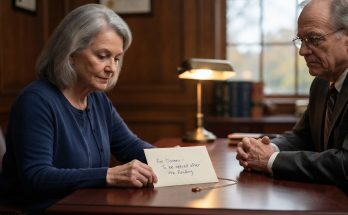
“Ryan’s not loud, but he’s solid. I don’t say it enough, but he’s who I’d want in charge if it all came down.”
I didn’t know whether to feel pride or anger. Why had he never said this to me? Why did he only find his voice through paperwork and lawyers after he was gone?
But that sentence, it lit something in me. Not rage, not revenge, just resolve. I closed the folder, pulled out my phone, and began typing.
Building the Foundation
The next morning, I asked Sabrina to help me get a few things moving. I made calls. I contacted the board of Whitmore Logistics. I started reviewing the bylaws.
I didn’t know exactly what I was building toward yet, but I knew I wasn’t going to just sit back and watch Drew throw one last tantrum and try to burn everything down. Because he would. I knew that now.
This wasn’t over for him, not by a long shot. But it was changing for me. I wasn’t going to play defense anymore. And if Drew wanted to test how solid I really was, he’d get his answer soon enough.
The shift didn’t happen overnight; it never does. But over the next few weeks, something changed, not just around me, but in me. I returned home with Sabrina to our place in Seattle, a penthouse with wide windows and a quiet view of the sound. The kind of home that felt calm, like it had nothing to prove.
I remember standing on the balcony that first evening back, watching the sun dissolve into the ocean, feeling something I hadn’t felt in a long time: certainty. Not about what I’d do next, but about why I had to do it.
Drew was silent for about 10 days after the will reading. No texts, no calls, not even one of his dramatic rants on social media. I knew what that meant. He was scrambling behind closed doors.
He was surely contacting every connection, every lawyer, every family friend who might find a loophole or some shred of sympathy to rally behind him. He’d always believed that confidence could fill in the gaps where competence failed. But now there were no shortcuts, no Mom to whisper in Dad’s ear, no Elise to run to when the lights dimmed.
Meanwhile, I began the process of stepping into the role Dad had quietly built for me. At first, I wasn’t sure I’d even keep the company. But Sabrina, ever the strategist, said something that stuck with me.
“You don’t have to wear your father’s shoes; just walk the path he paved with your own stride.”
So I did. I flew down to meet the Whitmore Logistics board 2 weeks after the funeral. I expected skepticism, doubt, maybe even resistance.
Instead, I walked into a room of gray suits and expectant eyes. And the first thing the chairman said was,
“You look just like your father when he was young.”
But I didn’t feel like him, and I didn’t want to be him. I told them as much.
“I’m not here to make promises I can’t keep,”
I began.
“But I won’t coast on my name, either. I want to understand what this company needs to survive the next 10 years, not just the next quarter.”
They nodded slowly at first, then with real interest. By the end of that 2-hour meeting, I had half of them shaking my hand and the other half pulling me aside to quietly say they were relieved Drew wouldn’t be involved. Sabrina was right. Dad had left the infrastructure, but now it was mine to shape.
That same week, a small business podcast interviewed Sabrina about her newest acquisition, and when the host asked about her husband, she didn’t flinch.
“He’s the most disciplined person I’ve ever met,”
she said, smiling.
“He doesn’t talk much, but when he moves, things shift.”
It shouldn’t have meant as much as it did, but hearing those words made something tighten in my chest. It felt like someone finally saw the version of me I’d always known was there, beneath the quiet, beneath the years of being second best.
The next month was a blur of meetings, plans, and quiet victories. We hired a new CFO for Whitmore Logistics, a sharp woman named Natalie with zero tolerance for fluff and a talent for spotting hidden inefficiencies.
I let Sabrina consult on operation strategy. Though she never overstepped, she was careful, respectful; she let me lead. And the numbers, they spoke for themselves.
Revenue stabilized, employee morale improved, and within six weeks, we negotiated two contracts that Dad’s team had been trying to land for years. My inbox went from ignored to overflowing.
I found myself invited to dinners, conferences, private equity discussions, none of which had ever included me before. But through it all, I stayed focused and quiet. Let Drew make the noise. I was building the foundation.
The Call and the Sabotage
Then, on a rainy Tuesday afternoon, the phone rang. I was in the office, going over restructuring plans with Natalie. I almost let it go to voicemail, but something made me answer. It was Elise.
“Hey,”
she said softly.
There was a long pause, like we were both trying to figure out if we were strangers or still something else.
“I wasn’t sure you’d pick up,”
she continued.
“But I wanted to say congratulations.”
I waited. She sighed.
“You know Drew’s been difficult. He’s taking it hard. He keeps saying you manipulated Dad somehow, or that Sabrina made you do it. Did she?”
“No,”
she admitted.
“He just—He can’t accept that you actually came out ahead, that you built something without playing dirty. It doesn’t fit his version of the story.”
That line stuck with me. “It doesn’t fit his version of the story.” Because that’s what it always was with Drew: a story where he was the hero, no matter how much wreckage he left behind. And now he had no narrative that could explain this version of reality where I didn’t just survive, I thrived.
Elise hesitated, then in a quieter voice,
“Can I ask you something?”
I didn’t answer, but she took that as a yes.
“Are you happy?”
I thought about that for a long moment. About Sabrina curled up with her tablet on the couch at night, humming softly while she worked. About the quiet mornings with fresh coffee and shared glances across the kitchen.
About the growing respect I was earning—not demanded, not gifted, but earned—from people who once ignored me.
“Yes,”
I said.
“I am.”
Elise was silent on the other end. Then she whispered,
“I’m sorry.”
“I know,”
I said gently.
“But that chapter’s closed.”
She didn’t argue, just hung up quietly. And when I looked up, I saw Sabrina standing in the doorway, holding two coffees. She didn’t ask about the call, just raised a brow and offered the extra cup. I took it.
Life had shifted, subtly but completely. But I knew the calm wouldn’t last. Because I had just stepped fully into the life Drew believed belonged to him, and now somewhere out there, he was rewriting his next move. And the only question left was: how far would he go this time?
It began with a single envelope, hand-delivered. No return address, no note, just my name on the front, pinned in the kind of rushed handwriting you only see when someone is angry or desperate.
I opened it at my desk the next morning, a light drizzle tapping against the office windows as Seattle yawned awake below. Inside was a folded set of documents: photocopies of emails, legal filings, and one printed text conversation.
My heart rate slowed as I flipped through them, then it started picking up again. Drew. He’d been trying to sell confidential Whitmore Logistics client data to one of our competitors.
Small time so far, nothing that had moved past whispers. The emails showed him offering insight on contracts, vendor weaknesses, even private performance metrics. It hadn’t gone through yet, but he’d tried.
And the worst part? He wasn’t even smart about it. He’d contacted an old acquaintance of his, someone he used to brag about beating in high school debates.
Turns out that guy had climbed up the ladder at one of our rival firms, but apparently he had a moral compass and a conscience. He sent everything anonymously. Didn’t want to be involved, but couldn’t ignore what Drew was doing.
I sat back in my chair, staring at the ceiling. So this was it. Drew hadn’t just accepted the loss; he was trying to sabotage me, to poison the ground I was finally standing on. Not to build something for himself, no. That would take vision, patience. He just wanted me to fall.
For days, I didn’t tell anyone: not Sabrina, not Natalie, not the board. Instead, I began gathering. I traced Drew’s communication patterns, used my old skills in cyber security to check where else he might have sent things, what data might have been exposed.
I discovered he had access credentials that should have been revoked when Dad passed, but someone in our outdated IT department had overlooked them. I quietly fixed the hole. No drama, no warnings, just preparation. Because if Drew was going to play dirty, then I needed to be several moves ahead.
The Final Checkmate
I flew out to New York for a conference the following week. Tech meets logistics—a strange combination, but one that mattered in our world.
Sabrina spoke on a panel, but I had a different reason for being there. I met with another company, a startup I’d been tracking for over a year.
Quietly, I’d been considering expanding Whitmore Logistics into something new: digital inventory automation. Something Dad never understood, but the world was shifting. Old models were rotting, and this startup, they were lean, smart, and hungry. All they needed was a strong partner to scale.
I made them an offer. Not public, not loud, but enough to get their board’s attention. If the deal went through, it would put Whitmore Logistics in a position of dominance, not just survival, control across multiple verticals.
The deal came with a catch, though. We’d need to do a full internal audit for legal compliance before they signed off. Standard practice, but for me, it was an opportunity.
An audit meant every file, every communication, every ghost in the machine exposed. And Drew’s fingerprints were all over things I now knew he’d hoped no one would ever see.
I called Natalie into my office the next day.
“I want to do a top-down systems audit,”
I said.
She frowned.
“You mean for the acquisition?”
“That’s part of it,”
I said.
“But I also want to know who still has legacy access to confidential systems.”
Her eyes narrowed just slightly.
“You think someone’s poking around?”
“Not yet,”
I said.
“But I want to be ready if they do.”
She didn’t press, because she trusted me now. And then, almost like fate aligning itself, I got another surprise.
Sabrina walked into my office later that day with a smile I hadn’t seen in weeks, a smile that meant something just clicked.
“We found the missing link,”
she said, dropping a binder on my desk.
Inside were scanned documents from a property we’d inherited, some old development land our father had bought years ago but never built on. He always said it was too risky.
But what Sabrina had discovered through a quiet land survey was that the zoning laws had shifted. That land was now cleared for commercial construction downtown. A gold mine.
And in the bottom of the folder was a contract, unsigned, between Dad and a company Drew had once tried to start. A contract Dad never moved forward with, one he quietly buried. He never trusted Drew to develop it. But now it was mine.
“It’s shovel ready,”
Sabrina said.
“And if you back it through Whitmore, you could double your valuation inside a year.”
My head swam. Everything was aligning: power, leverage, visibility. The very things Drew had always thought were his by birthright.
He tried to break me 6 years ago, tried to humiliate me at a funeral, tried to claw at my foundation when I finally stood on my own. But he didn’t know what was coming. Because now I had more than money: I had proof, I had power, I had a company behind me, a wife beside me, and a name Drew couldn’t erase anymore, not even with lies.
I didn’t want revenge, but I was about to show him something far worse than anger: indifference. And when I executed the next move publicly, he would finally understand what it meant to lose something he never truly owned.
But first, I had one last thing to do. Because Drew wasn’t going to stop, not until I made sure he couldn’t.
It was all in the timing. That was something Drew never understood. He rushed everything: relationships, business deals, even his own downfall. But I’d spent the last 6 years learning how to wait, how to sharpen the blade quietly while everyone else was still swinging wildly. And now the blade was ready.
The internal audit finished ahead of schedule. Natalie and her team turned over their findings on a Thursday morning, and I read them three times just to be sure.
Drew’s unauthorized access had left a trail clear as day. Data pulls from internal reports, suspicious login from a private IP, and worst of all, a download of confidential bid information just days before one of our largest contracts was lost to a competitor. That loss had cost us nearly $4 million. The board didn’t know it yet, but they would.
I called a special executive meeting for Monday morning. Sabrina would be present, so would the compliance officer, the company attorney, and the entire board of directors. And because it was protocol to invite all shareholders with a past managerial history and stake over 5%, Drew would be there too. I made sure of it.
He showed up 5 minutes late, of course, wearing a too-tight suit and an overconfident smirk, like he thought he was stepping into some casual sit-down where he’d get to play the role of misunderstood genius. Elise wasn’t with him. I had a feeling she was finally starting to see through the cracks.
“Didn’t think you’d miss the chance to look important,”
Drew said as he dropped into a leather chair near the end of the table.
I didn’t respond, just nodded to the lead attorney to begin.
The attorney cleared his throat and pulled up the screen behind him, where a slide titled “Security Breach Findings Summary Report” glowed in large, clean letters. The room fell quiet as the findings were laid out: time-stamped access logs, flagged IP addresses, and correlations with lost contracts.
I watched the reactions around the table: confusion, shock, then anger. And Drew, he didn’t blink, not at first.
But the moment the lawyer showed the screenshots of emails, his emails, offering Whitmore’s internal bid numbers to a rival firm, his jaw clenched.
“This is absurd,”
he finally said.
“You really think I’d risk everything over that?”
The attorney responded calmly,
“You didn’t just risk it, you executed it. We have digital verification, timestamps, traces of the downloads made using your legacy credentials.”
“Mr. Whitmore,”
he glanced at me,
“has already filed for a retroactive internal injunction, and given the evidence, we’re preparing to notify the state authorities.”
Drew laughed, but it was thin, brittle.
“This is a setup.”
Natalie spoke then,
“You’re the only person who still had access through a blind credential link your father left. We caught it. You exploited it.”
Sabrina leaned forward,
“And you thought you were going to sell off his company piece by piece while smiling at his funeral? You really don’t know how to build anything, do you?”
Drew turned red.
“This is insane. You’re just trying to wipe me out of the family completely.”
I finally spoke, calm, steady,
“No, Drew. You did that to yourself. I’m just making it official.”
I slid a document across the table. It was a formal cease and desist order drafted by our legal team, barring Drew from all Whitmore-owned properties, communications, and internal systems.
He was also being referred to state business regulators for corporate espionage and data theft charges that, while they might not land him in prison, would destroy any chance of starting a business again. His name would be flagged in every due diligence process for the rest of his life.
He stared at the paper, then at me.
“You think you’re the better man now?”
he spat.
“No,”
I said simply.
“I’m just not the fool anymore.”
He stood, shoulders heaving.
“This isn’t over. You think this is the end? You’re still the same silent little ghost living in my shadow, no matter what you do.”
“Then maybe,”
I said, cutting in gently,
“it’s time you stop walking in front of the sun.”
He blinked, taken aback. That was the last thing I said to him.
The New Empire
The board voted unanimously to sever all future association with Drew. His remaining shares, thanks to a clause Dad added in his final update, were forfeitable upon proven misconduct, which, given the report, was as proven as it could get.
By noon, his access was revoked. By nightfall, the press got wind of the internal security breach and the swift action taken by new leadership.
I gave no comment. Sabrina issued a one-line statement.
“We protect what we build.”
Drew, I later heard, tried to get a meeting with one of our former competitors, only to be politely turned away. He’d burned too many bridges, and the ones he thought he could buy, they were owned by someone else now: me.
In the days that followed, I didn’t celebrate. I just worked. Contracts were signed with the startup. Our market value rose.
Sabrina negotiated an investment partnership with a European firm that gave us presence in three new countries. I spent my days building, not gloating, not chasing ghosts.
But there was one final moment that made the revenge truly settle. A letter arrived, handwritten. No envelope this time, just a short message on lined paper.
“You got what you wanted. I hope it was worth it. D”
I folded it once and tucked it into the back of my desk drawer without a word. Because I had no interest in responding. He wanted me to come down to his level, but I was already building something he couldn’t reach anymore, and he finally knew it.
The fallout came quickly. A week after the board meeting, Drew’s name hit the industry blacklist. The startup circles he used to lurk in closed their doors.
I didn’t have to say a word. The documents we uncovered spoke louder than I ever could. His LinkedIn went dark.
Elise moved out quietly, without drama. I knew because Sabrina received an automated change of address alert linked to one of the old shared properties Drew had tried to funnel through their joint accounts. She moved back in with her sister across town. I wasn’t surprised.
A month later, Mom called. I stared at the screen for a long time. It blinked once, twice. Then I let it go to voicemail. She tried again the next day. This time she left a message.
“Ryan, I don’t even know what to say. He’s devastated. You didn’t have to destroy him like that. He’s your brother.”
No apology, not even a hint of accountability, just more excuses, more of the same. I deleted the message without replying.
Three months passed. Whitmore Logistics was thriving. The acquisition was finalized, and with Sabrina’s guidance, we rolled out a new digital logistics platform that reduced processing time by 37%.
Our valuation doubled. *Forbes* ran a profile titled “The Silent Son Who Rebuilt an Empire.” I didn’t care much for the headline, but the truth underneath it mattered. I was finally seen, not because I screamed, but because I stood firm.
Drew, he tried to start over. Moved to a smaller city two states over and launched a consulting firm under a different name, but it didn’t last. Word spread. No one trusted a man with a record of corporate theft and a reputation for burning bridges.
One of our clients sent me a photo a few months later: Drew working at a co-working space, hunched over a laptop, wearing the same jacket he wore at Dad’s funeral, same scowl too. He wasn’t building anything; he was just trying to stay afloat.
Mom stopped calling after that. I think she understood I wasn’t coming back. Not to Sunday dinners, not to birthdays, not to the fantasy she tried to preserve. The version of me who accepted scraps was gone.
And Elise, I saw her once by accident at a conference, standing near the coffee booth with a quiet, distant look in her eyes. She didn’t speak. Neither did I. But the sadness in her eyes said everything. She hadn’t just lost me; she’d traded me, and now the cost had caught up.
That night, back at home, I stood on the balcony with Sabrina, watching the city lights flicker beneath us.
“You know,”
she said,
“you never once raised your voice through all of this.”
“Didn’t need to,”
I said.
She smiled and leaned her head on my shoulder.
“You didn’t just win, you outgrew them.”
And she was right. For the first time in my life, I didn’t feel like I was standing in anyone’s shadow. I was standing on solid ground, my own. And I’d built it from the ashes they left behind.