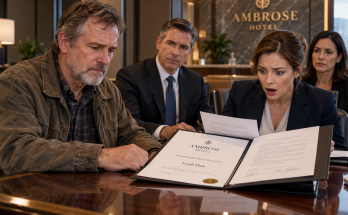
I cheated once, and my husband punished me with eighteen years of silence. He never touched me again, never looked at me like a woman, and I accepted that sentence… until a doctor opened his file and said a phrase that drained all the blood from my body. My name is Elena Navarro. I thought Javier hated me. But that morning, I realized that perhaps I had spent eighteen years blaming myself for the wrong lie.
But I had never signed it.
The blade trembled between my fingers.
Not because it weighed me down, but because suddenly I had eighteen years of nights without a hug, eighteen years of birthdays with dry cake, eighteen years of sitting in front of Javier as if we were watching over someone no one dared to name.
“That’s not my signature,” I said.
My voice came out so low that I didn’t even recognize it.
Javier continued standing, with his hands resting on the doctor’s desk. His knuckles were white. The doctor, uncomfortable but firm, pointed to another line of the file.
“Here it says that eighteen years ago Mr. Javier had a reactive HIV test. It was a screening test. Confirmation was then requested.
I felt that the clinic was getting smaller.
“HIV?” I asked, and my throat closed.
Javier turned his face.
He didn’t want to see me.
The doctor continued:
—The subsequent confirmation was negative. There is no record of antiretroviral treatment, there is no viral load, there is no active diagnosis. Mr. Javier’s current studies are also negative.
I stared at my husband.
Negative.
That word, so clean, so simple, came late as old trains arrive: with smoke, with noise, dragging the dead.
“You… You thought you were sick? I asked him.
Javier closed his eyes.
“I didn’t think, Elena. They told me.
The doctor took a deep breath.
The problem is that the confirmatory result is delivered weeks later. Here is a receiving signature. Yours, Mrs. Navarro. And a note requesting “not to discuss the result with the spouse due to family conflict.”
“I never signed that.
The doctor nodded.
“That’s why I’m telling you this. The NOM of the clinical record requires confidentiality, integration and proper management of the file. A fake signature on a medical document is not a minor detail. It is a serious irregularity.
Javier sat down as if his legs had been cut off.
I couldn’t cry.
Not yet.
He had cried out of guilt for eighteen years. But that was not fault. It was something else. It was anger mixed with a sadness so old that it smelled musty.
“Why didn’t you tell me?” I asked him.
Javier let out a broken laugh.
“Because that night I found your messages. Because the next day I went to get tests like an idiot scared to death. Because when they called me and told me “reactive,” I thought that life was charging me something that I hadn’t even done.
“Javier…”
“And because I hated you, yes. But not so much that you take risks.
I put my hand to my mouth.
He finally looked at me.
His eyes were full of water.
“I couldn’t touch you, Elena. I didn’t know if I could infect you. I didn’t know if you already knew. I didn’t know if it came from you, from him, from a transfusion when I had surgery on my leg in the workshop, from God knows where. And then… then I couldn’t speak.
The doctor looked down.
Outside, in Colonia Del Valle, traffic roared over Félix Cuevas, near that area where Mexico City seems to always live in a hurry, between hospitals, tamale stalls and people crossing as if they didn’t have a soul on them. The 20 de Noviembre National Medical Center is there, in Félix Cuevas, near the Metro line 12, and I thought it was cruel that a place full of doors could hold so many secrets.
We left without saying goodbye well.
In the elevator, Javier and I look at our reflections in the metal.
He looked older.
So do I.
When they reached the street, a lady was selling guava atole in Styrofoam glasses. The sweet smell hit me and, without warning, I began to cry. I didn’t cry pretty. I cried with a crooked face, with shame, with snot, as women cry when they discover that a whole life could have been different.
Javier didn’t hug me.
But he raised his hand.
He left it suspended for a second.
Then he put it on my shoulder.
It was a minimal weight.
A feather.
An earthquake.
“Who signed?” I said.
He did not answer.
“Javier, look at me. Who was able to sign?
His hand withdrew.
“My mother accompanied me to that clinic.
The name fell between the two of them like a stone.
Amalia.
My mother-in-law.
Dead six years ago, but still sitting in the living room of our house like a portrait that judges.
Amalia never forgave me for being born poor in Analco. He never liked me working. She never liked that Javier consulted me on things. When he found out about my infidelity, he didn’t scream. He just looked at me with an icy calm and said:
“Women like you don’t destroy a house all at once. They are rotting it.
I thought that phrase had been his only punishment.
I was wrong.
“Did she know about the result?” I asked.
Javier wiped his face with his sleeve.
“I was destroyed. I went with her because I didn’t have anyone else. He took me, waited for me, talked to the receptionist. Then he told me that I had to accept God’s will. That it was best never to touch you again.
“And the negative result?”
“I never saw him.
We did not return to Puebla that afternoon.
We returned to our house in silence, but it was no longer the silence it had been before. That old silence was a wall. This was an excavation. Every minute he opened a bone.
As I entered, I saw Javier’s blue cup next to the sink.
For years I hated her.
It seemed to me the symbol of his loveless permanence.
That night I washed it with my hands.
He stood in the kitchen doorway.
“You don’t have to,” he said.
“I know.
The hot water burned my fingers.
“But for eighteen years I did things out of guilt. Today I want to do something of my own volition.
Javier lowered his head.
We slept in separate rooms one more night.
Not because we wanted to.
Because approaching after so much abandonment was scary.
The next morning we drove to Puebla. Javier didn’t want Uber or bus. He took out the old car, checked the oil and put a rosary in the rearview mirror. On the Mexico-Puebla highway, Popocatepetl appeared among clouds, huge and still like a sleeping animal.
I was walking with my hands on my knees.
He was driving slowly.
At the height of San Martín Texmelucan, he said:
“I punished you too.
“No,” I answered. You thought you were protecting me.
“At first. Not anymore. Then I was afraid to know the truth. I was afraid that if we talked, I would have to forgive you or leave. And I chose to do nothing.
I looked at the dry fields by the side of the road.
“I chose to betray you.
“Yes.
His sincerity hurt, but it didn’t cut short.
He just opened.
“I don’t want this to erase what I did,” I said. I don’t want to play the victim.
Javier pressed the steering wheel.
“You’re not innocent, Elena.
I swallowed hard.
“I know.
“But you weren’t the monster my mother needed you to be, either.
We arrived in Puebla at noon.
The city was full of sunshine, that Puebla sun that bounces off the colonial facades and makes the Talavera shine as if each tile kept a piece of sky. We passed through the Center, through streets where it still smelled of sweet bread, mole and hot oil. I saw the Zócalo, the Cathedral, the doorways with families eating ice cream, and I felt an absurd pang: life had continued to be beautiful while we lived buried.
Amalia’s house was near 14 Oriente, not far from those places where workshops, old neighborhoods and cemita stalls are mixed.
Javier had inherited the house, but we almost never went.
Entering was like opening a closed mouth.
Everything smelled of camphor and wood.
In the living room there was the same plaster Christ, the same glass case with glasses that no one used, the same photo of a young Amalia, with pursed lips and eyes of sentence.
“His papers are in the back room,” Javier said.
We go through boxes for hours.
Electricity bills.
IMSS booklets.
Stamps.
Letters from dead aunts.
A recipe for chiles en nogada written in round letters.
In the evening, I found a black missal inside a grocery bag at the Parian. Between its pages there was a yellow envelope, hard for years.
It had no name.
Just one word written in blue ink:
“Javier”.
If you say it.
He didn’t open it right away.
His fingers were shaking.
“Open it,” I whispered.
Inside was a copy of a result.
Confirmatory HIV: non-reactive.
Date: eighteen years ago.
And a letter.
Javier read aloud, but on the third line he broke. So I took the paper.
The lyrics were Amalia’s.
“Son: if you ever find this, forgive me. I did what a mother had to do. Elena stained you. If you tell her you’re healthy, you’ll go back to her bed and she’ll humiliate you again. A woman who betrays once always betrays. I signed for her because she had already signed her sin. I didn’t kill you, I saved you.”
I couldn’t continue.
The entire room seemed to tilt.
Javier put his hands to his face and let out a sound that he had never heard before. It wasn’t crying. It was something older. As if a child inside him had waited eighteen years to ask for help.
I approached.
This time I didn’t wait for permission.
I hugged him.
At first his body stiffened.
Then he folded.
Javier cried against my shoulder.
He cried for his mother.
For me.
For him.
For the years when he bathed before dawn so as not to cross my skin.
For the nights when I heard his cough across the hall and didn’t dare knock on the door.
For each anniversary with flowers bought out of habit.
For each family photo where the children smiled between two broken adults.
“Forgive me,” he said.
“Don’t carry everything.
“I left you alone.
“I let you go first.”
We stayed like this for a long time, sitting on the dusty floor, among boxes and ghosts.
Outside a bell began to ring.
Puebla has that: even if one is dying inside, there is always a church reminding the world that the time changes.
That night we did not return to Mexico City.
We walked to the Center without talking much. Yellow lights fell on the sidewalks. On Calle de los Dulces, the windows showed sweet potatoes, Santa Clara pancakes and colorful drunks as if childhood could be bought by a quarter of a kilo.
Javier bought me a pineapple sweet potato.
He hadn’t given it to me since Inés was a baby.
“You liked them,” he said.
—I still like them.
We ate sitting on a bench.
People passed by with bags, children, balloons, in a hurry. An organ grinder played out of tune near the doorways. I thought Mexico is made of those things: private tragedies walking past corn vendors, family secrets passing in front of gilded churches, broken hearts that still stop for a freshly soaked bread.
The next day we went to Santo Domingo.
Javier was not devout, but he said he needed to get in.
The Chapel of the Rosary shone as if someone had decided to cover a wound with gold. It is one of the most recognized baroque jewels of Puebla, inside the temple of Santo Domingo, and when I saw it I understood why so many people keep silent there without anyone asking them to.
Javier sat in the last pew.
I knelt beside him.
“I don’t know how to pray like I used to,” he said.
“Then don’t pray. Speak.
He looked straight ahead.
“I lost half my life for obeying fear.
I took his hand.
His skin was warm.
It was not an accidental touch.
It was not courtesy.
It was a decision.
Click Here to continuous Read Full Ending Story👉 Part2: I cheated once, and my husband punished me with ei…