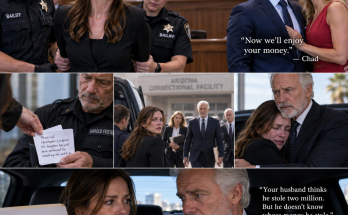
“I was aware that Mr. Dalton had advised me that the full financial picture would be presented at the appropriate time,” he said. “The specifics were not shared with me in advance.”
The judge nodded once, in the way that acknowledges an answer without fully accepting it.
She called a recess.
In the corridor, Miguel walked with me to the water fountain at the far end, where no one else was standing, and he kept his voice very level.
“You want to explain to me,” he said, “what just happened in there.”
“I told you to wait for the question.”
“You told me to wait for a question. You did not tell me the question was going to change the entire nature of the proceeding.”
“I didn’t know exactly when it would come,” I said. “I knew it would come.”
He looked at me for a long moment.
“Twenty-three million dollars,” he said.
“Four hundred thousand, give or take, after the structure.”
He looked at the ceiling, then back at me.
“Vincent,” he said. “I have spent three weeks preparing to minimize your losses in a custody case we were almost certainly going to lose.”
“I know.”
“And you spent those three weeks doing what, exactly?”
“Waiting,” I said. “And letting them build the version of me they wanted to build. The more certain they were about what I was, the less they were going to look for what I actually was.”
He was quiet for a moment.
“Your daughter,” he said. “Emma.”
“Yes.”
“What do you want for Emma?”
This was the question that mattered. This was the question I had been answering for myself since I left the house on that Wednesday afternoon, every decision since measured against it.
“I want her to grow up knowing that her father is not what people said he was when it was convenient for them to say it,” I said. “I want fair custody, which means real time, not supervised visits twice a month. I want her to know, when she is old enough to understand it, that I did not fight for her by being louder than the other side. I fought for her by being more prepared.”
Miguel looked at me for a while.
“You’re going to need an actual attorney,” he said.
“I have one,” I said. “He filed the Meridian documents six days ago. He’ll be here when we go back in.”
He nodded slowly.
“Is there anything else I should know before we walk back into that courtroom?”
“No,” I said. “That’s the whole thing.”
He straightened his jacket. “Okay.”
We walked back down the corridor.
The hearing reconvened forty minutes later. My attorney, a woman named Sandra Kelley who had handled Meridian’s legal affairs for three years, was seated beside me. She had a particular quality that I had valued from the first time I worked with her: she was calm in the specific way of someone who does not need the room’s validation, who does not require the performance of authority because the substance of it is sufficient.
Hartwell had made calls during the recess. I could see it in the way he carried himself back to the plaintiff’s table, in the quality of his stillness as he arranged his papers. He had made calls and what he had learned had not improved his morning.
Jessica had not looked at me since the corridor. She sat with her yellow legal pad on the table in front of her and the pen she had picked up and set down twice, and she had the appearance of a woman who is reconstructing something from the beginning, who is finding that the story she has been telling herself about a situation does not account for the room she is currently in.
The proceedings that followed took three hours.
I will not reconstruct them in full because the legal choreography is less important than the shape of what emerged from it. What emerged was this: the court determined that the financial picture presented by Hartwell in his opening had been materially incomplete, through technically accurate misrepresentation, in a way that had misled the court’s preliminary assessment of relative resources. The Meridian valuation and the corporate structure were entered into the record. Sandra walked the court through the company’s history, the deliberate step-back from active management, the income arrangement, the reasons for it, which predated the divorce and were documented.
Judge Whitmore was thorough. She asked questions that indicated she had read the Meridian filing during the recess and understood its architecture better than most people would have after a forty-minute review.
At the end, she looked at both tables.
“The custody arrangement requested by the plaintiff assumes a significant disparity in parental resources that this court is no longer confident exists,” she said. “I am not prepared to finalize a custody arrangement today. I am ordering a thirty-day continuance, during which both parties will submit complete financial documentation, including all corporate holdings, equity interests, and deferred compensation arrangements, to this court.”
She looked at Hartwell specifically on the last part of that sentence.
“Furthermore, the court will appoint an independent guardian ad litem to assess Emma Dalton’s interests without reference to either party’s financial presentation.”
Jessica leaned toward Hartwell. He said something brief in response. Her face did not change.
“Mr. Dalton,” the judge said.
I stood.
“Supervised visitation, twice monthly, was the request. That arrangement will not stand pending the outcome of the complete review. You may have unrestricted scheduled visitation with your daughter during the continuance period, subject to any logistics the parties can agree on. If they cannot agree, this court will set the schedule.”
She removed her glasses.
“I want to say one thing for the record.”
The room was completely still.
“This court exists to serve the interests of the child in a custody proceeding. It does not exist to serve the interests of whichever party presents the most compelling financial contrast. The purpose of these hearings is not theater.” She looked at the gallery briefly, then back at the tables. “I expect the next thirty days to be used for accurate, complete, and honest disclosure from both parties. That is all.”
She rose. The room rose.
In the corridor afterward, Sandra walked beside me toward the elevators.
“How do you feel?” she said.
“Like I’ve been awake since five,” I said.
She almost smiled. “That’s accurate.”
David Park was waiting in the lobby, which I had not expected, and which told me he had been following the hearing in whatever way he could from outside the courtroom.
He looked at my face when I came through the door and said: “Well?”
“Continuance,” I said. “Thirty days. Complete disclosure from both sides.”
He was quiet for a moment.
“And Emma?”
“Unrestricted visitation while we wait.”
He nodded once.
We walked out into the afternoon together, into the parking lot and the flat ordinary light of a weekday in November. He had driven over in his truck, which still had a cracked bumper from a parking garage incident two years ago that neither of us had gotten around to addressing. I had driven over in my car, which was an eight-year-old Civic with good tires and nothing to apologize for.
“You know what happens now,” he said.
“More lawyers,” I said. “More paperwork. More of the process.”
“And after the process?”
I thought about Emma. I thought about the last weekend I had with her, two weeks ago, a Saturday afternoon that we had spent at the science museum because it was her current enthusiasm and because there are few things in the world more satisfying than watching a nine-year-old discover that friction is interesting. She had explained three separate exhibits to me with the confidence of someone who has recently acquired knowledge and finds it almost unbearably worth sharing.
I thought about what I wanted for her.
Not what I wanted her to have. What I wanted her to be. Someone who understood that the story other people tell about you is not the story you are required to live inside. Someone who knew that preparation is more durable than performance and that the patient version of a plan is almost always the right version. Someone who knew, when it mattered, what her father was.
“After the process,” I said, “I go pick up my daughter.”
David looked at the parking lot. He looked at the court building behind us. He looked at me in the blue Walmart shirt that I had worn deliberately into a room where it was supposed to tell one story and had ended up telling a different one entirely.
“You know,” he said, “you could have told them at the beginning.”
“Yes,” I said.
“It would have been simpler.”
“Simpler is not always better.”
He thought about that.
“Jessica is going to be very angry,” he said.