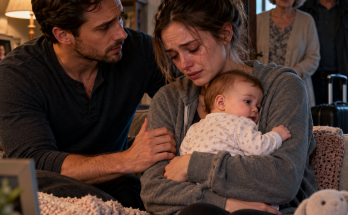
“No!” my mother shrieked as the deputies marched Bianca and Kyle toward the door. “Zara, you have the money. You are rich. You can afford to lose fifty thousand. Why are you doing this?”
“Because it is not about the money,” I said, my voice cold as the winter air rushing in through the open door. “It is about the price of admission, and you just could not afford the ticket.”
I watched as my sister and her husband were dragged out into the snow, their cries fading into the wind.
My mother stayed on the floor, weeping into the rug, realizing too late that the daughter she had thrown away was the only one who could have saved her, and I had just closed the vault.
I turned back to the room, picked up a fresh glass of champagne, and raised it to the empty doorway.
“To family,” I said, taking a sip. “And to the high cost of tuition. School is dismissed.”
The flashing red and blue lights of the sheriff’s cruiser painted the snow in violent strokes of color. As Bianca and Kyle were placed in the back seat, I watched through the window, holding my champagne flute like a shield.
Bianca pressed her face against the glass, her makeup smeared into a mask of despair, mouthing words I could not hear but could easily guess. She was begging. She was blaming. She was realizing that for the first time in her life, consequences were not going to disappear just because she cried.
Kyle sat beside her, staring straight ahead, his jaw slack with shock.
As the cruiser pulled away, tires crunching on packed ice, a silence settled over the driveway. It was not a peaceful silence. It was the vacuum left by a disaster.
Inside the villa, the air was still warm and scented with expensive candles. But the mood had shifted from celebration to execution.
Titus approached my parents. He did not need to speak. His presence alone was command. He gestured toward the door with the finality of a judge’s gavel.
My mother looked around the room one last time—eyes lingering on the fire, the food, the warmth she was about to lose. She looked at me, but I turned my back. I walked to the fireplace and warmed my hands, watching the flames dance.
I heard the heavy oak door open. I heard the wind howl as it rushed into the foyer, snatching at their clothes like a hungry beast.
Then I heard the door close.
The lock clicked with a sound that felt like closure.
Outside, the reality hit them with the force of a blizzard. I watched on the security monitor as they stood on the heated pavers of my driveway, shivering in inadequate coats.
Their rental SUV was miles away, stuck in a snowbank—dead and useless. Their credit cards were frozen blocks of plastic. They had no cash. They had no plan.
And they had no friends.
The Walkers were the final nail. They had called a private car service while the arrests were happening. A sleek black town car pulled up to the gate, headlights cutting through the swirling snow. The driver stepped out and opened the door for Mrs. Walker.
My mother reached out a trembling hand toward her.
“Carol, please,” my mother cried, voice thin and desperate in the wind. “We cannot stay here. We will freeze. Please, just give us a ride to town, just to a hotel.”
Mrs. Walker stopped. She turned slowly and looked at my mother with a gaze so cold it made the winter air feel tropical.
“I do not know you,” she said flatly. “I do not know your daughter. I do not know your thief of a son-in-law. As far as I am concerned, this entire family is a bad memory I am going to forget by morning.”
Her voice cut sharper.
“Do not speak to me again.”
She got into the car. Mr. Walker followed, slamming the door without even glancing at my father.
The town car pulled away, tail lights fading into the whiteout, leaving my parents standing alone in the dark.
They were isolated on the side of a mountain in the middle of a blizzard with nothing but their pride—which was currently freezing to death.
My phone buzzed in my hand.
It was my father.
I looked at the screen as his name flashed. I could see him down there holding the phone to his ear, face turned up toward the window where I stood. He knew I was watching. He knew I was warm.
I answered and put the phone to my ear. I did not speak. I just listened to the wind whipping around him.
“Zara!” he shouted over the gale, his voice cracking. “Zara, please. It is freezing. We are going to die out here.”
“You are not going to die, Dad,” I said, calm and detached. “It is twenty degrees. Uncomfortable? Yes. Fatal? Not immediately.”
I took a sip of my drink.
“You can walk to the main road. There is a gas station about four miles down.”
“Four miles?” he sputtered. “Your mother cannot walk four miles in snow. She is wearing heels.”
“That sounds like a planning error,” I said. “Maybe she should have worn boots. Or maybe you should not have stolen $50,000 and driven into a blizzard to harass me.”
Silence, filled with ragged breathing.
Then his voice changed. The anger drained out of it, leaving only a hollow rasp.
“I am sorry,” he whispered. “I am so sorry, Zara. I was wrong. I was wrong about everything. About Bianca, about you. I should have protected you. I should have been a better father. Please… I am begging you. Let us in.”
I closed my eyes for a second. I had waited thirty-two years to hear those words. I had spent my entire life trying to be good enough, smart enough, successful enough to make him say them.
And now that he finally had, they felt empty.
They were not born of love or realization.
They were born of cold and fear.
They were currency he was trying to spend to buy a ticket out of the snow.
“Your apology is noted, Dad,” I said, my voice soft but unyielding. “But you taught me something important today. You taught me that everything has a cost.”
I watched him look up at the window, his face a pale blur in the storm.
“You tried to buy a lifestyle you could not afford with my money. You tried to buy respect with lies. And now you are trying to buy warmth with words you do not mean.”
I let the final truth land.
“Words are cheap. Action is expensive. And right now, your account is overdrawn.”
I hung up.
I watched for a moment as he stared at the device in his hand as if it had betrayed him. Then I turned away from the window. I walked back to the fire, back to my guests, back to the warmth I had built with my own two hands.
I left them in the cold where they belonged.
Six months is a lifetime in the business world, but it feels like an eternity in the criminal justice system. The snow long melted from the peaks of Aspen, but the freeze in my family relations hardened into permafrost.
I have not spoken to them since that night in the driveway. I do not need to call them to know how their lives are unraveling.
I have the court transcripts and the public records.
Bianca took a plea deal to avoid prison time. Her lawyer argued for leniency based on her lack of prior convictions, but the judge was not charmed by her tears. She is currently serving three years of probation, wearing a GPS ankle monitor that clashes horribly with her wardrobe.
Her days of being a digital influencer are over. The internet does not forgive and it certainly does not forget. Her follower count dropped overnight, replaced by trolls and commentary channels dissecting her downfall.
She works now—not as a silent partner in a tech firm, but as a night-shift stocking clerk at a discount warehouse. It was the only place that would hire someone with a grand larceny conviction on their record. She spends her nights lifting heavy boxes of merchandise she can no longer afford to buy.
Kyle was not so lucky. Because he had a prior history of embezzlement and because he crossed state lines with stolen funds, the federal prosecutor made an example of him. He is currently serving eighteen months in a minimum-security facility.
He lost his real estate license permanently.
The Walkers, true to their word, filed for an annulment and cut him out of the will completely. When he gets out, he will have nothing—no wife, no money, no career, and a family name he disgraced beyond repair.
But the most tragic figures in this drama are my parents.
The house in Cascade—the beautiful brick home that I had quietly paid off for them two years ago—is gone. They had to sell it in a fire sale to pay the restitution for Bianca and the exorbitant legal fees for defense attorneys.
They drained their retirement accounts. They sold the furniture. They sold the jewelry. They sold the very image they spent a lifetime cultivating just to keep their golden child out of a cell.
They live now in a two-bedroom apartment near the airport. The walls are thin. The neighbors are loud. The carpets smell of stale smoke and old cooking oil.
There are no more garden parties. There are no more bridge clubs. The social circle they valued so highly evaporated the moment the moving trucks arrived.
The church was the hardest blow for my father. Desmond Wilson had been a deacon—a pillar of the community, a man who sat in the front pew and passed judgment on others.
But the scandal was too loud and too public. The board asked him to step down. The pastor suggested they find a new congregation. They went from being the first family of the church to the people who sit in the back row hoping no one notices their frayed coats and scuffed shoes.
They lost their standing. They lost their dignity. And they lost the only child who actually had the means to support them in their old age.
It was a Tuesday afternoon when the final blow landed.
My mother was standing in the checkout line at a grocery store, counting out coupons with trembling hands. She looked older now, her hair graying at the roots because she could no longer afford the salon.
My father stood beside her, staring vacantly at the floor, holding a basket containing store-brand bread and canned soup.
As the cashier scanned their items with a rhythmic beep, my mother glanced to her left at the magazine rack. It was filled with the usual tabloids and gossip rags, but right in the center, at eye level, was the new issue of Forbes.
She froze.
Her hand stopped midair, holding a crumpled dollar bill. She stared at the cover. She blinked, trying to process what she was seeing.
It was me.
I was wearing a white power suit, standing on the balcony of my Aspen villa, the mountains rising majestically behind me. My arms were crossed, my expression calm and unshakable.
The headline was printed in bold gold letters that seemed to shimmer under the grocery store’s fluorescent lights:
The Silent Strategist: How Zara Wilson built a luxury empire from the shadows and became the new face of self-made wealth.
My mother made a small choking sound. She reached out and touched the glossy paper as if testing whether it was real.
My father looked up, his eyes following her hand. He saw it too—the daughter he called a failure, the spinster he banned from dinner, the woman whose money he tried to steal.
He read the subtext below the headline:
Net worth estimated at $20 million and climbing.
The cashier cleared her throat.
“Ma’am, are you going to pay for those beans or not?”
My mother looked at the cashier, then back at the magazine. She looked at the beans in her basket.
The contrast was absolute. She was counting pennies to buy dinner while the daughter she threw away was being celebrated as a titan of industry.
“I know her,” my mother whispered, her voice cracking. “That is my daughter.”
The cashier popped her gum and looked at the cover, then back at the woman in the faded coat.
“Sure it is, honey,” she said with a dismissive laugh. “And I am the Queen of England. That will be $12.50.”
My father pulled my mother away, his hand gripping her arm tightly. He did not say a word. He could not. The shame was a physical weight crushing the air from his lungs.
They left the magazine there in the rack—a glossy testament to everything they had lost. They walked out of the store into the gray drizzle of a Tuesday afternoon, carrying their cheap groceries and the heavy burden of knowing they had held a diamond in their hands and thrown it away because they thought it was glass.
It is my 33rd birthday, and the mountains that were once covered in snow are now green and alive with summer. The infinity pool reflects the blue sky, and the air smells of jasmine and expensive sunscreen.
I am sitting on a lounge chair wearing a swimsuit that makes me feel powerful—not just rich.
Around me, the villa is buzzing with life, but this time it is the right kind of life. Aunt May is sitting under a cabana, laughing with Elena, my business partner. She is holding a glass of iced tea and looks ten years younger than she did back in Atlanta.
There is no tension here. There is no walking on eggshells. There is just the easy rhythm of people who genuinely like each other.
Next to me, David squeezes my hand. He is an architect I met three months ago. He does not know about the Porsche or the $50,000 or the night I left my parents in the snow.
He just knows me. He knows I like my coffee black, that I work too hard, that I am fiercely protective of the peace I have built.
He leans over and kisses my cheek, and for the first time in my life, I do not wonder what he wants from me. I know he just wants to be here.
But the past has a way of trying to reach out from the grave.
Earlier that morning, the mail arrived. Buried between investment statements and birthday cards was a gray envelope with a stamp that made my stomach turn:
Department of Corrections.
I picked it up, holding it between two fingers like it was contaminated.
It was from Bianca.
I did not need to open it to know what it said, but I did anyway.
The handwriting was jagged and desperate.
“Zara, please,” she wrote. “The public defender is useless. They are going to make me serve the full term. I need a real lawyer. I need money for the appeal. Mom says you will not take her calls. We are sisters, Zara. Blood is thicker than water. You cannot leave me in here.”
I read the words and waited for the guilt—for the old familiar pang of obligation, the voice in my head that said I was the big sister and it was my job to fix things.
But it did not come.
All I felt was mild annoyance, like a fly buzzing near my ear.
Blood is thicker than water.
It was the lie they used to manipulate me for decades. They used blood like a chain to bind me to their toxicity while they drained me dry.
I looked at David. I looked at Aunt May laughing in the sun. I looked at the life I had curated, the empire I built, the peace I fought for.
I stood up and walked to the fire pit at the edge of the patio. It was lit for ambiance, flames dancing in the daylight.
I held the letter over the fire. I watched the corner turn brown, then black, then burst into orange flame. I watched Bianca’s desperate scrawl turn to ash. I watched the guilt and the obligation and the manipulation drift away on the wind as smoke.
I dropped the burning paper into the pit and watched it crumble into nothing.
Aunt May looked over and raised her glass, a silent question in her eyes.
I smiled and picked up my wine. I walked back to my chair and sat down, taking a sip of crisp, cold Chardonnay.
David looked at me.
“Everything okay?” he asked.
“Everything is perfect,” I said.
I looked out at the mountains and finally understood the lesson it took me thirty-two years to learn.
Family is not about whose DNA you share. It is not about obligation or history or shared last names. Family are the people who love you when you have nothing to give them.
Family are the people who celebrate your wins without jealousy. Family are the people who love you—not the blood relatives who just want to suck you dry.
I took another sip of wine, closed my eyes, and let the sun warm my face.
I was alone in the best way possible.
I was free.