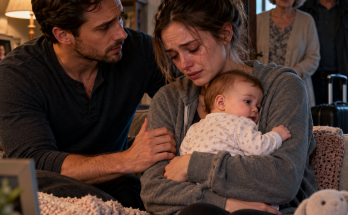
My eyes stung again. “He didn’t tell me,” I said, more to myself than to her. “For years. He carried all of this and never…”
Teresa’s expression softened. “Sometimes people hide the things they build for others because they’re afraid,” she said. “Afraid it won’t be enough. Or afraid that if they share it too soon, someone will take it away.”
I thought of the black sedan, of Victor’s red, furious face.
“Yes,” I murmured. “He was afraid of that, too.”
Teresa studied me for a moment, then glanced toward the far corner of the greenhouse, where a door led out toward a shabbier part of the property. “There’s something else you should see,” she said. “He told me to show you if your brothers-in-law ever started… circling.”
“Circling?” I repeated with a wry smile.
“That was my word, not his,” she admitted. “He used… less polite terms.”
Curiosity flared again, stronger than the fear. “Alright,” I said. “Show me.”
We crossed the garden toward a weathered tool shed I hadn’t noticed from the house. It sagged slightly on one side, its wooden boards gray and rough with age. The roof was patched in places with sheets of corrugated metal, and a rusted wheelbarrow leaned against one wall.
“That’s the point,” Teresa said. She moved to the back corner of the shed, where several heavy crates were stacked. Gripping the top one, she heaved it aside with a grunt, revealing a section of concrete floor with a large, square outline.
A trapdoor.
My pulse sped up.
Teresa pulled a key from her pocket—smaller than the ridge gate key, but similar in its sturdy, old-fashioned design—and knelt to fit it into a recessed lock. With a creak that sounded like it hadn’t been used in a while, the hatch lifted, revealing a steep, narrow staircase descending into darkness.
She flicked on a flashlight and gestured. “After you.”
Under normal circumstances, I might have balked at walking into a hidden underground room on my own property, guided by a woman I had met five minutes ago. But somehow, in the context of everything else, it felt almost logical.
I descended slowly, one hand on the cool, concrete wall. The air grew cooler, the scent changing from earth to something more metallic and faintly electric.
At the bottom, Teresa reached past me and flipped a switch.
Fluorescent lights flickered on with a low hum, revealing a room that made my breath catch.
It wasn’t large—maybe twenty by fifteen feet—but it was packed.
Maps covered one wall, pinned up in overlapping layers. I stepped closer and realized they were surveys of Blue Heron Ridge and the surrounding area. Property boundaries were drawn in thin black lines. Some sections were circled in red. Others were shaded, annotated with notes in Michael’s handwriting.
PHASE 2 EXPANSION, read one scribble. GOLF COURSE CORRIDOR, another. EASEMENT PATH—TARGET.
A long steel table ran down the center of the room, littered with binders, notebooks, and stacks of printed emails. A corkboard on the opposite wall held photographs, newspaper clippings, and sticky notes.
It looked like a war room.
“My husband did all this?” I asked softly.
“For the last few years of his life, yes,” Teresa replied. “He spent a lot of nights down here. Even more after the Summit Crest people started sniffing around and your brothers-in-law came by with questions. He’d come up from the city on weekends, disappear into this room after midnight, then stumble out at dawn looking like he’d aged ten years.”
I moved to the table, my fingers skimming over the spines of the binders. Each was labeled: SUMMIT CREST – FINANCIALS. V. QUINN – OFFSHORE ACCOUNTS. PEARCE DEV. HOLDINGS. N. QUINN – DAMAGES.
“Summit Crest has been buying land around here for years,” Teresa explained, leaning against the wall. “Most of the locals sold. Hard to turn down that kind of money, especially when they frame it as inevitability. ‘Sell now, while you can still get something for it.’ That sort of thing.”
“But Michael didn’t sell,” I said.
“Oh, they tried,” she said. “Sent their reps. Called. Even had one of the slick suits show up in person. But Michael was stubborn. And he had history here. He started digging, and what he found…” She gestured to the binders. “Let’s just say, none of it was pretty. Summit Crest’s development plan depends heavily on your land, Mrs. Quinn. Without it, their entire Phase 2 collapses.”
“And my brothers-in-law?” I asked, eyeing the binders with their names.
“Your husband discovered some creative accounting on their part,” Teresa said carefully. “Shell corporations. Funds siphoned from your parents’ estate. They used company money to cover personal debts. If the right people see these documents, there would be… consequences.”
I exhaled slowly.
Michael hadn’t just built a sanctuary for us.
He’d built a weapon.
My phone buzzed loudly in my pocket, making me jump. The screen lit up with Sophie’s name.
My heart, already battered by the day, constricted.
“Hey, sweetheart,” I said, putting the call on speaker so Teresa could hear in case it mattered.
“Mom,” Sophie said, her voice tight with a mixture of anger and confusion. “Why didn’t you tell me Dad had some secret mountain property? I just got a call from Uncle Victor. He says you’re up there and you’re… confused. That we should all be working together to make sure the inheritance is handled fairly. He suggested we meet tomorrow with some investors. He said if I sign a few papers, it’ll help secure my future. What is happening?”
Teresa’s lips thinned. “They move fast,” she muttered.
“Sophie, listen to me,” I said, my voice sharper than I intended. “Do not sign anything. Do not meet them alone. Do you understand?”
“Mom,” she protested. “If there’s a lot of money involved, don’t I at least have a right to know what’s going on? I’m not a kid anymore.”
“You absolutely have a right to know,” I said, forcing myself to lower my tone. “And I will tell you everything. I promise. But your uncles are not acting in your best interest. They are trying to use you to get to this property. Your father knew this might happen. He left messages for both of us. I need you to trust me for twenty-four hours. Can you do that?”
There was a pause. I could almost hear her thinking, could picture her pacing in her small off-campus apartment, her hair twisted around one finger, biting her lip.
“Twenty-four hours,” she said finally. “Then we talk. All of it. No more secrets.”
“No more secrets,” I agreed, the words tasting both heavy and necessary.
“How I want to play this,” I echoed, glancing around the room. Maps, files, evidence. It felt like stepping into the middle of a chess game where half the pieces had already been moved by someone else. “I’m not a strategist. I’m a scientist. A teacher.”
“Then treat it like research,” Teresa said. “You have data. Use it.”
Despite everything, a small, fierce smile tugged at the corner of my mouth.
Michael had always said that about my work. “You see patterns other people miss,” he’d told me once, when I’d stayed up all night analyzing a dataset. “That’s your superpower.”
Maybe it was time to apply that to more than the flowering cycles of rare plants.
The next day, I met Sophie at a small café in town—a neutral ground halfway between her campus and the mountain.
She arrived five minutes late, which was early by her standards, walking in with her bag slung over one shoulder, her brow furrowed. She spotted me immediately and crossed the room, dropping into the seat across from me.
Her eyes—Michael’s eyes, the same shade of warm brown—were wary.
“Okay,” she said, pushing her hair back. “I’m here. Talk.”
I looked at her, really looked at her, and the weight of what I was about to say settled on me like a physical thing. Sophie had always been perceptive. She’d suspected for a long time that there were things Michael wasn’t telling us, particularly toward the end when he’d grown more introspective, more distant in a way that wasn’t entirely attributable to illness.
“You know how Dad came from money,” I began. “At least, more money than we ever had.”
She rolled her eyes slightly. “Please. The stories about Grandpa’s company and the estate were like family myths. The Great Quinn Fortune.”
“Right,” I said. “What you don’t know is that when your grandparents died, your father’s share of that fortune was… stolen, essentially.”
Her eyebrows shot up. “What?”
“Your uncles forged documents,” I said simply. There was no point sugarcoating. “They diverted assets that should have gone to your father into their own accounts, using shell companies and fraudulent filings. When your father discovered it and threatened to take it to court, they made his life very difficult. They tried to ruin his reputation, professionally and personally. He walked away for his own sanity. He married me. He started over.”
Sophie absorbed this silently, her jaw tightening.
“And then,” I continued, “a few years before he died, he was diagnosed with a brain aneurysm. He didn’t tell us right away. He used some of that time to buy and build a house in Blue Heron Ridge. He poured his money into it. Not because he wanted a vacation home, but because he wanted a place that was completely separate from his brothers. A place that couldn’t be touched by anything they had done.”
I reached into my bag and pulled out the tablet I’d brought, already queued up. “He also made these.”
I turned the screen toward her and hit play.
Her father’s face appeared—alive, laughing a little awkwardly as he adjusted the angle. “Hey, sweetheart,” he said, the affection in his tone unmistakable. “If you’re watching this, it means your mom listened to me and came to the house. Which also means I’m not there to talk to you myself. So I’m going to do something you’ve been begging me to do for years. I’m going to tell you about my family.”
Sophie’s hand flew to her mouth.
We watched together as Michael laid it all out—not just the facts of the inheritance theft, but the emotional context. How Victor had always been the golden child, the one groomed to take over the company. How Pierce had been the charmer, the risk-taker who turned other people’s money into his own ladder. How Noah, the youngest, had followed whichever brother seemed most likely to win at any given moment.
He talked about the night they’d pushed him into signing documents he didn’t fully understand, then used those signatures as cover for their own fraud. He talked about the fear of going up against them in court, knowing they had far more resources and fewer scruples. He talked about deciding, after weeks of stress and arguments, to walk away—not because he didn’t care about the money, but because he cared more about his sanity and, later, about the family he was building with us.
“Don’t let them twist loyalty into greed,” he said in the video, his eyes glassy. “Family is not defined by who shares your blood. It’s defined by who protects your heart.”
When the video ended, Sophie sat very still.
Tears streaked her cheeks.
“So when they called me,” she said softly, “they were trying to finish what they started.”
“Yes,” I said. “They see this house, this land, as a loose end. And now, with Summit Crest’s development looming, they see dollar signs. They also know that you, as Michael’s daughter, might be a weak point. A way to pressure me.”
She sniffed and wiped her nose with the back of her hand, then let out a shaky laugh.
“They don’t know me very well,” she said.
I smiled, pride swelling in my chest. “No,” I agreed. “They don’t.”
“So what do we do?” she asked, leaning forward. “We can’t just let them take everything Dad worked for. And we can’t just hand it over to some resort company either, can we?”
“No,” I said. “We can’t. What we can do is use what your father left us.”
I outlined the plan that had been forming in my mind over the past twenty-four hours, honed by late-night reading in the bunker, phone calls with Daniel, and conversations with Teresa. Sophie listened intently, her eyes brightening with a fire I hadn’t seen in her since before Michael’s illness.
“We don’t fight on their terms,” I said finally. “We fight on ours.”
The next morning, Blue Heron Ridge felt different.
Daniel arrived with an assistant, both loaded with additional files and legal pads. Sophie sat at my right hand, Michael’s old watch on her wrist, its face scratched and worn.
Teresa moved quietly in the background, bringing coffee, arranging chairs, occasionally offering a piece of practical advice that landed with surprising strategic weight. At one point, she said, “If they start yelling, lower your voice. People lean in to hear the quietest voice.” I filed that away like a weapon.
I had also made one more phone call the previous evening—to a number I’d found in the Summit Crest folder, next to a name underlined several times.
Evan Carr, CEO.
He had picked up on the second ring. His voice was smooth, practiced, with a hint of impatience.
“Mr. Carr,” I’d said, “my name is Naomi Quinn. I believe my husband’s property in Blue Heron Ridge is causing you some complications.”
There’d been a pause, then a shift in his tone as he realized who I was. “Mrs. Quinn,” he’d said. “Yes, your late husband’s estate is… a pivotal piece of our expansion plans. I’m very sorry for your loss, by the way.”
“Thank you,” I’d replied. “I’d like to invite you to the house tomorrow morning at ten. My in-laws will be there, as well as my attorney. I think it’s time we all had a very frank conversation.”
Another pause. Then, to his credit, he’d said, “I’ll be there.”
At exactly ten, tires crunched on the gravel.
This time, the black sedan returned with a second car behind it—a sleek silver one that practically screamed corporate executive. Victor, Pierce, and Noah emerged, dressed more formally than the day before—suits, ties, polished shoes. With them was a man in his sixties, carrying a leather briefcase, his hair silver and perfectly combed.
“Our lawyer,” Pierce said when I raised an eyebrow.
“And that must be Summit Crest,” Daniel murmured under his breath as a tall man in a dark suit stepped out of the second car. He carried himself with a certain effortless confidence—the kind of man used to having doors opened for him. His eyes took in the house, the grounds, and us in one sweeping glance.
“Mrs. Quinn,” he said as we met them on the porch. “I’m Evan Carr.” He extended a hand. His grip was firm. “Thank you for inviting me.”
“Thank you for coming,” I said. “Let’s go inside.”
In the great hall, the contrast between the orchid paintings and the papers laid out on the table was stark. My husband’s two worlds—the artist and the strategist—converged in that room, and for once, I felt firmly planted in both.
Victor was the first to speak once we were all seated.
“Naomi,” he began, plastering on a smile that didn’t reach his eyes. “Look, there’s no need for all this tension. We’re family. We all loved Michael. We just want to make sure that his legacy is handled in a way that benefits everyone.”
“By ‘everyone,’ you mean you,” I said calmly.
His smile flickered. “We mean the Quinn family,” he corrected. “You married into that. So did Sophie. This estate has been part of our family’s future for decades. Michael knew that. It’s why he built here in the first place. If you just sign over a portion of the ownership, we can present a united front to Summit Crest. We all profit. Nobody goes to court.”
He gestured toward the window, where the ridge rolled away in green waves. “This land is more valuable than you realize, Naomi. You could spend the rest of your life as a very wealthy woman.”
I glanced at Sophie, who suppressed an eye roll worthy of an Olympic medal.
“Feel free to correct me if I’m wrong, Mr. Carr,” I said, turning to the Summit Crest CEO, “but from what I’ve read, this particular parcel is more than just valuable. It’s essential. Without it, your Phase 2 expansion—golf course, luxury villas, the whole thing—falls apart. The terrain doesn’t support your design anywhere else. You’ve already sunk a lot of money into infrastructure on the assumption that you’d acquire this land, haven’t you?”
“My husband did,” I corrected. “I’m just reading the notes.”
I picked up the remote and clicked. The projector hummed to life, casting a map onto the far wall. It was one of the surveys from the bunker, overlaid with Summit Crest’s own planning documents. Colored lines indicated roadways, building sites, water lines. A large swath ran directly through the section labeled QUINN ESTATE.
“In case anyone here is still under the illusion that we’re talking about a nice little vacation home,” I said, “let me dispel that. This isn’t just sentimental real estate. It’s the lynchpin to a multi-million dollar corporate strategy and a long-standing family dispute.”
I clicked again. The slide changed to a series of bullet points summarizing, in broad strokes, the evidence Michael had gathered of his brothers’ financial activities—the shell companies, the creative accounting, the siphoning of funds.
“This,” I said, placing a neat stack of copied documents in the center of the table, “is a summary of your previous misdeeds. Forged signatures. Misappropriated funds. Tax evasion. It’s not exhaustive, but it’s damning. If we go to court over this property, all of this becomes public record. I suspect neither your businesses nor Summit Crest would enjoy that kind of publicity.”
The brothers’ lawyer shifted uncomfortably in his seat, flipping through the top pages. His frown deepened with each one.
“No one is accusing anyone of anything—” Victor began.
“Oh, I am,” Sophie interrupted, her voice clear and steady. All eyes turned to her. She looked suddenly much older than her twenty years. “You stole from my father. You spent years pretending it was his fault that he walked away, when in reality, he was the only one honest enough to leave. You don’t get to come here now and talk about ‘family legacy’ like you’re doing us a favor.”
Her hands trembled slightly on the table, but her gaze was unwavering.
“You did this once,” she said. “You’re not doing it again.”
Silence followed, thick and charged.