“Connor.” Her voice was a syrupy blend of relief and accusation. “Oh, thank God. I was so worried. The police said you were okay. But I had to hear it from you. Why would you scare me like that?”
I took a deep breath, focusing on keeping my voice as flat and emotionless as possible.
“I’m fine, Mom. I’m calling about something else.”
“Oh yeah?”
“I was just looking at my credit report. Funny thing says I have two new credit cards, a Capital One and a Chase.”
There was a brief pause on the other end, a tiny crack in her facade.
“Oh, that,” she said, her voice a little too casual. “I was going to tell you about that.”
“You were?” I asked, my voice dripping with false curiosity.
“When I was helping you,” she said, the confidence returning to her tone. She was shifting into her familiar role as the martyr, the mother who only ever does what’s best for her ungrateful children. “You’re young. You need to build your credit history. A good credit score is very important for your future.”
I almost choked.
“You think opening two cards and maxing them out on party supplies is building my credit?”
“Don’t be so dramatic, Connor,” she scoffed. “It’s for your sister. It is for the family. You should be grateful you’re in a position to help pay for Ava’s sweet 16. We’re a family. It’s family money. What’s yours is ours.”
That was it. The line. The core of her entire twisted philosophy. The words that had governed my entire life.
What’s yours is ours.
My own voice came out colder than I expected.
“No, Mom,” I said slowly, enunciating each word. “What’s mine is mine, and what’s yours is currently under criminal investigation.”
The silence that followed was the most satisfying sound I had ever heard. It was heavy, complete, and filled with the dawning horror of her realization. She had walked right into the trap.
“What? What did you just say?” she stammered.
“I said I’m talking to the bank’s fraud department, and they take this sort of thing very seriously. Identity theft is a felony, Mom.”
She started sputtering. The confident matriarch replaced by a panicked mess.
“You wouldn’t. You wouldn’t do that to your own mother. You’re destroying this family over a misunderstanding.”
“No,” I said, and a strange calm settled over me. “You destroyed it the moment you decided my name was worth more to you than your son.”
I hung up the phone.
I looked at my phone screen. The little red light indicated the call had been recorded. I saved the file. I named it evidence.
And for the first time in a long time, I felt like I had some power back. She had given me the knife. And now I just had to decide when and where to use it.
The next 24 hours were a blur of calculated moves. I was no longer the emotional, wounded son. I was a strategist. My apartment became a war room. The target was no longer just survival. It was justice.
First, I went to the police station. I filed a formal report for identity theft. I gave them the names on the accounts, the transaction histories I had printed out, and the contact information for Evelyn Hayes at the bank. I didn’t give them the recording yet. That was my ace in the hole, and I wasn’t going to play it until the stakes were highest.
Next, I called my dad. His number was still blocked, so I used a friend’s phone.
His voice was weary when he answered.
“Dad,” I said, skipping the pleasantries, “I need to talk to you, Mom, and Ava, together in person.”
“Connor, your mother is a wreck,” he sighed. “She said you’re accusing her of terrible things.”
“I’m not accusing her of anything she didn’t do,” I said flatly. “I have proof. We can either discuss this as a family first, or we can let the police and the banks handle it from here on out. Your choice.”
The threat worked. He agreed immediately.
We decided to meet at a neutral location, a quiet, generic diner halfway between my apartment and their house, a place with vinyl booths and bad coffee where no one could scream without making a scene.
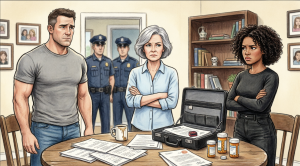
Before the meeting, I laid everything out on my coffee table. The printed bank statements with the fraudulent charges highlighted in yellow, a copy of the police report, the case number circled in red. I made sure the audio file of my conversation with my mother was saved to my cloud storage and easily accessible on my phone.
Then I called Leo, my one true ally. He had been my friend since college, the one person who had seen the dynamic in my family for what it was. He was the one who sat with me for hours after my college graduation, getting me drunk and letting me rage about the non-refundable weekend trip.
“Are you sure you want to do this, man?” he asked, his voice full of genuine concern. “You know how she is. She’ll twist everything.”
“I know,” I said, looking at the pile of evidence on my table. “But this time, I have receipts. Literally. I just need to see their faces when they realize I’m not backing down. I need to do this for myself.”
“All right,” he said. “Call me the second you’re out of there. And Connor, don’t let them get in your head. Remember what they did. Remember the empty chairs.”
I hung up.
I felt a strange sense of calm. I was nervous, yes, but it was the nervousness of a soldier before a battle they have prepared for. I had my armor. I had my weapons. I had the truth on my side.
For 16 years, I had played their game by their rules. Tonight, they were going to play mine.
I gathered my files, put them into a crisp manila folder, and walked out the door, feeling for the first time like I was the one in control.
The diner smelled of stale coffee and grease.
My family was already there, huddled in a corner booth. My mother, Eleanor, was dabbing at her dry eyes with a napkin, putting on a performance for an audience of one. My sister, Ava, was slouched against the window, staring at her phone, completely oblivious and uninterested. My dad, Richard, just looked exhausted. A man caught in a crossfire he had spent two decades avoiding.
I slid into the booth opposite them.
“Thanks for coming, Connor. This is insane,” my mother began immediately, her voice a theatrical whisper. “Telling the bank I’m a criminal, filing a police report. After everything I’ve done for you.”
I didn’t take the bait. I simply opened the manila folder and slid the first document across the table, the Capital One statement. I pushed a yellow highlighter with it.
“Page two. The charge for $1,200 to Ava’s Enchanted Sweet 16. Did I authorize that?”
She glanced at it and pushed it away.
“I told you, I was building your credit.”
I slid the next document over. The Chase statement.
“What about these? The charges at Macy’s and Nordstrom. Was that building my credit too, or were you just building Ava’s birthday wardrobe?”
For the first time, Ava looked up from her phone. A flicker of interest in her eyes.
My mother’s face flushed.
This is where my father finally spoke up. He picked up the statements, his brow furrowed. He looked at Eleanor, and for a fleeting, beautiful moment, I saw a spark of anger in his eyes.
“Eleanor,” he said, his voice low. “Did you do this? Did you open credit cards in his name?”
My heart leaped.
This was it. This was the moment he finally stood up. The moment he finally chose his son. The moment the tide would turn.
Eleanor’s face crumpled. The crocodile tears she had been faking before now seemed real.
“I… I did it for Ava,” she sobbed, reaching for his hand. “I just wanted her to have one perfect day. Connor has a good job. He has his whole life ahead of him. I thought… I thought he wouldn’t mind. I did it for the family.”
I watched my father’s face. I saw the anger melt away, replaced by his familiar, spineless pity. He looked from his crying wife to me, his face a mask of conflict.
“Connor,” he said, his voice pleading, “look, she made a mistake, a big one, but she did it out of love. Can’t you just call the bank? Tell them it was a misunderstanding. We’ll pay you back every penny. You’re tearing this family apart over some money.”
And there it was. The final betrayal.
It wasn’t loud or violent. It was quiet, pathetic, and utterly devastating. He had seen the truth laid out in black and white, and he had still chosen the lie. He had chosen the path of least resistance. He had chosen her.
In that moment, any lingering hope I had for a relationship with my father died. He wasn’t a victim of my mother’s manipulation. He was her willing accomplice, her enabler. He was the warden who kept the prison doors locked from the inside.
A cold, hard clarity washed over me.
I wasn’t there to save my family. My family was beyond saving. I was there to save myself.
I looked at my father, at the man who had just failed his son for the last time.
“It was never about the money, Dad,” I said, my voice devoid of all emotion. “And you still don’t get that?”
My father flinched at the coldness in my voice. My mother, sensing she had won him over, pressed her advantage. She sat up a little straighter, the tears magically drying up.
“See, Richard,” she said, her voice dripping with vindication, “he’s being cruel. He enjoys this. He wants to see his own mother in trouble.”
She turned her venomous gaze on me.
“You always were a dramatic, ungrateful child.”
I just looked at her. I let her words hang in the air. Let my father absorb them. Let Ava hear them. I let the silence stretch, becoming heavy and uncomfortable.
My mother’s smug smile started to fade, replaced by a flicker of uncertainty. She was used to me yelling, arguing, pleading. This quiet, calm version of me was unnerving to her.
“I was hoping it wouldn’t come to this,” I said softly, reaching into my pocket. “I was hoping that seeing the proof in black and white would be enough for you to finally tell the truth, to apologize, but you just can’t do it, can you?”
I pulled out my phone. My thumb hovered over the screen.
“You didn’t just make a mistake, Mom. You committed a felony. And you were so proud of it, you even confessed.”
Her face went pale.
“What are you talking about?”
“I’m talking about our phone call yesterday,” I said. “The one where I asked you about the credit cards.”
I hit play.
The small speaker on my phone was surprisingly clear in the quiet diner. My own voice, calm and questioning, filled the booth first. Then came my mother’s.
“I was helping you,” her recorded voice chirped, oozing false sincerity. “You need to build your credit history.”
My father’s eyes widened. He stared at my mother, his mouth slightly agape.
“Don’t be so dramatic, Connor,” the recording continued, her voice full of condescending arrogance. “You should be grateful you’re in a position to help pay for Ava’s sweet 16. We’re a family. It’s family money. What’s yours is ours.”
That line hit the air like a physical blow.
My father visibly recoiled. Ava, for the first time, looked up from her phone, her eyes wide with shock. She was finally listening.
I let the recording continue all the way to my final cold statement.
“What’s mine is mine, and what’s yours is currently under criminal investigation.”
The silence that followed the recording was absolute. A family of four, frozen in a tableau of disgrace. The only sound was the distant clatter of dishes from the kitchen.
My mother stared at the phone on the table as if it were a venomous snake. Her face had gone from pale to a blotchy, furious red. The mask of the caring, martyred mother had been incinerated, leaving only the ugly, raw face of a con artist who had just been caught.
“You… you recorded me,” she whispered, her voice trembling with rage. “That’s illegal.”
“In our state, it only requires one-party consent, and I consented,” I said calmly, reciting the fact I had looked up an hour before the meeting. “I knew you would lie. I knew you would twist it. So, I let you bury yourself. And you did.”
I looked at my father.
He wouldn’t meet my eyes. He was staring at his wife with a look of horrified disillusionment I had never seen before. He finally saw her. He finally saw the woman I had been dealing with my entire life.
I stood up, my legs feeling steadier than they had in years.
“I’m done,” I said, my voice clear and strong. “I have given this recording to the bank. They’re moving forward. I suggest you find a very good lawyer. You’re going to need one.”
I left the folder of evidence on the table. I didn’t need it anymore.
I turned and walked out of the diner, not looking back. The weight of their world was no longer on my shoulders. It was their problem now. All of it.
I didn’t go to my sister’s sweet 16.
Obviously.
The day of the party, I did something I hadn’t done in years. I turned my phone off, drove out to a state park, and went for a long hike. I just walked for hours, listening to the sound of the wind in the trees, feeling the sun on my face.
I was trying to reconnect with myself, the person I was before I became the family ATM, the family disappointment, the family detective.
As I was driving home that evening, I turned my phone back on. It exploded with notifications, missed calls, and frantic texts from my father, my aunt, my cousins. I ignored them all.
But then an email caught my eye. It was from Evelyn Hayes at the bank. The subject line was simple: Update on case number 7345.
Dear Mr. Reed.
The email read, “As per our protocol in active fraud investigations involving large vendor payments, we dispatched a field agent accompanied by local law enforcement to the venue of the event to verify the services rendered. They arrived at approximately 7:30 p.m. this evening. We will be in touch with further updates.”
I had to read it twice.
They sent a bank agent and the police to the party. To the actual party.
A slow smile spread across my face. I hadn’t asked them to do that. I hadn’t even known it was a possibility. It was just bank policy. It was the cold, impersonal, beautiful logic of a system designed to protect itself.
Later, I got the full story in bits and pieces from a cousin who had been there.
The party was in full swing. The venue was draped in pink and silver. A DJ was playing. Ava was in her brand new, illegally funded dress, holding court with her friends. My parents were playing the role of proud, generous hosts.
And then two uniformed police officers and a man in a sharp suit walked in.
They didn’t make a scene. They were quiet, professional. They walked directly to my father and asked to speak with him and his wife in private. But in a room full of a hundred people, private doesn’t exist.
The music faltered. Conversations died down. Everyone stared.
My cousin said you could see the color drain from my mother’s face.
The man in the suit, the bank agent, started asking questions about the credit card used to pay for the venue. He used words like fraudulent account and identity theft. The guests couldn’t hear everything, but they heard enough. The whispers started to ripple through the crowd.
The party, which was supposed to be the crowning achievement of my mother’s social calendar, the ultimate testament to her perfect family, had just become a crime scene.
The DJ, sensing the mood had shifted from celebration to public humiliation, quietly packed up his equipment. Guests started making awkward excuses and slipping out the door. Within 30 minutes, the grand ballroom was nearly empty.
Ava was reportedly in tears, not because of the fraud, but because her perfect party had been ruined.
My mother, for once, was speechless. Her reputation, the thing she valued more than her own son, was being dismantled in front of all her friends. There was no way to spin this. There was no way to play the victim.
The truth had shown up uninvited, and it had shut the whole party down.
It was a spectacular karmic implosion. And the best part? I had nothing to do with it. I was miles away, breathing fresh air. All I did was tell the truth.
The consequences, for once, had landed on the right doorstep.
This is the moment that changed everything. The moment I finally took back control of my life.
Thank you for sticking with me this far. You guys are awesome. If you could, please help me out by liking this video and commenting the number one down below, just so I know you made it here with me. It doesn’t just help more people find this story. It lets me know that my experiences mean something to someone out there. Your support is the biggest motivation for me to keep sharing the rest of this journey.
The days following the party were a storm of voicemails and texts. Most of them were from my father. His tone had shifted from pleading to outright desperation. The public humiliation had done what my private pain never could. It had made the problem real for him.
I let his calls go to voicemail for two full days. I needed the silence. I needed to let the dust settle in my own head before I engaged with their chaos again.
Finally, on the third day, I saw a call coming in from him and, on an impulse, I answered. I put it on speakerphone. I wanted to be able to walk away if I needed to.
“Connor, thank God,” he said, his voice raspy. “Son, you have to stop this. You have to call the bank and tell them it was all a misunderstanding.”
I was silent for a moment, listening to the sheer panic in his voice.
“There is no misunderstanding, Dad,” I said calmly. “She stole my identity. That’s a crime. It’s not a family squabble.”
“Your mother, she’s not eating. She’s not sleeping. She’s a mess. The bank is demanding full repayment immediately or they’ll press charges. We don’t have that kind of money, Connor. Not after the party.”
The irony of that last statement was so thick I could have choked on it.
“That sounds like her problem,” I said. “She bought the ticket. She gets to take the ride.”
“This is destroying us,” he yelled, his voice cracking. “Is that what you want? To destroy your own family?”
And that’s when the last bit of sympathy I might have had for him evaporated. He still didn’t get it. He wasn’t calling to apologize. He wasn’t calling to ask how I was. He was calling to perform damage control. He was calling to try and shove the genie back in the bottle, to get me to go back to my designated role, the family shock absorber.
“Let me be very clear, Dad,” I said, my voice hard as steel. “The family was already destroyed. It was destroyed every time you stood by and watched her use me as a bank account. It was destroyed every time you let her prioritize a party over my graduation. You didn’t have my back then, and I certainly don’t have yours now. This is the consequence of your actions. Both of you.”
He started to argue, to bring up the past, to talk about the good times that I honestly couldn’t remember.
I cut him off.
“I am not setting myself on fire to keep you warm anymore. This conversation is over. Don’t call me again.”
And I hung up.
I immediately blocked his number again. It felt different this time. It wasn’t an act of anger. It was an act of finality. A boundary drawn not in sand, but in concrete. The door was closed. The lock was thrown. And for the first time, I felt truly, completely, and blessedly free from the obligation of their mess.
With the emotional ties severed, dealing with the logistical fallout was surprisingly easy. It was just a series of tasks, a checklist for my new life.
Evelyn Hayes from Capital 1 was a godsend. She walked me through the final steps. Because I had filed a police report and provided the recording, the bank’s case was airtight. They officially designated the accounts as fraudulent. The nearly $2,500 of debt was wiped from my name. It was transferred into a collections account under my mother’s name. She was now legally obligated to pay it back in full.
Whether she did or not was no longer my concern.
The real cleanup, though, was fortifying my own life against any future intrusions. I placed a freeze on my credit with all three major bureaus, Equifax, Experian, and TransUnion. This meant no one, not even me, could open a new line of credit in my name without going through a complicated verification process. It was a digital fortress, and I was the only one with the key.
I went to my bank and closed the checking account I had held since I was 16. It was the account my mother was linked to as a co-signer when I was a minor. I had never bothered to change it. I opened a new account at a completely different bank, ensuring there were no residual ties, no forgotten permissions that could give her a backdoor into my finances.
The social fallout for my family was, from what I heard, swift and brutal. The story of the party-turned-police visit spread like wildfire through their social circle. The Hamiltons, old family friends who had been at the party, were apparently telling everyone.
My mother, who had built her identity around being a pillar of their suburban community, was now a pariah. People she had known for years were suddenly crossing the street to avoid her.
I felt a strange sense of detachment from it all. It wasn’t joy or schadenfreude. It was just closure. It was the natural, logical end to a story of deceit. Actions have consequences. It was one of the first lessons you learn as a child, a lesson my parents had somehow managed to avoid their entire adult lives.
It seemed the universe had finally decided it was time for them to get a crash course, and I was no longer willing to be the one to bail them out of class.
6 months can feel like a lifetime.
6 months after walking out of that diner, I was living in a different world. It wasn’t just that I had moved to a new apartment in a different part of the city. It was that I was breathing different air.
After years of sending my money home, I finally had savings. Real savings. It allowed me to quit my dead-end data entry job and focus all my energy on finding a career that utilized my master’s degree.
3 months later, I landed it. A position as a junior data analyst at a tech firm called Nova Data Labs.
The first time I got my salary deposit, I just stared at the number in my bank account. It was more money than I had ever seen in one place. My first instinct, born of years of conditioning, was a jolt of anxiety.
Mom will be calling soon. What’s the new emergency?
Then came the wave of relief. The phone wouldn’t ring. The money was mine. All of it.
My new boss was a man named Mr. Sterling, the CEO of the company. He was everything my father wasn’t. Decisive, fair, and he valued competence above all else.
During my 3-month review, he called me into his office. I was terrified I had done something wrong.
“Connor,” he said, leaning back in his chair, “your work on the quarterly projections was outstanding. You didn’t just run the numbers. You found a narrative in them. You identified an inefficiency that’s going to save this company a lot of money.”
He smiled.
“I’m giving you a promotion. You’re leading the new analytics team for the marketing department.”
I was speechless.
A promotion. After 3 months.
I had spent 28 years trying to earn a single I’m proud of you from my own family and gotten nothing. And here, a near stranger was recognizing my value, rewarding my hard work, and trusting me with responsibility.
It was a form of validation so pure and professional that it felt more meaningful than any familial approval I had ever craved.
My life started to fill with genuine connections. I reconnected with friends I had neglected while I was buried in work and family drama. Leo and I started a weekly tradition of grabbing a beer and just talking about work, about dating, about nothing at all.
I even started seeing a therapist, someone to help me unpack the years of emotional baggage. It was hard work untangling all the knots of guilt and obligation. But with each session, I felt lighter.
One evening, I was having dinner with Leo and he asked me if I ever missed them.
I thought about it for a moment.
I didn’t miss the anxiety, the demands, the constant feeling of being not good enough. But I realized there was a phantom limb, a dull ache where a family was supposed to be.
“I don’t miss them,” I said slowly. “But I think I’ll always be sad about what we could have been. I’m mourning the family I never had.”
It was a sad thought, but it wasn’t a crippling one. It was just a fact. A scar from a wound that had finally, after all these years, begun to heal.
Just when I thought the past was firmly in the rearview mirror, a ghost appeared.
It arrived in a plain white envelope, tucked into my new mailbox. My mother’s looping, overly ornate handwriting was on the front. My new address, my aunt Carol, the family’s resident busybody, must have given it to her.
My first impulse was to throw it away unopened. But curiosity, that old human failing, got the better of me.
I took it inside, slid it open with a kitchen knife, and unfolded the single sheet of stationery inside.
It was a letter. A two-page, rambling attempt at an apology that was, in reality, just another masterclass in manipulation.
 : PART3: “Graduation Ignored. Mom Asked For Money.”