Not everyone. I saw my Aunt Helen go still, horror sharpening her face. I saw my mother’s smile freeze into something brittle and absent. But enough people laughed. Enough that the sound reached me as one thing, one wave, one proof that humiliation can echo louder when strangers decide it is funny.
I sat there in my wedding dress while my father called my husband desperate and my life a joke.
Everything inside me went white and distant. I could hear the room, but it seemed to come from far away. My chest tightened. My hands were cold. I had spent twenty-nine years learning how to survive moments like that, and what survival looked like was not strength. It was paralysis. It was stillness. It was the old childhood instinct to disappear inside yourself until the danger passed.
I could not move.
Marcus could.
He stood slowly, the kind of slowly that draws attention without asking for it. He did not slam his hand on the table. He did not shout over my father. He did not give the room any spectacle except the one it had already chosen.
My father watched him with amusement, still basking in the afterglow of his own punchline.
“Oh, the groom wants to respond,” he said into the microphone. “By all means. This should be good.”
Marcus ignored the bait.
He crossed the reception hall toward the projector setup, reached into his vest pocket, and pulled out the USB drive that had been with him all day. The same one he had touched after the ceremony. The same one he had carried for months.
He plugged it into the laptop connected to the projector.
“Thank you, Richard,” he said. His voice was calm, clear, and steady enough to make the silence that followed feel sudden. “I do want to say a few words.”
The screen flickered to life behind him.
“But instead of talking about how desperate I am to marry your daughter, I think we should talk about what you did.”
My father’s smile slipped. Not all at once. Just enough for me to see the first crack.
“What are you doing? Please…”
Marcus lifted one hand.
“Let me finish. You’ve had your turn.”
Then he clicked.
The first slide appeared.
A scanned bank statement dated August 15, 2013. An account in my name. A withdrawal of $47,000. A transfer into an account belonging to Richard M. Foster.
The room went silent.
Not a polite silence. Not the brief pause of confused guests waiting for context. A sharp, collective vacuum. The kind that feels like the air itself has changed shape.
“This,” Marcus said, “is the college fund Dalia’s grandparents left for her education. The money that was supposed to pay for her degree.”
He clicked again.
“And this is where it went.”
My father had gone pale so quickly it was almost startling. The hand holding the microphone twitched once. He opened his mouth, then closed it. For the first time in my life, Richard Foster looked like a man who had reached for control and found nothing there.
I wish I could tell you that I stood up then, that I found my voice in some cinematic instant, that years of humiliation burned off me at once and left only clarity. That is not what happened.
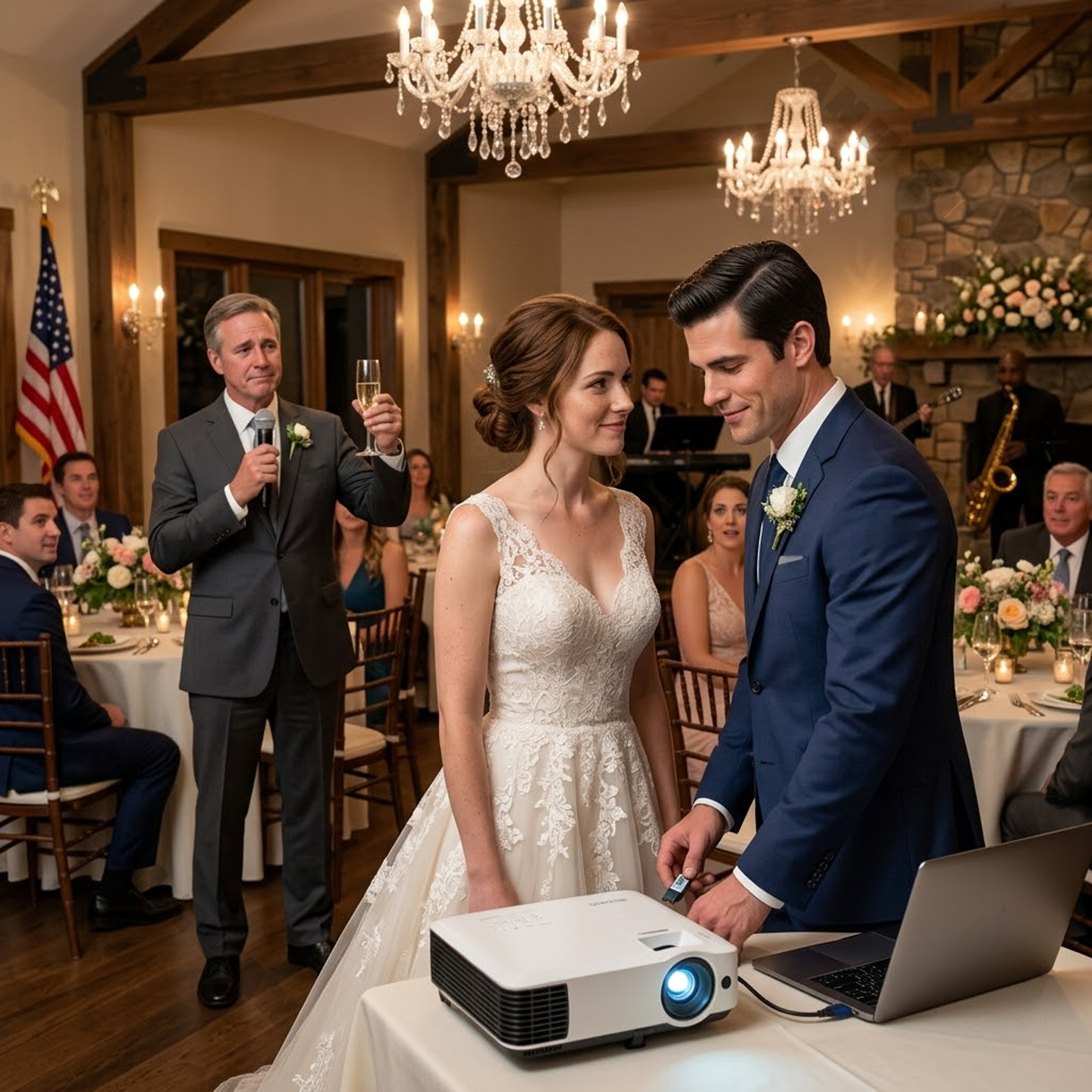
What happened was stranger and quieter. I sat frozen at first, watching my own life reframed on a screen in a reception hall in Napa Valley while 187 people stared at my father and, by extension, at me. I could feel every pulse beat in my wrists. I could feel the tight corset seams of my dress against my ribs. I could smell lilies, candle wax, and red wine. The room had never been so full and so still at the same time.
Marcus was just beginning.
The statement remained on-screen for several seconds while the room absorbed what it was seeing. The account name. The amount. The transfer. The details had been redacted where they needed to be, but the truth was still bright enough to cut through any attempt at confusion.
Then Aunt Helen’s voice filled the room through the speakers, clear and steady.
“My parents left $47,000 for Dalia’s college education. Richard told her the money was gone, that it wasn’t enough. But I found the records. He transferred every penny into his own account.”
My father moved then.
He lunged toward the laptop with a suddenness that made a woman at the nearest table gasp.
“Turn that off. This is slander.”
Marcus did not step back.
“It’s a bank statement, Richard,” he said evenly. “Bank statements aren’t slander. They’re facts.”
“I’ll sue you.”
“For showing people a document with your name on it?”
Whispers spread across the room like dry brush catching. Heads turned. Chairs creaked. Someone near the back pulled out a phone. Someone else said my father’s name under their breath in the tone people use when they have just realized a social evening has become evidence.
At one of the front tables, Thomas Brennan, my father’s biggest business partner, sat perfectly still, his heavy jaw set hard. Thomas had known my father for fifteen years. He had spent Christmases at our house. He had shaken my hand at graduation parties and once given Derek and me matching forty-dollar gift cards when we were teenagers, as if generosity were easiest in equal small doses. His distribution deal with Foster Motors was worth around $340,000 annually. Until that moment, I had always assumed men like Thomas would stay loyal to men like my father, because in the world my father built, money and loyalty often confused themselves with one another.
Marcus clicked again.
“That money was supposed to pay for Dalia’s education,” he said. “Instead, she spent the last decade paying off $52,000 in student loans. Four hundred eighty-seven dollars a month, while her father drove a Mercedes and took golf trips to Scottsdale.”
My father’s face shifted from pale to red.
“This is a private family matter,” he said, and I remember thinking even then how quickly men appeal to privacy when shame finally reaches them.
“You made it public when you picked up that microphone,” Marcus said.
Then he clicked to the next slide.
The screen changed.
Text messages appeared.
The sender name was visible.
Richard Foster.
The recipient’s identifying information was blurred, but the content was unmistakable.
Meet me at the hotel tonight.
March 2015
I’ll leave her soon. Just wait for me.
November 2016
I love you, not her.
June 2018
A champagne glass slipped from someone’s hand and shattered on the floor.
No one moved to clean it.
“These messages span six years,” Marcus said, his voice still maddeningly calm. “From 2014 to 2019. The woman in these conversations has confirmed their authenticity and provided a sworn statement.”
He clicked. More messages. More promises. More lies. Each one less surprising than the one before and somehow more brutal for that exact reason.
I can’t live without you.
She means nothing to me.
Just a little longer. I’ll leave her.
I turned to my mother.
She was standing by then. One hand pressed hard over her mouth. The other wrapped around the back of her chair so tightly her knuckles had gone white. Thirty-two years of marriage. Thirty-two years of dinners, tax seasons, holidays, church-basement charity auctions, country-club events, dealership banquets, morning coffee, and evening television. Thirty-two years of building a home around a man who had apparently lived several lives inside it.
“This is fabricated,” my father snapped, but there was something cracked in his voice now. “I’ll have you arrested for…”
“For what?” Marcus cut in. “Showing your text messages? Messages with timestamps and phone records that can be verified?”
The final slide came up.
All documents have been notarized and copies are held by legal counsel.
My father stood there with the microphone still in his hand, his carefully built image collapsing around him in real time.
My mother did not look at him.
She walked toward me.
When she reached me, she put both arms around my shoulders and held on. She was trembling.
“Thirty-two years,” she whispered into my hair. “Thirty-two years I trusted him.”
I held her in the middle of my wedding reception while all around us the room fractured into shock, calculation, discomfort, judgment, and a strange kind of relief. Because truth does not only destroy illusions. It also ends the labor of pretending.
The silence lasted only a few more seconds.
Then Thomas Brennan stood.
He was a large man, not loud but commanding in the way certain older businessmen are when they know they have spent decades being obeyed. He adjusted his jacket, looked once at the screen, once at my father, then nodded almost imperceptibly at Marcus. He took his wife’s hand and walked out of the reception hall without a word.
The doors had barely swung closed behind him before three other couples rose and followed.
From there, the unraveling quickened. Some guests remained rooted in place, stunned into inertia. Others began gathering purses, phones, wraps, and jackets. A few drifted toward my father, but not in support. Their faces wore that cautious, tightened look people get when they are silently recalculating whether association with you has become professionally inconvenient.
My brother Derek sat at the head table, motionless.
He had not defended my father. He had not defended me. He just sat there looking like someone had kicked a hole in the center of the world as he understood it. I watched him and felt something sadder than anger. He had been built inside my father’s system so completely that he did not know who he was without it.
Marcus walked toward my father and held out his hand.
For one odd second I thought, absurdly, that he was offering peace. A handshake. A truce.
Then I realized he was reaching for the microphone.
My father gave it to him.
That more than anything else told me how stunned he was. A man like my father did not surrender instruments of control unless some deeper part of him had already understood the room was gone.
Marcus turned back to the guests.
“I want to be clear about something,” he said. “I’m not desperate. I’m not settling. I’m the luckiest person in this room.”
He looked at me, and despite everything, despite the tears on my mother’s face and the tension still snapping through the air, something warm moved through my chest.
“Dalia is brilliant. She’s kind. She’s stronger than anyone I’ve ever met.”
Then he looked back at the room.
“And she has spent twenty-nine years being told she was less than enough by a man who stole from her and lied to everyone around him.”
He turned to my father.
“You had twenty-nine years to be her father. You used that time to take her money and break her down. Today is the last day you get to humiliate her.”
There are moments when the whole shape of a life shifts, not because something new happens, but because something old is finally named in front of witnesses.
That was one of those moments.
My father opened his mouth, but Marcus was already turning back to the room.
“To everyone else, I’m sorry for the disruption. If you’d like to stay and celebrate with us, you’re welcome. If you’d rather leave, we understand. Either way, dinner is paid for.”
A small, startled laugh moved through the crowd. Then another. It was the first real laughter of the night, not the laughter of complicity, but the laughter of pressure breaking.
The room began to reset itself.
Some guests left. Some stayed. Some sat back down with the dazed expression of people who had just stumbled into the most unforgettable wedding story of their lives and were not sure whether to admire, flee, or ask for more bread.
I counted later. One hundred twenty people stayed. Sixty-seven left.
My father did not leave immediately. He moved toward the exit, then paused there as if waiting for someone to call him back. My mother. Derek. One of his business friends. Anyone.
No one did.
He turned and looked over the room, and finally his eyes found mine. For a second I saw confusion on his face, not remorse but true confusion, as if he genuinely could not understand how a performance that had always worked for him had suddenly failed.
Then the confusion hardened.
“You’ll regret this,” he said. Not loud, but loud enough.
He pushed through the main doors and disappeared into the September evening.
I stood there in the aftermath and waited for guilt to hit me the way it always used to whenever peace broke around my father. I waited for the inner voice that had governed me for years to start chanting its old script.
Don’t make waves.
Don’t embarrass the family.
Let it go.
Be the bigger person.
But the guilt never came.
What came instead was air.
Breath.
Space where fear had lived for so long that I had mistaken it for part of my personality.
Marcus appeared at my side again and took my hand.
“Are you okay?”
I considered the question honestly. My father had just been publicly exposed at my wedding. My mother was in tears. My brother looked lost. My reception hall felt like the site of some social detonation. Part of the room was empty.
And yet.
“For the first time in twenty-nine years,” I said, “I think I might be.”
He squeezed my hand.
“Then let’s go cut our cake.”
And we did.
At eight-fifteen, the band started playing again. Softly at first, then with more confidence as people realized the night was not being canceled, the venue was still beautiful, the food was still warm, and life, even shattered life, insists on continuing. The servers moved carefully around fragments of glass and scattered tension. Guests began talking again in low voices. Someone made a joke about never having been to a wedding quite like this one. Someone else asked for another bottle of champagne.
My college friends found me first. Sarah, my old roommate, hugged me so tightly I almost laughed.
“We always knew something was off with your dad,” she said. “The way you’d go quiet when he called. The way you’d flinch during finals if his name popped up on your phone.”
“I wasn’t ready to hear it back then,” I said.
“But you’re here now.”
Aunt Helen came next, her eyes red, her face softer than I had seen it in years.
“Your grandparents would be proud of you,” she told me. “They always knew you were special. They just didn’t live long enough to see you stop shrinking for him.”
Then Margaret, Marcus’s mother, kissed me on both cheeks and took both my hands in hers.
“Welcome to the family,” she said. “Officially.”
There was no pity in her face. Only warmth and a kind of fierce, practical loyalty I had not known could feel so healing.
We cut the cake, three tiers of vanilla I had never wanted but suddenly did not mind. We had our first dance to one of the few songs my father had not managed to overrule. The photographer, to her everlasting credit, kept shooting through all of it. Later, she would tell me some of the most powerful photos she had ever taken came from that night, because nothing was staged anymore. Everyone’s face had been stripped back to whatever was true.
By eleven-thirty, the last guests had gone. The caterers were packing up. The fairy lights in the garden glowed against the dark. My body felt hollowed out with exhaustion, the way grief and relief together can leave you.
My wedding day had become a public reckoning.
It had also become the first day of my real life.
At eleven-forty-five, Marcus and I were finally alone in our hotel suite. I had kicked off my shoes and was sitting on the edge of the bed when I realized my phone, screen down on the nightstand, had been blinking for hours.
“How many?” Marcus asked.
I turned it over.
Fourteen missed calls from my father. Three voicemails.
“Are you going to listen?”
I played the first one.
My father’s voice exploded into the room, raw with rage.
“You ungrateful little… How dare you humiliate me in front of… I’ll make you pay for this. Do you hear me? I’ll…”
I deleted it before it finished. Then the other two.
There was a text from my mother.
I’m staying at Helen’s tonight. I need time to think.
And one from Derek.
Why didn’t you tell me first?
I stared at that message for a long time. It was so painfully Derek, even then. Not I’m sorry. Not I had no idea. Not Are you okay. Just why didn’t you protect me from what our father had done.
Marcus took the phone gently from my hand and set it back on the table.
“You do not have to answer anyone tonight,” he said. “This is still our wedding night.”
For the first time I could remember, I turned my phone off without guilt.
The fallout could wait until morning.
The first domino fell on Tuesday.
Thomas Brennan called Foster Motors and requested a meeting with my father. Derek texted me the details later, though I had not asked. The meeting lasted seven minutes.
Fifteen years of partnership. Roughly $340,000 in annual business. Gone.
“He said he couldn’t do business with someone he couldn’t trust,” Derek wrote. “Dad tried to explain. Thomas wouldn’t let him.”
By Thursday, two more partners had “paused” their contracts pending review, which is the kind of corporate language that means the same thing a slammed door means, only with nicer stationery.
The rumors traveled through Sacramento faster than I expected, though maybe I should have known better. My father’s world was built on image. Country club men. Rotary lunch tables. charity galas. dealership donors. the sort of business community that pretends to be large but is really just an ecosystem of repeated names and grudges that all ride in the same SUVs.
Richard Foster’s daughter exposed him at her own wedding.
He stole her college fund.
He had an affair for six years.
His wife left him that same night.
That last part was true.
My mother stayed at Aunt Helen’s after the wedding, then at a friend’s for two nights, and by the following weekend she had met with a lawyer. She did not announce any of this dramatically. She did not call me sobbing at midnight or ask me to make decisions for her. She simply began moving through her own shock with a terrible, quiet competence that made me understand how much of her life had been spent surviving too.
Derek called me the Friday after the wedding.
“I didn’t know about the money,” he said without preamble. His voice sounded thinner than I had ever heard it. “I swear, Dalia. I didn’t know.”
“But you knew he treated me differently.”
There was a long silence.
“Yeah,” he said. “I knew that.”
It was not an apology. Not yet. But it was the first honest sentence my brother had spoken to me in years.
October 2024 brought more truths.
My mother met with a divorce attorney, a colleague Marcus knew, and came out of the consultation carrying a legal pad full of notes and a look on her face I had never quite seen before. Not anger exactly. Not even grief in its purest form. It was something sharper. Determination, maybe. Or the expression of a woman who had finally stopped asking herself if she was imagining things.
We met for coffee that afternoon in San Francisco. She sat across from me in a navy cardigan and no wedding ring, stirring her drink long after the sugar had dissolved.
“He had gambling debts,” she said.
I set my cup down.
“What?”
“In 2013.” She looked directly at me. “Eighty-nine thousand dollars.”
The room seemed to narrow.
“That’s the year…”
“Yes,” she said. “The same year he took your college fund.”
For a second I felt nothing. Then I felt too much. It came in layers. Shock first, then anger, then a cold, old grief so familiar it almost felt childish.
“He used my inheritance to pay gambling losses?”
My mother nodded once.
“And he never told me. Not about the gambling. Not about the money. Nothing.”
Thirty-two years of marriage, and she was still discovering who she had married in pieces.
She filed for legal separation on October 18, 2024.
My father called me seven times that month. I answered once.
“You’ve destroyed this family,” he said.
He sounded tired then, which somehow made him more dangerous, not less. Exhaustion had scraped some of the polish off him and left only accusation.
“Are you happy now?”
I thought about the years of comments. The loan payments. The wedding toast. The money my grandparents had saved for me. The way he had demanded loyalty from everyone while offering none.
“No,” I said quietly. “You destroyed this family a long time ago. I just showed people what it looked like.”
He hung up.
I sat with the phone in my lap afterward and realized something that should have come to me much sooner. I had spent my entire life trying to earn approval from a man who was never going to give it, not because I lacked anything, but because he needed me to feel lacking. My smallness had always been one of the pillars holding up his size.
That realization was almost more important than the public exposure itself.
It meant the chase was over.
In November 2024, Marcus helped me draft a formal demand letter.
We kept it simple. Forty-seven thousand dollars, plus the interest I had paid on student loans that should never have existed. The total was around $58,000. The letter went out through Marcus’s firm on official letterhead, accompanied by copies of the bank statement and a summary of the evidence establishing the transfer.
My father responded through a lawyer.
“Mr. Foster categorically denies any wrongdoing and considers this matter closed.”
Marcus read the line aloud in our apartment kitchen, then gave me a look.
“He’s bluffing,” he said. “His lawyer knows the bank records speak for themselves. He’s hoping you’ll back down.”
I didn’t.
We filed a civil complaint, not a full-blown lawsuit yet, but enough to make clear this was not a threat made in anger. It was a process, and I was willing to follow it.
Three weeks later, his lawyer called with a settlement offer.
“My client is willing to settle for fifty-two thousand dollars, payable over twenty-four months, in exchange for a confidentiality agreement.”
Marcus muted the call and looked at me.
“Your decision.”
I thought about it. Fifty-two thousand was not the full amount, but it was close. Twenty-four months meant I could finally clear the debt while still in my early thirties. The confidentiality agreement, though, was a different matter.
“No gag order,” I said. “Everything else is fine.”
Marcus relayed it.
There was a long silence on the other end. Then the lawyer said he would get back to us.
The final agreement was signed on December 3, 2024. Fifty-two thousand dollars. Twenty-four monthly payments. No confidentiality clause.
The first check arrived on December 15.
I used it to pay off the remaining balance on my student loans.
When the final payment processed, I sat staring at the screen for a long time. No confetti animation. No choir of angels. Just a zero where there had once been years of obligation.
For the first time since I was eighteen, I owed nothing to anyone for becoming myself.
January 2025 was the month I had to decide what, if anything, I wanted my relationship with my father to look like going forward.
People who have not lived inside families like mine often talk about cutting contact as if it is a switch you simply flip when someone has hurt you enough. Sometimes it is that clear. Sometimes it should be. But when the person who did the hurting is also the man who once taught you to ride a bike in a cul-de-sac at dusk, who held the back of the seat while you wobbled and panicked and screamed that he was letting go too soon, your grief does not arrive in clean moral lines.
There were memories I could not entirely kill. Summer evenings in Sacramento when the heat finally broke after dinner and the sprinklers clicked across front lawns all down the block. A Fourth of July when I was maybe seven and he carried me on his shoulders so I could see fireworks over the river. A birthday cake from a grocery-store bakery when I was ten, frosted badly and perfect anyway because I had not yet learned how conditional love could become.
That is part of what makes people stay too long. Abuse is rarely every minute. Cruelty does not erase all tenderness. It simply teaches you to live on the ration of it.
Still, I knew I could not go back.
I could not sit through another holiday meal while he turned me into a joke between courses. I could not listen to one more “harmless” comment about my work, my marriage, my body, my choices, my age, my usefulness. I could not keep pretending that blood required access.
So I wrote him an email.
Dad,
I’m willing to maintain limited contact under the following conditions:
No comments about my career, my marriage, or my life choices.
No references to the wedding or what happened there.
Any meetings must include Marcus or Mom as a witness.
If you violate any of these terms, I will end contact completely.
This is not a negotiation.
Dalia
I sent it on a Tuesday morning before work, then closed my laptop and sat in silence at the kitchen table while the city outside our windows moved through its usual weekday rhythm. A garbage truck clanged somewhere below. Someone on the sidewalk laughed too loudly into a phone. A bus sighed at the curb. It struck me then that there was something almost holy about the ordinariness of the morning. I had spent so much of my life treating confrontation with my father like weather, like some giant atmospheric event that would have to rupture the whole sky. But the truth was that major changes often happen while coffee cools and neighbors walk dogs and someone in another apartment burns toast.
Two weeks later, he replied.
Fine.
That was it.
No apology. No recognition of what he had done. No curiosity about whether I was okay. No acknowledgment of the years behind my boundaries. Just one curt word, the same kind of word a man might text a contractor about a gate repair.
Oddly, it was enough.
Not because it gave me closure. It did not. But because it confirmed what I had needed to understand for years: that I was never going to receive from him what I had once waited for with such humiliating hope. No breakthrough. No confession. No transformed father rising at last from the wreckage of his ego.
The boundary was not about repairing our relationship.
It was about protecting me inside the reality of who he already was.
Once I understood that, I felt something in me unclench.
March 15, 2025, my mother’s divorce was finalized.
California is a community property state, which meant she walked away with half of everything, approximately $2.1 million in assets, including the house she had spent thirty-two years turning into something warmer than the man who paid for it deserved. She sold it within a month.
“Too many memories,” she told me when I asked.
That was all she said, but I understood. The house had been beautiful in the way large suburban houses often are, all vaulted ceilings and curated artwork and polished countertops and carefully maintained landscaping. But beauty cannot undo the memory of years lived inside tension. There are homes where the air itself seems trained to listen for footsteps.
She bought a small apartment in San Francisco, fifteen minutes from ours if traffic behaved, twenty-five if the city was being itself. It had bay windows, a narrow galley kitchen, and floors that creaked in charming rather than alarming ways. There was a bookstore on the corner and a café across the street where the barista learned her name within a week.
We started having lunch together every Sunday.
At first the lunches were tentative. We were not used to each other outside the gravity field of my father’s moods. Conversation came in careful loops. Recipes. Work. Weather. The latest weird thing Aunt Helen had texted. A show she was watching. The peculiar joy she took in choosing furniture for a place no man had any authority over. But slowly, over bowls of soup and shared desserts and long walks through neighborhoods smelling of eucalyptus and coffee and bus exhaust, we became something we had never fully been allowed to become before.
Just a mother and daughter.
Not allies by necessity. Not women triangulating around a difficult man. Not two people silently translating his moods in real time so the afternoon would remain survivable.
There were Sundays when she told me stories from before she married him, and those may have moved me more than anything else. The young version of my mother, the one who had once driven with friends down the coast with no map and no reservations, sleeping in cheap roadside motels and stopping for strawberry shakes in half-forgotten beach towns. The version who had loved old movies and once wanted to take art classes. The version who laughed easily and did not apologize for taking up room in a conversation.
I mourned that woman a little, hearing about her.
I also watched her return.
Derek was harder.
Healing with a sibling raised under the same roof but rewarded by it is messy in ways people do not always understand. My brother had not only failed to protect me. He had benefited from my diminishment. He had grown up standing in the warm center of a system built partly by keeping me at its edges. That kind of dynamic does not disappear because the truth comes out in public and the right person finally says the right thing into a microphone.
He started therapy in November after the wedding. That, at least, was something. In February 2025, he asked if we could meet for coffee. I said yes, though I almost changed my mind twice on the morning of.
We met at a place in Midtown Sacramento near the Capitol, one of those coffee shops with exposed brick, impossible parking, and baristas who look like they could front indie bands on weekends. Derek arrived early. He had dark circles under his eyes and the vaguely undone look of a man who had recently discovered that his life had structure only because he had mistaken dysfunction for stability.
We sat down. He wrapped both hands around his cup and stared into it for a while before speaking.
“My therapist says Dad pitted us against each other.”
I let the silence sit there. Some truths deserve to stand on their own legs for a second.
“He did,” I said.
Derek nodded. “I thought… I don’t know. I thought that was just how families worked when one kid was more interested in business and the other one…” He stopped.
“The other one what?” I asked.
He looked up at me then, and something painful crossed his face.
“The other one threatened him,” he said quietly.
That was the first time my brother had ever admitted what I think he had always sensed but never named. My achievements had not been ignored because they were unimpressive. They had been ignored because they interfered with a family script my father needed. Derek as successor. Me as decorative side plot. If I became too accomplished, too independent, too obviously capable, then the hierarchy no longer looked natural. It looked manufactured.
“I benefited from a system that hurt you,” Derek said. “I don’t know how to fix that.”
“You can’t fix childhood,” I said.
“I know.”
We sat in that for a while.
He told me then that he had begun noticing things in therapy that he could not stop seeing once he saw them. The way our father would praise him in front of me. The way he would compare us when there was no need to compare anything. The way generosity toward Derek was always treated like an investment and anything extended toward me came wrapped in suspicion or contempt. Derek admitted he had accepted privileges he should have questioned.
“At the time it just felt normal,” he said. “Now it feels… ugly.”
That was probably the first real apology he ever gave me, even if he never used the word directly.
We were not suddenly close after that. Healing with siblings is slower than movies make it seem. There were awkward texts. Gaps. false starts. little moments when old reflexes returned. But we had begun telling the truth, and that mattered.
Thanksgiving 2025 happened at my apartment.
It was the first holiday meal of my life that did not feel like a performance review in disguise.
I cooked. Marcus handled the drinks. My mother brought her apple pie, the one with the cinnamon-heavy filling and the crust she still rolled by hand because she said machines had no feel for dough. Aunt Helen drove down from Sacramento with a casserole wrapped in towels. Derek came with his wife, both of them looking slightly unsure of themselves, as if walking into a house where old rules no longer applied had temporarily stripped them of muscle memory.
There were six of us.
No business partners. No clients. No golf buddies. No extra guests invited so my father could seem more important. No one steering conversation toward revenue or appearances or who had impressed whom lately. No one weaponizing a toast.
The turkey was a little dry, if I am being honest. The rolls were late because I misjudged the oven timing. Someone spilled sparkling water. Aunt Helen complained about freeway traffic. Marcus made a terrible joke about pie percentages that only he found funny.
It was perfect.
At one point I looked around the table and felt this small, bright shock pass through me. I had spent so many years believing family was something you endured that I had not understood how quiet a table could feel when no one was waiting to be cruel.
My father was not invited.
That was the best Thanksgiving I had ever had.
By December 2025, I was thirty years old.
I was still working in finance, though the title on my office door had changed. Associate Director. I had earned the promotion three months earlier after another year of performance reviews that used phrases like “strategic leadership” and “consistently exceeds expectations.” My portfolio had grown from $14 million to $18 million. My salary had changed. My confidence had changed more.
It is difficult to explain to people who did not grow up under constant diminishment how revolutionary simple self-trust can feel.
For most of my twenties, competence had felt like something I could display everywhere except at home. At work, I was decisive, analytical, calm under pressure, trusted with money and forecasts and complex client conversations. But around my father, those parts of me collapsed into something anxious and apologetic. It was as if I had two nervous systems. One for the world. One for him.
After the wedding, after the truth, after the boundaries and the legal paperwork and the silence that followed, the split began to heal.
I no longer felt the same electric panic when my phone rang and his name appeared. I no longer rehearsed explanations in my head before seeing him. In fact, I saw him very little. Limited contact, as stated in the email, turned out to mean exactly that.
The first time we met after the boundary email, it was at a bland little lunch place halfway between Sacramento and the city, the kind of neutral restaurant chosen by people who know they need witnesses. Marcus came with me. My mother joined fifteen minutes late. My father spoke about traffic, then about some minor issue at the dealership, then about the weather. He did not mention the wedding. He did not mention the money. He did not mention my work. For forty-five minutes we sat in that strange, artificial politeness, all of us understanding the terms more clearly than he wanted to admit.
Then, just as the check came, he said, “I still think you made a mistake airing family business.”
Marcus looked at me. I looked at my father. For a brief second I could feel the old reflex rise, the familiar urge to smooth things over, to choose ease over self-respect.
Instead, I placed my napkin on the table and stood up.
“This meeting is over,” I said.
It was the first time in my life I had enforced a consequence in real time.
My father looked genuinely startled. “Oh, come on, Dalia. Don’t be dramatic.”
“I told you the condition,” I said. “You broke it.”
Then I walked out.
My mother followed. Marcus followed. My father stayed at the table with the check.
Afterward, I sat in the passenger seat of our car and shook for a few minutes, not because I thought I had done the wrong thing, but because my body was learning a new pattern in real time. Boundaries sound crisp on paper. In practice, they often feel like grief the first few times you hold them.
That was also the day I understood something else. A boundary is not a speech. It is an action. It is not what you hope someone will understand. It is what you do when they choose not to.
Marcus and I started talking seriously about children near the end of that year.
Not in the dreamy, abstract way couples sometimes do before they have actually thought through what raising a human being requires. We talked about timing, yes, and money and apartments and schools and parental leave and whether we wanted one child or two. But we also talked about tone. About the atmosphere we would want in our home. About what kind of language we wanted our children to hear from us and what kind of silence we never wanted them to mistake for safety.
I knew one thing with a certainty I had never felt about anything in my life.
I would never speak to my children the way my father spoke to me.
I would never confuse teasing with humiliation or standards with contempt. I would never mock a child in front of a room full of people to make myself look witty. I would never require them to become smaller so I could feel larger. I would never teach them that love must be earned by self-erasure.
Some people become parents by repeating what they were shown. Others become parents by quietly building the opposite.
I think I will be the second kind.
People sometimes ask if I hate my father now.
The truth surprised me when I finally understood it.
I don’t.
That is not forgiveness. It is not absolution. It is not some saintly release from anger. For a while I thought anger would calcify inside me forever, that I would carry him around in my body as a hard thing, a stone I could neither swallow nor spit out.
But hatred takes energy, and I have better uses for mine.
What I feel now is closer to clarity than rage.
My father is a man who needed to diminish other people in order to feel impressive. He stole from me. He lied to my mother. He built a public version of himself sturdy enough to survive admiration but not truth. He loved control more than intimacy. He loved image more than honesty. He mistook fear for respect and authority for worth.
That is his burden.
Not mine.
I look back at my wedding now and feel something I never expected to feel about it.
Gratitude.
Not for what he did. Never for that. But for the fact that the moment he intended to use for one final public humiliation became the moment my life cracked open in the other direction. He thought that microphone would let him define me one last time in front of a crowd he had assembled for his own reflected glory. Instead, it became the moment the whole room saw him clearly, and I finally saw myself through different eyes too.
I was not the lesser child.
I was not difficult, ungrateful, too sensitive, too ambitious, too much, not enough, lucky to be tolerated, lucky to be chosen, lucky anyone stayed.
I was a daughter who had been wronged. A woman who had been underestimated. A person who had learned too late but not too late to stop handing her dignity to someone who had never valued it.
You cannot control how people treat you.
That line gets said too often, usually by people who use it as an excuse not to intervene. But there is another part to it that matters more. You can decide what treatment you will continue to allow. You can decide what access people lose when they keep mistaking your love for permission. You can decide that family does not outrank self-respect.
It took me twenty-nine years to learn that.
I hope it does not take you that long.
Sometimes, late at night, I still replay the moment when my father lifted the glass and made the joke. Not because I want to live there. Not because I am trapped there. But because I understand now how close I came to letting that moment become one more thing I absorbed in silence.
If Marcus had laughed politely and moved on, if I had smiled through it, if the room had returned to dinner and dancing and champagne as if nothing had happened, the old script would have survived. My father would have gone home pleased with himself. The guests would have remembered the wedding as lavish and slightly awkward. I would have woken up married and still carrying the same private bruises.
Instead, the truth interrupted the script.
I think about that often. How many lives are shaped not just by cruelty itself, but by whether anyone interrupts it when it happens.
What happened at my wedding did not heal everything overnight. It did not erase childhood. It did not untangle every knot between my brother and me or restore my mother’s lost years or give my grandparents a chance to see me become the woman they had believed I could be. It did not even turn my father into a better man. He remains, as far as I can tell, exactly who he has always been, only with fewer people willing to pretend otherwise.
But it did something more important than revenge.
It changed the terms of my life.
I sleep differently now. I speak differently. I enter rooms without unconsciously scanning for danger. I trust my own version of events faster. I do not rush to rewrite pain into something more flattering for the person who caused it. I say no sooner. I leave sooner. I apologize less for existing.
That is not a dramatic transformation from one day. It is the accumulation of many small acts. Turning off my phone on my wedding night. Cashing the first settlement check. Sending the email with conditions. Standing up from that restaurant table when my father crossed the line. Hosting Thanksgiving. Watching my mother laugh at something ridiculous Marcus said while the pie cooled on the counter. Letting myself believe that peace is not something I have to earn by swallowing harm.
There are still moments that catch me unexpectedly. A father-daughter dance at someone else’s wedding. A movie scene where a girl calls her dad with good news and assumes he will be glad for her. The particular ache of realizing how much easier life might have felt if love had not always come tangled in judgment.
But even those moments no longer make me want to go back and negotiate for scraps.
I know what scraps cost now.
So when I think of my father, I do not think first of the wedding toast or the bank statement or the shattered champagne glass on the reception floor. I think of something quieter. I think of that brief pause at the door after Marcus finished speaking, when my father stood there waiting for the room to come back to him.
No one moved.
That was the real ending of his version of the story.
And the beginning of mine.
If you’re still here, thank you. That means more than you know.
Hit subscribe if you want to hear more stories like this one. Drop a comment and tell me, have you ever had to set a boundary with family.
Until next time, take care of yourself.


One Comment on “PART4: At my own wedding, my dad took the microphone, raised his glass, and made a joke about his daughter “finally finding a man patient enough to walk with her all the way to the end.” A few guests laughed, thinking it was just a lighthearted moment. But my fiancé didn’t laugh along. He walked over to the projector, started a video, and then said softly, “Today is beautiful, but only when everyone sees the whole story does it truly mean what it should.””