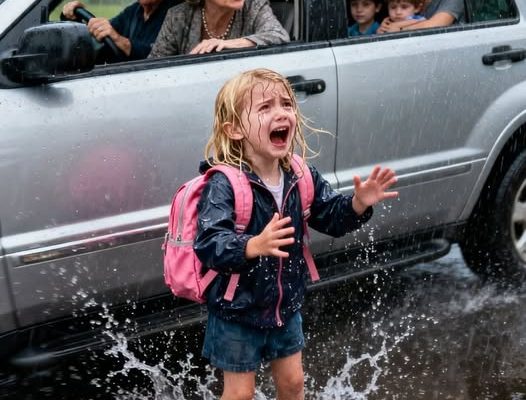
At school pickup, my parents drove off with my sister’s kids right in front of my daughter. When she ran up to the car expecting a ride home, mom rolled down the window and said, “Walk home in the rain like a stray.” My daughter pleaded, “But grandma, it’s pouring and it’s miles away.” They just drove off, leaving my six-year-old standing there soaked and crying…
The rain fell in relentless sheets, hammering the asphalt and turning the school parking lot into a blur of gray and silver, each drop a reminder of the storm brewing both outside and within my chest. At pickup time, I had been sitting in a budget meeting, the fluorescent lights buzzing overhead, when my phone vibrated violently across the polished conference table. Mrs. Patterson’s name flashed on the screen, and an icy dread spread through me before I even answered.
“Your little girl is standing outside the school gates in this downpour,” Mrs. Patterson’s voice trembled with controlled panic. “She’s absolutely drenched and crying her eyes out. I think something happened with your parents.” My stomach dropped as if it had fallen into a bottomless pit. Without hesitation, I grabbed my keys, leaving the meeting and my professional life behind in a blur of urgency and dread. The rain poured against my windshield, relentless and punishing, blurring the world outside. Every second felt like a year as I thought of Lily, soaked to the bone, trembling in confusion and fear, left by the very people who were supposed to protect her.
Pulling up to the school, I spotted Mrs. Patterson holding an umbrella over my daughter, shielding her from the worst of the storm. Lily’s pink backpack clung to her drenched clothes, her golden hair plastered against her tear-streaked face. Her small shoulders shook with cold and fright. The moment she saw me, she ran, her tiny feet slapping against puddles, water spraying in every direction. “Mommy!” she cried, her voice raw, cracking as I swept her into my arms, feeling the wet weight of her small body against mine.
“Grandma and Grandpa left me here,” she whispered, chattering teeth and mascara-streaked cheeks painting a picture I could not erase. My blood turned to ice as I pressed her closer. Through muffled sobs, she recounted the cruel words, the casual dismissal that had shattered her sense of safety. My parents had arrived at the school as usual, twice a week, their silver SUV gleaming even in the gray rain. Lily had run toward them, excitement lighting her small face. But my mother, Claudia, had rolled down the window, voice calm, detached, delivering a verdict that cut deeper than any blade: “Walk home in the rain like a stray.”
Her words echoed in my mind as if the air itself carried them. My father, Raymond, leaned across the driver’s seat, adding, “We don’t have room for you.” Lily pleaded, tears soaking through her jacket, the cold seeping into her tiny body. “But Grandma, it’s pouring, and it’s miles away!” She begged, hoping for compassion, and found none. Then, from the passenger seat, my sister Miranda appeared, her expression a twisted smirk that had haunted me for decades. Her children, Bryce and Khloe, sat in the back seat, dry, unbothered, staring blankly at their cousin left behind in the storm. “My kids deserve the comfortable ride,” Miranda said, dismissive, final. And with that, they drove away, leaving Lily in a torrent of rain and despair, her small figure shivering and alone.
I thanked Mrs. Patterson, pulling Lily into the warmth of my car and cranking the heat as high as it would go. Her teeth chattered uncontrollably as I pressed the seatbelt across her damp, quivering form. Every mile home, the fury inside me grew, crystallizing into sharp, purposeful focus. The injustice of it—the casual cruelty, the preferential treatment, the blatant favoritism over a child’s well-being—stirred something deep and resolute within me.
Years of sacrifices and silent generosity flashed before me as I navigated the slick streets. My parents had always favored Miranda, the younger daughter who had stayed close to home, married early, produced grandchildren first. But leaving my six-year-old in a thunderstorm, telling her to walk home like a stray, revealed the true extent of their cruelty. Every birthday gift I’d purchased, every family vacation I’d funded, every tuition check and emergency dental payment—they all came flooding back, a tally of generosity exploited and returned with contempt.
Back home, I ran a bath for Lily, the warm water enveloping her small, shivering body. I made her hot chocolate, the sweet steam filling the kitchen as I dried her tears and held her close, whispering assurances. “You’ll never have to see them again if you don’t want to,” I promised. Her small arms tightened around me, a grip filled with love, trust, and unspoken questions. Her tears soaked into my shirt, and yet in that moment, they also soaked into my resolve, reinforcing every decision I had made in the storm’s aftermath.
Once Lily was safely tucked into bed, her soft breathing slowly evening into calm, I sat at my laptop and opened my banking apps. For years, I had been the invisible engine of my family’s finances. Nearly $3,000 a month went to my parents’ mortgage, another $800 to their car, $600 for health insurance, plus utilities, HOA fees, and even their country club membership so my mother could maintain appearances among her friends. On top of that, I had been supporting Miranda and her family, covering private school tuition, car leases, vacations, and emergency expenses that never ended, adding up to nearly $90,000 a year.
The numbers blurred and twisted in my mind, forming a damning portrait of misplaced loyalty. Every dollar I had sacrificed, every hour of overtime, every skipped family gathering for my own child—all spent propping up people who would abandon my daughter in the rain without a second thought. As I meticulously reviewed transactions, emergency expenses, and gifts, the sum made me physically recoil: over $370,000 in just four years, money I had given freely, blindly, while being met with betrayal and emotional cruelty in return.
I began severing ties with precision. Automatic payments for the mortgage, car, and utilities were canceled. Health insurance policies removed. School tuition for Miranda’s children stopped immediately. Every financial pipeline connecting me to my parents and sister was methodically dismantled, leaving them dependent on nothing but themselves, and for the first time in years, the scales of power began to tip. I sat back, staring at the screen, stomach twisting with disbelief at the scope of the exploitation I had allowed, and at the same time, a sense of clarity and cold determination washed over me.
David found me at 11 p.m., weary but alert, leaning over my shoulder at the spreadsheet. “Jesus Christ,” he said softly, eyes wide at the staggering total. I whispered, almost to myself, “I’ve been a fool.” He shook his head, hands on my shoulders. “No,” he said firmly, “you’ve been generous to people who didn’t deserve it. That’s different.” His voice carried the kind of steady conviction I needed to anchor me.
Sleep came fitfully that night. I kept seeing Lily’s face in the downpour, hearing the echo of my mother’s words in my head, the casual cruelty slicing through my veins. Those were the people I had sacrificed for. Those were the people I had worked overtime for, worried over, given financial lifeblood to. And yet, here was the ultimate betrayal: my daughter, standing alone in the storm, abandoned by her own family.
The next morning, I took Lily to her favorite breakfast spot, watching her laugh and chatter like a normal six-year-old, her small hands clutched around a steaming mug of hot chocolate, oblivious to the full scope of the cruelty she had narrowly escaped. I knelt beside her in the parking lot afterward, rainlight shimmering off the wet pavement. “Mommy,” she asked softly, “are Grandma and Grandpa mad at us?” I met her eyes, steady, and shook my head. “They made a bad choice, sweetie. Sometimes grown-ups make bad choices, and there are consequences, but you didn’t do anything wrong. None of this is your fault.”
She pressed herself to me, her warmth and trust a beacon amid the chaos. “I love you, Mommy,” she whispered. “I love you too, baby, so much,” I replied. And in that moment, the decision was final. I pulled out my phone and sent a single, decisive group text to my parents and sister: After what you did to Lily today, every payment I’ve been making stops immediately. You’re on your own. Don’t contact me or my daughter again. Then I turned off my phone, leaving the storm and betrayal behind.
The next morning, I…
Type “KITTY” if you want to read the next part and I’ll send it right away.
The following morning, my phone lit up with missed calls and messages that shifted rapidly from confusion to outrage as the financial consequences became real.
My mother demanded to know why the mortgage had bounced, my father accused me of overreacting, and Miranda sent a stream of texts insisting that her children should not suffer because Lily was “too sensitive.”
I read every word without responding, feeling a calm detachment settle over me where guilt used to live.
They spoke about money, inconvenience, and embarrassment at the country club, but not one message asked whether Lily was safe, warm, or frightened the night before.
By noon, my father’s tone hardened into threats about family loyalty and reputation, and my mother warned that cutting them off would fracture the family permanently.
I looked at Lily playing in the living room, her laughter bright and unburdened for the first time in days, and I realized the fracture had happened long before I canceled a single payment.
When my phone rang again and I saw my father’s name flashing across the screen, I answered this time, letting the silence stretch just long enough for him to understand that the balance of power had shifted.
He began to speak, his voice tight with anger, but before he could finish his first sentence, I said something that made him go completely quiet.
C0ntinue below
The phone call came at 3:47 p.m. on a Tuesday. I was in the middle of a budget meeting when my cells started vibrating across the conference table. Mrs. Patterson’s name flashed on the screen. She lived two houses down from Metobrook Elementary, the school where my daughter Lily attended first grade.
My stomach dropped before I even answered. “Your little girl is standing outside the school gates in this downpour,” Mrs. Patterson said, her voice tight with concern. She’s absolutely drenched and crying her eyes out. I think something happened with your parents. I grabbed my keys and bolted from that meeting without a word of explanation.
The drive to the school felt like it took hours instead of the 12 minutes it actually was. Rain hammered against my windshield so hard the wipers could barely keep up. All I could think about was Lily standing alone in this weather, wondering why nobody came for her. When I pulled up to the school, Mrs. Patterson was holding an umbrella over my daughter.
Lily’s pink backpack was soaked through, her blonde hair plastered to her small face. Her little body shook from the cold and mascara-like streaks of mud ran down her cheeks where she’d been crying. The moment she saw my car, she ran toward me. Mommy. Her voice cracked as I swept her into my arms.
She felt so small and cold against me. Grandma and Grandpa left me here. I tried to get in the car, but Grandma told me to walk home like a stray dog. My blood turned to ice. What did you say? Through chattering teeth and fresh tears, Lily told me what happened. My parents had arrived at pickup time like they’d agreed to do twice a week.
Lily had seen their silver SUV and run toward it, excited to see them. But when she reached for the door handle, my mother Claudia rolled down the window just enough to speak. Walk home in the rain like a stray, she’d said with a dismissive wave. My father Raymond had leaned across the driver’s seat to add his own contribution. We don’tt have room for you.
Lily had begged them, rain already soaking through her jacket. But Grandma, it’s pouring and it’s miles away. That’s when my sister Miranda appeared in the passenger seat, her face twisted in that familiar smirk I’d grown to hate over the years. Her two children, Bryce and Khloe, sat dry and comfortable in the back seat, staring out at their cousin with blank expressions.
“My kids deserve the comfortable ride,” Miranda had said before my father drove away. “They’d left her there.” “My six-year-old daughter,” standing in a thunderstorm, watching her grandparents choose her cousins over her. I thanked Mrs. Patterson and got Lily into the car, cranking the heat as high as it would go. Her teeth wouldn’t stop chattering.
I drove home, barely seeing the road through my rage. The history behind this betrayal stretched back years, woven through with patterns I’d been too accommodating to confront. My parents had always favored Miranda. She was the younger daughter, the one who stayed close to home, the one who gave them grandchildren first.
When she married Quentyn 5 years ago, they treated it like a royal wedding. My own marriage to David 3 years later received polite applause at best. But favoritism was one thing. This cruelty toward Lily crossed every line. After I got Lily into a warm bath and made her hot chocolate, after I dried her tears and promised her she’d never have to see them again if she didn’t want to, I sat down at my laptop.
The fury that had been building during the drive home crystallized into something sharp and purposeful. I opened my banking app and started reviewing transactions. Over the past four years, I’d been making regular payments to support my parents. When my father retired early due to a workplace injury, his pension hadn’t been enough to maintain their lifestyle.
I’d stepped in without hesitation because that’s what you do for family. $3,000 monthly for their mortgage payment, another 800 for their car payment. I’ve been covering their health insurance premiums at 600 a month, their homeowners association fees, their utility bills during winter months, even their damn country club membership so my mother could play tennis with her friends.
All told, I’d been sending them nearly $60,000 a year. And Miranda, I’d been floating her, too. When Quentyn’s contracting business hit a rough patch two years ago, I’d started helping with their kids’ private school tuition. 12,000 per child per year. I covered Miranda’s car lease when she wanted to upgrade to a luxury SUV.
I’d pay for family vacations that I wasn’t even invited on, trips where my parents took Miranda’s family to beach houses and mountain resorts while making excuses about limited space when I asked about joining. The numbers swam before my eyes. In total, I’d been providing nearly $90,000 annually in support to my parents and sister.
Money I’d earned through brutal hours at my consulting firm, climbing from junior analyst to senior director through sheer determination. I’d done it because I thought it made me a good daughter and sister. I’d done it because I wanted Lily to grow up seeing what family support looked like. But leaving my daughter in a storm, telling her to walk home like a stray animal, that revealed what they really thought of us.
My fingers moved across the keyboard. I canceled the automatic payment for my parents’ mortgage. Cancelled the car payment transfer scheduled for the following week. Removed them as beneficiaries from my accounts. I drafted an email to the insurance company removing myself as the policy holder for their health coverage.
I contacted the private school Miranda’s kids attended and informed them I would no longer be covering tuition. Every single financial connection I had to my parents and Miranda, I severed it. The whole process took less than 30 minutes. Before I finished for the night, I pulled up my records going back four years.
I wanted to see exactly how much I’d given them. The spreadsheet I created made my stomach turn. Beyond the regular monthly payments, there were countless extras I’d forgotten about. The emergency dental work for my father that cost $4,500. the roof repair on their house that set me back $12,000. Miranda’s loan of $8,000 to cover Quentyn’s business expenses that was never repaid because it became a gift when I didn’t push for repayment.
Christmas presents every year that cost hundreds per person because my mother had specific standards about gift giving. The family dinner bills I’d picked up dozens of times because my father would make a show of reaching for his wallet while everyone waited for me to say I’ve got it. The plane tickets I bought for my parents to visit Miranda’s family but never to visit mine.
birthday parties for Bryce and Khloe where I’d contributed to elaborate bounce house rentals and catered meals. The total came to over $370,000 across four years. More than a third of a million dollars I’d handed over to people who just traumatized my child. I sat back in my chair, the number glowing on my laptop screen.
That was a house down payment. That was Lily’s entire college education funded. That was early retirement money. That was financial security I traded away for the privilege of being treated like a walking ATM by my own family. David came into the study around 11 p.m. and found me staring at the spreadsheet.
He looked over my shoulder and let out a low whistle. “Jesus Christ, I knew it was a lot, but I’ve been a fool,” I said quietly. “No.” He turned my chair to face him. “You’ve been generous to people who didn’t deserve it. There’s a difference. That night, I barely slept. I kept seeing Lily’s face in the rain.
Click Here to continuous Read Full Ending Story👉 Part3: At school pickup, my parents drove off with my sister’s kids right in front of my daughter. When she ran up to the car expecting a ride home, mom rolled down the window and said, “Walk home in the rain like a stray.” My daughter pleaded, “But grandma, it’s pouring and it’s miles away.” They just drove off, leaving my six-year-old standing there soaked and crying…
At school pickup, my parents drove off with my sister’s kids right in front of my daughter. When she ran up to the car expecting a ride home, mom rolled down the window and said, “Walk home in the rain like a stray.” My daughter pleaded, “But grandma, it’s pouring and it’s miles away.” They just drove off, leaving my six-year-old standing there soaked and crying…
Part 1 of 3