WHEN MY FATHER STOOD UP IN A COUNTY COURTROOM, LOOKED A JURY OF HIS FRIENDS IN THE EYE
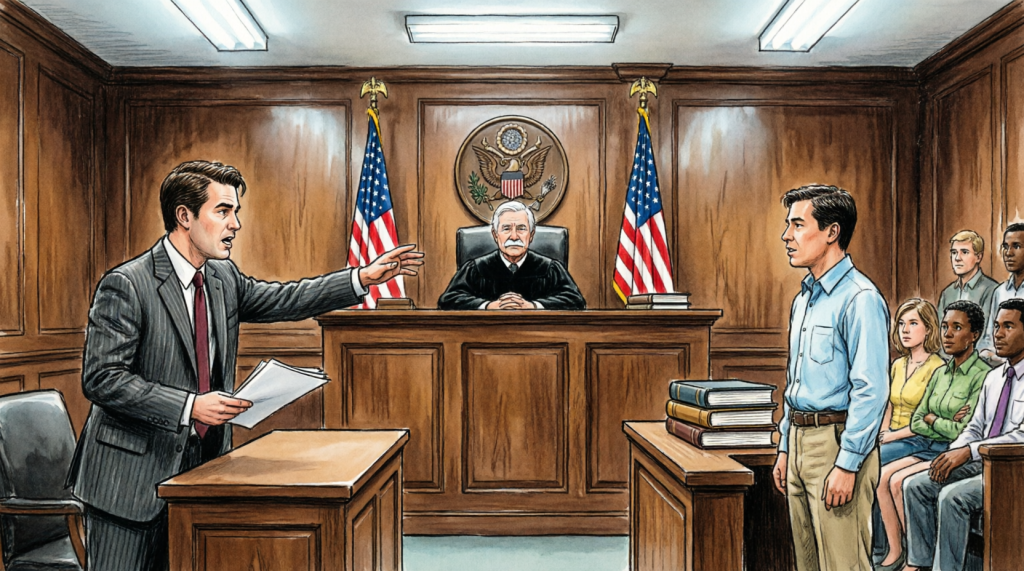
“She has not worked a day since college and now she is stealing from her own dead mother.”
That is what my father says under oath to a jury of nine people who have known him since before I was born.
I do not flinch.
I do not turn.
I take a sip from the plastic cup of water in front of me—metallic, lukewarm, the kind of water that tastes like old pipes and courthouse dust—and I set it back down on the wooden rail without a sound.
My name is Elena Vance. I am forty-one years old. And up until nine seconds ago, I was sitting in the witness box in Fairfax County Circuit Court listening to my father describe a woman I barely recognized.
Now I am watching Robert Vance wave a manila folder at the jury like it is a battle flag.
His face is the color of brick dust. His voice fills every corner of the room, bouncing off wood paneling darkened by decades of heat and stale breath. The courthouse smells like old paper, cheap cologne, coffee gone bitter on a hot plate, and rain trapped in wool coats. There is a ceiling fan turning slowly overhead, more decorative than useful. There is a clock above the judge’s bench that clicks louder than a clock should. There are twelve people in the gallery, including my younger sister Ashley, who is folded into grief like she practiced it in a mirror before coming here.
And there is a sealed black envelope sitting inside my attorney’s briefcase.
My father does not know that yet.
He thinks this is his room.
That’s the thing about men like Robert Vance. They never fully understand the difference between authority and familiarity. He has sat in rooms like this for half his life—town board meetings, zoning disputes, permit appeals, budget hearings, ribbon cuttings, condemnation fights. He knows how to talk over people and call it leadership. He knows how to smile at a judge and insult a witness in the same breath. He knows how to build a truth that functions perfectly well as long as no one introduces evidence stronger than his confidence.
For thirty years he ran the county council in all but title. He decided which roads got resurfaced, which contractors got favored, whose kid got a summer job on the parks crew, which local family was “good people” and which one was quietly not. In his mind, that made him important in a way the law should respect automatically.
In his mind, I am still twelve years old and standing in the wrong boots in a muddy field.
“She is a ghost,” he tells the jury, his voice booming with the same false righteousness he used to use at Sunday dinners when he wanted the roast passed faster. “Ask anybody in this county. Ask the neighbors. Ask the hardware store, the church office, the postmaster. Elena Vance hasn’t lived among us in fifteen years. She claims she works for some logistics group in Washington, but there is no office. There is no website. There’s no payroll trail, no real company, no honest work. She has spent her whole life living off scraps my wife threw her. And now that her mother is dead, she’s trying to bleed the estate dry.”
He turns toward the jury on the word dead, letting it hang there. He knows how to use grief as punctuation.
Ashley keeps her eyes lowered. Her cardigan is cream cashmere, the expensive kind that pills if you breathe on it wrong. I know the exact kind because three years ago I paid for it—or rather, I paid into the private “professional attire assistance” fund that somehow found its way to the school district foundation Ashley had conveniently joined as a board volunteer six months before she applied for classroom grants. She never knew the money came from me. She wore the cardigans anyway. She accepted the version of reality that flattered her.
That has always been Ashley’s particular genius.
Mine was leaving.
Or that is how Robert tells it.
In his version, I ran away. I abandoned the family land, abandoned my obligations, abandoned my mother, abandoned everything real for a vague office job in Washington no one could verify because there was nothing worth verifying. In his version, Ashley stayed. Ashley cared. Ashley understood duty. Ashley did not think she was better than the county that raised her.
In my version, I left because I was smart enough to understand that staying would mean shrinking until there was nothing left but usefulness.
The Vance farm sat on two hundred and eleven acres just outside town, all fields and fencing and a white farmhouse with green shutters my mother painted every seven years because she said weather respected attention. We were not rich, despite the way Robert liked to talk. Land-rich, yes. Cash-rich, never. The county loved to pretend my father was some kind of local titan, but titans don’t usually argue over diesel prices or patch combine tires themselves on a Sunday. What Robert really had was influence and performance. He knew how to look like the center of things. That mattered more to him than money, maybe even more than truth.
I learned early that love in our family moved through channels he approved.
Ashley, younger by seven years, warm-faced and pretty and instinctively adaptable, could charm him even when she disappointed him. She knew when to tilt her head, when to laugh, when to cry without quite smudging her mascara. She understood attention as a language and spoke it fluently.
I was different from the beginning. I liked schedules. Maps. Quiet. Systems that worked because they were designed well, not because some loud man barked over them until everyone else backed off. When I was ten, I was making inventory sheets for the barn feed by hand because the numbers in Robert’s ledger irritated me. When I was twelve, I was reading history books under the blankets with a flashlight and dreaming of places where nobody knew my last name. When I was fifteen, I could strip irrigation pumps and rebuild them faster than most of the hired boys, and Robert hated that I could because it made him proud in a way he did not know how to survive.
He liked daughters ornamental or grateful. He did not know what to do with competence in female form unless he could claim authorship of it.
At twelve, after I beat three boys and one college freshman from the FFA chapter at a county mechanics competition, he stood in the kitchen doorway that night while my mother frosted a sheet cake and said, “Don’t get carried away. This is a phase, not a future.”
My mother paused with the spatula in her hand.
I remember the kitchen light reflecting off the metal bowl. I remember the smell of sugar and vanilla and grease from the roast chicken. I remember how hard I stared at the back of my chair so I would not let him see my face.
A phase, not a future.
He said it casually. That was his preferred method when he wanted a wound to last. Casual makes cruelty look like practicality.
My mother said nothing then. But later that night she knocked once on my bedroom door and came in carrying a plate with the cake trimmed from the edges where the frosting had gone crooked.
“He doesn’t know what to do with things he can’t name,” she told me.
I was twelve, humiliated, and too proud to cry in front of her.
“So I’m the problem?”
She sat on the edge of my bed.
“No,” she said. “You are the thing he cannot name.”
It took me thirty years to understand how much of my mother’s love was hidden inside sentences like that.
She was the only person in that house who ever really looked at me without trying to turn me into a simpler story.
She knew I was leaving before I did.
By high school I was splitting mornings between classes and chores and afternoons between farm work and ROTC meetings. Robert called it my “government costume phase.” When my university acceptance letter came with honors and an ROTC scholarship attached, my mother cried into the dish towel and my father said, “Washington will eat you alive.” He meant it as a curse. I took it as a dare.
I left for college and did not come home except on holidays and harvest weekends when my mother asked in the careful tone that meant she would never pressure me but hoped anyway.
Ashley stayed local for school. Education degree. Cheerful photos. Church bake sales. Safe choices. My father called her grounded. He called me ambitious the way some men say rabid.
By the time I commissioned, he had stopped pretending to understand my path at all. My ROTC portrait—dress uniform, shoulders squared, eyes younger than they should have been—hung in the hallway for years not because Robert liked what it represented, but because my mother put it there and dared anyone to take it down.
After college came the first gray rooms.
There are parts of my work I cannot tell and parts I would never tell even if I could. Secrecy is not only policy after a certain point. It becomes reflex. Muscle memory. A second skin. What I can say is that I entered federal service through one door and intelligence through another, and by thirty I had become very good at moving information through chaos without leaving myself inside the records. I worked first in support, then analysis, then operations. My cover evolved as my responsibilities did. So did the lies I was permitted to tell.
North Atlantic Logistics Group was one of those lies. A cover designation. A shell of paperwork, tax records, addresses, a plausible employment history that could survive surface-level scrutiny and little more. It did not exist for town gossip or county investigators or offended fathers. It existed for adversaries who kill people for less.
The blank spaces in my life were not accidents. They were architecture.
The cost of that architecture was invisibility.
No plaques. No hometown newsletter profile. No ability to tell my family, actually, the reason I miss Thanksgiving is that I’m in a windowless room helping decide whether two men across a border live or disappear before dawn. No way to explain why you sound tired on the phone without saying that the airfield tarmac in the dark smelled like burned hydraulic fluid and fear. No chance of telling your father that the “generic office job” he mocks has, in certain years, touched more national policy than his entire county council career combined.
You learn to live without witness.
Most of the time, I was good at it.