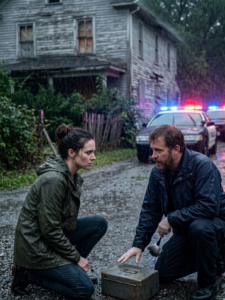
I dropped to my knees.
My fingers hovered over the engraving. The dust was undisturbed except where Frank’s flashlight beam had traced the edges. My grandmother had put this here behind a false wall inside a house she gave only to me.
“How long has it been here?” I whispered.
The officer with the camera stepped back. “It’s your property,” he said. “You can open it. We just need to document what’s inside.”
The lock was a four-digit combination.
I stared at it and thought about all the numbers Margaret ever made me memorize—her phone number, her recipes, the way she’d tell me, “Don’t rely on other people to remember the important things for you.”
My birthday was the simplest.
March 19.
I turned the dial.
The lock clicked.
My throat tightened.
The lid was heavy. I lifted it with both hands.
Inside, the box was divided into three neat compartments, each lined with cloth. The kind of careful you give to things that matter.
The first compartment held a thick envelope sealed with wax.
I broke it open.
Inside was a handwritten document—four pages on ruled paper. At the top, in Margaret’s unmistakable script: Last Will and Testament of Margaret Anne Whitfield Harrow.
Dated eighteen months before the will Gordon Blake read in his office.
Two witness signatures.
A notary stamp.
My vision blurred.
This wasn’t a copy. This wasn’t a note. This was an original testament.
A real will.
The second compartment held another letter—also handwritten, four pages, the ink slightly faded, the paper smelling faintly of lavender like her drawers always did.
The first line read: My dearest Elise, if you are reading this, then they did exactly what I feared they would do.
My breath caught. I pressed my hand to my mouth and kept reading.
She wrote about Richard. About Vivian. About pressure. About fear.
They have been taking from me for two years. I could not stop them alone, so I prepared.
The third compartment held a smaller envelope stamped PRIVATE in red ink.
I reached for it.
“Ma’am,” the officer said, stepping forward gently. “We recommend a lawyer look at that one first. Some contents may be evidentiary.”
I pulled my hand back and looked at the officers, then at Frank, who stood in the doorway gripping the frame like he needed it to stay upright.
“What’s in there?” Frank asked.
I held up the first document, hands trembling but voice steady.
“Her real will,” I said. “The one they tried to erase.”
The officer photographed it. I scanned the pages, eyes moving fast, heart hammering.
The real will left the trust—everything—and the Weston house to me.
Celeste received the Ridgefield house and fifty thousand dollars.
Richard and Vivian each received one dollar.
And at the bottom, in Margaret’s hand: So they know I did not forget them. I simply did not forgive.
The room went silent.
Rain tapped the windows.
Frank exhaled a breath he’d been holding since I arrived.
I folded the letter carefully and pressed it against my chest. The paper smelled like my grandmother’s linen closet, like safety.
They will tell you I didn’t love you enough to give you more, she wrote. The truth is I loved you too much to let them take everything.
I stayed on that floor longer than I can explain.
The next morning, a detective from Ridgefield Police called.
“Sergeant Ortiz,” he introduced himself, voice flat, professional. “We opened the third envelope with forensic present. I need you to come in.”
At the station, Ortiz walked me through what they found.
Bank statements—dozens—printed, highlighted, annotated in Margaret’s handwriting. They traced transfers from her trust into a personal account under Richard Harrow’s name, spread over twenty-three months.
Total: approximately three hundred forty thousand dollars.
Each transfer had an authorization form attached.
Each form bore Margaret’s signature.
Except—Ortiz turned one of the pages toward me—Margaret had written in the margins in pencil, small and steady: I did not sign this. This is not my handwriting.
She had requested duplicate statements mailed to a private PO box. She had tracked every fraudulent transfer. She had built the file herself.
Ortiz slid another document across the table.
A request to change the trustee and legal representative of her estate filed six months before her death. The signature said Margaret’s name, but the handwriting was wrong in a way even I could see.
“This goes beyond civil dispute,” Ortiz said. “We’ve forwarded everything to the district attorney.”
I sat in the parking lot afterward, hands shaking, and called the attorney my coworker swore could handle probate fraud.
Eleanor Voss answered on the first ring.
I talked for nine minutes straight. I told her everything—Gordon Blake, the false wall, the steel box, the two wills, the forged transfers.
She listened without interrupting.
When I finished, she said, “Your grandmother didn’t just leave you a house, Elise. She left you a case. Come to my office tomorrow. Bring everything.”
I drove home with the windows down even though it was cold. The air felt different—not lighter, but clearer, like someone had opened a window in a room I didn’t realize was suffocating me.
Ortiz had mentioned one more thing before I left: the third envelope contained additional documents related to family history. They’d referred those to a federal agency.
“Which agency?” I asked.
Ortiz hesitated. “The FBI.”
I didn’t ask why.
I wasn’t sure I was ready for that answer.
Word travels fast in a small town.
Someone saw the police cruisers at Birch Hollow. Someone texted someone. Someone told Richard.
He called the next evening.
No greeting. No warm-up.
“Whatever you think you found,” he said, voice tight and controlled, “it means nothing. I have the best lawyers in this county. You’ll lose everything, including that shack.”
Underneath his anger was something I had never heard before.
Fear.
I said nothing.
He hung up.
An hour later, Vivian called. Not crying this time—cold.
“If you go through with this,” she said, “you will have no family left. Is that what you want?”
I held the phone and looked at the silver bracelet on my wrist. Looked at the photo of Margaret and the steel box on my kitchen counter.
“I haven’t had a family in a long time,” I said quietly. “I just didn’t know it yet.”
She hung up first.
Celeste texted at midnight: You’re delusional. Dad’s lawyer will bury you.
Two days later, Gordon Blake walked into Eleanor Voss’s office carrying a settlement proposal. His hands were steady. His eyes were not.
“My client is offering a generous resolution,” Blake said. “Elise keeps the Ridgefield property. She receives an additional fifty thousand. In exchange, she signs an NDA and surrenders all materials recovered.”
Eleanor didn’t blink.
“My client doesn’t negotiate when forged documents are on the table,” she said.
Blake stood, buttoned his jacket, and paused at the door.
Not to me—to Eleanor—he said quietly, “Tell her to be careful. Richard Harrow knows people in this county.”
When the door closed, I turned to Eleanor.
“What does he mean—knows people?”
Eleanor set down her pen. Her expression didn’t shift, but something behind her eyes hardened.
“It means,” she said, “we might not get a fair trial here.”
Eleanor filed the initial challenge with Fairfield Probate Court anyway—motion clean, evidence attached, chain of custody included.
Two weeks later, the denial came back.
No hearing. No forensic review. Summary denial in forty-eight hours.
Eleanor called me from her car. I could hear her breathing—slow, deliberate, the way someone breathes when choosing words carefully.
“The judge didn’t schedule a hearing,” she said. “He didn’t review the analysis. He issued a summary denial.”
“That doesn’t happen,” I whispered.
“No,” Eleanor agreed. “It doesn’t.”
I asked the question I already knew the answer to.
“Why?”
“Judge Kern and your father are members of the Fairfield Country Club,” Eleanor said. “I pulled sign-in logs. They’ve had dinner together three times in the last month.”
The floor didn’t tilt because I was surprised.
It tilted because I realized this was exactly what Margaret had been preparing for.
They did exactly what I feared they would do.
The walls closed in.
The bank wouldn’t extend my credit line. Renovation bills stacked. Frank delayed payment, but I could hear strain under his kindness when he said, “Take your time.”
Time costs money.
That night, I sat on the floor of Birch Hollow—the half-gutted living room, exposed wiring, sawdust floating in flashlight beams.
I unfolded Margaret’s letter and read the line I kept coming back to.
Don’t let them make you small, Elise. The truth is heavy, but it will hold you up when nothing else can.
The next morning, Eleanor called.
“We’re going federal,” she said. “I’m making a call.”
“Federal?” I repeated. The word felt enormous.
“Bank fraud is federal,” she said. “Elder financial abuse in connection with managed trusts—federal jurisdiction. And if local bench is compromised, we have grounds to escalate.”
Her voice was steel.
“This isn’t revenge,” she said. “This is procedure.”
I closed my eyes and pictured Margaret’s handwriting—steady, certain, even at the end.
“Make the call,” I said.
A week later, a number I didn’t recognize flashed on my phone.
“Miss Harrow,” a man said when I answered, voice low and precise. “My name is Marcus Whitfield. I’m a retired special agent with the FBI. I’ve been asked to consult on your case.”
Whitfield.
My grandmother’s maiden name.
We met at a café in Westport. He was already seated, silver hair neatly combed, brown tweed jacket over a pressed shirt. Reading glasses rested on the table. Coffee untouched.
His eyes were sharp, but there was warmth in them—earned warmth, the kind that takes decades.
He didn’t start with documents.
He started with her.
“Tell me about your grandmother,” he said.
I wasn’t expecting that. My throat tightened.
“What do you want to know?” I asked.
“Whatever you want to tell me,” he said.
So I talked.
I told him about lemon cake. Sunday calls. Margaret’s porch. The way she could make you feel safe by simply sitting in the room.
Marcus listened without interrupting. He didn’t take notes.
Once—just once—he looked away, and I saw something move behind his expression. Not professional distance. Something closer to grief.
“She was remarkable,” he said quietly when I finished.
Then he told me the FBI was opening a federal investigation. Subpoenas. Forensic analysis. Court outside Fairfield’s reach.
“This will go to court,” he said. “And it won’t be Judge Kern’s court.”
When we stood to leave, he reached out and took my hand, holding it a moment longer than a stranger would. His palms were warm, his grip careful.
“You have her eyes,” he said softly.
I blinked. “People say I look like my mother.”
“No,” Marcus said. “You look like Margaret.”
He released my hand and walked to his car, leaving me on the sidewalk with that name in my head.
Marcus Whitfield.
Whitfield.
My grandmother’s maiden name had been Whitfield before she married.
I stood there long after his car disappeared.
Richard didn’t wait for subpoenas.
A story appeared in the Fairfield County Register, the kind that reads like journalism but smells like a press release.
Local family in turmoil as youngest daughter contests mother’s estate.
Richard was quoted: “Elise is going through a difficult period after losing her grandmother. We only want to help her.”
He sounded reasonable, caring, which made it dangerous.
Vivian took it to social media—a public Facebook post with a Christmas photo from two years ago. Matching sweaters. Margaret in the center. Caption: Our family is being torn apart by greed and false accusations. All I ever wanted was to keep us together. Please pray for us.
Sympathetic comments poured in.
I wasn’t tagged. I wasn’t named. Everyone knew anyway.
At work, my supervisor pulled me aside.
“Elise,” she said quietly, “I support you, but a few donors have asked questions. Try to keep this private.”
She meant well. There was no private anymore.
Then came the real strike.
Celeste called, voice flat. “Dad says if you don’t drop this by Friday, he’ll petition to have you declared mentally unfit.”
I laughed once, sharp and disbelieving. “That’s absurd.”
“It’s not a bluff,” Celeste said.
Three days later, Eleanor forwarded me the filing: a petition for mental competency evaluation submitted to Fairfield Probate Court. Petitioner: Vivian Harrow.
Her statement included my “documented history” of anxiety and depression, referenced therapy I’d done two years ago after a particularly brutal case at the nonprofit and the weight of being invisible in my own family.
I had told Vivian because I’d hoped—stupidly—that honesty might soften her.
She’d saved it, not to help me.
To weaponize it.
Eleanor called within the hour.
“They’re trying to strip your legal standing,” she said. “If they succeed, you can’t sue. You can’t testify. You become a ward, not a plaintiff.”
I stared at Vivian’s neat signature—no hesitation, no tremor. My own mother had filed paperwork to call me insane to protect money she stole.
I called Dr. Patterson, my therapist, that afternoon. She listened to everything, then said, “I’ll have the evaluation letter on your attorney’s desk by morning.”
The letter was three pages: thorough, unambiguous.
Elise Harrow demonstrates full cognitive and emotional competence. There is no clinical basis for a competency challenge. Her decision-making is consistent, informed, and self-directed.
Eleanor filed the rebuttal and simultaneously filed a motion to transfer jurisdiction to federal court.
The FBI backed the transfer with a supporting brief.
Fairfield Probate didn’t fight it.
Judge Kern recused himself before he could be forced out.
The case moved up.
That evening, I did something I’d never done before.
I called Richard directly—not to plead, not to argue. To inform.
“Dad,” I said when he answered, voice level. “I know what you and Mom did. I have the original will. I have the bank records. I have the forged signatures. The FBI is involved now.”
Silence.
Then Richard’s voice, low and hard: “You’re going to regret this. You have no idea what you’re starting.”
“I didn’t start this,” I said. “Grandma did. She knew you’d come for her money. She just made sure I’d have the proof.”
I hung up.
My hands were trembling, but not the way they used to tremble when I was scared of my father’s disapproval.
This wasn’t fear.
This was something shifting into place.
Eleanor called that night.
“FBI forensics completed analysis of Blake’s will,” she said. “Handwriting experts concluded: ninety-nine point seven percent probability the signature is not Margaret’s.”
Ninety-nine point seven.
Not a shadow of doubt. Not ambiguity. A number as clean as a blade.
Dorothy Callahan called Sunday morning.
“Come to my house,” she said. “There are things I should’ve told you at the funeral.”
Her living room smelled like bergamot and old paper. She sat across from me in a wingback chair with a quilt over her lap. A framed photo of her and Margaret in their twenties sat on the side table—two women laughing on a dock somewhere.
“Your grandmother had a life before Richard,” Dorothy said. “Before Harold, before all the Harrow polish. There was someone else.”
She told me about a young man named Marcus. How Margaret loved him in a way that didn’t fit the family’s plans. How they made her end it.
“What happened to him?” I asked.
“He disappeared,” Dorothy said quietly. “Moved away. Margaret married Harold the next year. Never mentioned Marcus again for decades.”
Dorothy stared at the photo.
“Then one day,” she said, “maybe fifteen years ago, Margaret told me she’d found him. They’d been in contact. She said, ‘He never stopped looking for me, Dorothy.’”
Dorothy reached behind her chair and pulled out a small wooden box.
“Margaret gave this to me a year before she died,” Dorothy said. “‘Give it to Elise if something happens.’ Only Elise.”
Inside was a black-and-white photograph: a young woman and a young man, arms linked, in front of a building I didn’t recognize. She wore a white dress. He wore a dark suit.
On the back, in faded ink: M & M. 1974.
I held the photo closer.
The young man’s eyes were dark and steady.
I had seen those eyes before—across a café table in Westport.
Marcus Whitfield.
My stomach dropped.
Dorothy watched my face and nodded slowly, like she’d been waiting for me to connect it.
“She planned everything, dear,” Dorothy whispered. “She was the smartest woman I ever knew. And the most heartbroken.”
I drove home with the photo on the passenger seat. Pieces rearranged in my mind, snapping into a shape I wasn’t ready to name.
That night, I sat at my kitchen table with three things in front of me: Dorothy’s photo, Margaret’s silver bracelet, and the steel box from Birch Hollow.
I picked up the bracelet and turned it over under the lamp.
I’d worn it almost every day since the hospital, but I’d never examined it closely. The outside was plain—tarnished, unremarkable, exactly the kind of thing Vivian dismissed.
But when I tilted it just right, I saw faint etching inside the clasp—letters so small I needed a magnifying glass.
A sequence of numbers.
September 17, 1974.
The same year as the photo.
A date hidden in plain sight for forty years.
My breath caught.
I carried the steel box to the table. When police processed it, they documented the three compartments, but I remembered something else: a smaller combination panel built into the base. The officers had tried a few combinations and moved on. They’d left it for me.
I input the numbers: 09171974.
The base released with a soft click.
Inside was a folded document protected by plastic.
A birth certificate.
State of Connecticut.
Name: Margaret Anne Whitfield.
Mother: Ruth Ellen Whitfield.
Father: Marcus James Whitfield.
The room went quiet in my head.
Marcus wasn’t my grandmother’s old love.
Marcus was her father.
I set the birth certificate down and unfolded the letter beneath it.
Two paragraphs, Margaret’s handwriting again.