
His jaw tightened. “I thought this was a family thing.”
“You said you wanted to come home,” I told him. “This is home now. Stay and see what it looks like without you.”
Something flickered in his eyes, anger and shame braided together. He looked at the crowd inside, then nodded once.
Most of my siblings were seated near the front. As we walked down the aisle, their faces shifted when they saw him. Hannah, who had never known him, stared like she was seeing a ghost.
Mom sat in the middle of the row, twisting her program. He slipped into the row behind us.
The lights dimmed. A professor welcomed everyone and started calling names. Graduates crossed the stage. Families cheered. Then the slideshow began.
At first it was random students in scrubs, hugging their families. Then Mom’s face filled the screen.
She was in a faded T-shirt and sneakers, mopping an office hallway. A stroller sat behind her with a sleeping toddler inside, a textbook propped on the handle. Another photo appeared: Mom at our kitchen table, surrounded by notes, highlighter in hand.
Dad sucked in a breath behind me.
The dean stepped up to the mic. “Tonight, we are honored to present our Student of the Decade award.” Mom’s head snapped up.
“This student began our program as a single mother of 10 children,” the dean said. “She worked nights, raised her family, and still showed up for every clinical.”
I felt Dad flinch.
“She maintained one of our highest GPAs,” the dean continued. “Please help me honor Maria Alvarez.”
We jumped to our feet. The kids screamed and clapped, some of us already crying. Mom sat frozen, then stood, eyes glassy.
Mom walked up, shoulders squared, and took the plaque with shaking hands. She laughed once, like she couldn’t believe the sound belonged to her.
The dean smiled. “And tonight, her eldest daughter has a few words.” She gestured toward our row.
My heart slammed into my ribs.
I stood. Dad grabbed my wrist. “Mia, don’t drag our history into this,” he hissed.
“You wrote that history,” I said, pulling free.
Onstage, the lights were hot. I hugged Mom. She trembled against me. “Please be gentle,” she whispered.
“You’ve been gentle for both of you for 10 years,” I murmured. “Let me be honest.”
I turned to the mic and looked out at the crowd, then found my father in the back row.
“My mom had ten kids,” I started. A soft laugh rolled through the room. “She married a man who called a big family his blessing.”
I swallowed. “He also said God was calling him elsewhere when she was eight months pregnant with number 10.”
The laughter died.
“He left that night,” I said. “No savings, no plan. Just a suitcase and some verses about trusting God. I thought she’d fall apart.”
Instead, she cleaned offices at midnight and studied at three a.m. She cried in the shower so we wouldn’t hear. She told us not to hate him.
The room went dead still.
“Because when he left, we learned something important,” I continued. “He wasn’t the backbone of this family. She was. He showed us who was really holding everything together.”
I let it hang. Then the room erupted, applause, whistles, people standing. Mom covered her face, laughing and sobbing at once.
After the ceremony, the lobby became a blur of hugs and photos. Professors called her an inspiration. The little kids passed her plaque around like it was a trophy.
Through the glass doors, I saw Dad standing under a streetlight, hands jammed in his pockets. After a few minutes, Mom stepped outside for air, bouquet in hand. He moved toward her.
She gave a small, tired smile. “Thank you.”
“I know I messed up,” he said. “God’s been working on me. The girl left. I’m alone. I want to make things right. I want to come home, Maria.”
She studied him for a long moment. “I forgave you a long time ago,” she said.
He exhaled, relieved. “Thank God.”
“But forgiveness doesn’t mean you get to move back in,” she added.
His face fell. “After 25 years, that’s it?”
“After ten years of raising ten kids alone while you played house with a girl from the choir,” she said quietly, “yes. That’s it.”
He glanced toward the doors. “What about the kids? They need a father.”
“They needed one then,” she said. “You weren’t there.”
I stepped beside her. “We needed you when the lights went off, and when Hannah asked why her friends had dads at school events. You weren’t there.”
He looked through the glass at the chaos inside, kids laughing, Mom in her navy dress, the plaque on the table. It was a whole life grown around the gap he left.
“So that’s it,” he said.
Mom nodded. “That’s it.”
He walked to his car, shoulders slumped, and drove away again. No big speech. Just tail lights fading.
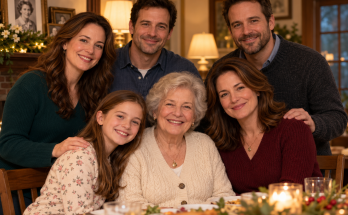
Inside, someone yelled, “Family picture!” We crowded around Mom, pulling her into the center. There was a space where a father usually stood.
I saw it for one second. Then I stepped into it and wrapped my arm around her shoulders. She leaned into me, medal cool against my arm, smile soft and real.
The camera flashed. For years, I’d been the girl whose dad walked out. That night, I realized I was the daughter of a fantastic woman. And that was finally enough.
In Her Fading Memory, I Became the Hope She Needed
Part 2 of 2

One Comment on “Part2: My Dad Left My Mom With 10 Kids for a Younger Woman From Church – 10 Years Later, He Called Mom Asking to Be a Family Again, but I Taught Him a Lesson”