
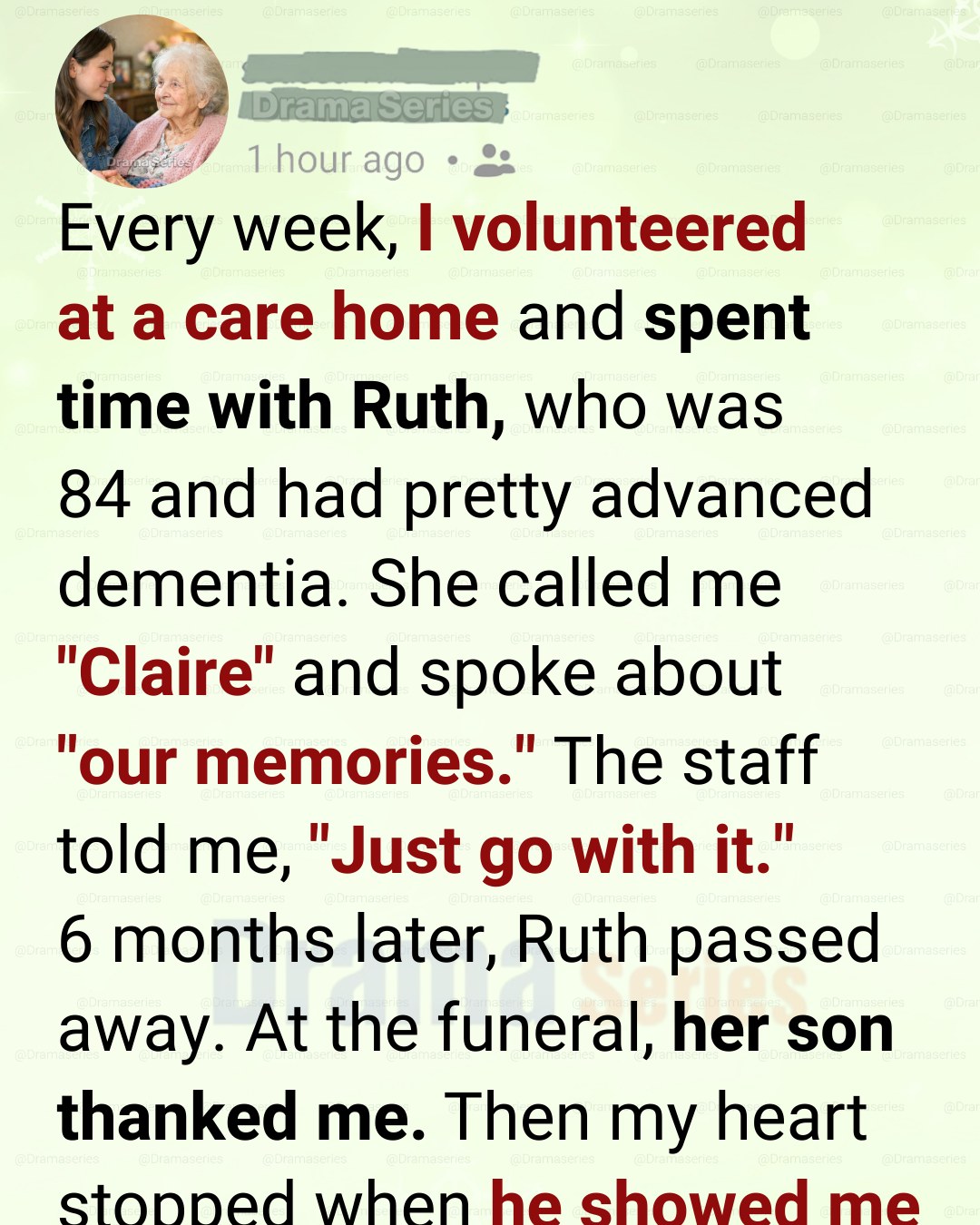
In it stood a young woman about my age. Blonde hair falling over her shoulders. A familiar crooked smile. Even the faint dimple in her left cheek.
My stomach dropped.
She looked like me.
Not exactly—but enough that it felt like looking at a cousin. Or a reflection from another time.
“That’s my sister,” he said quietly. “Claire.”
I stared at the photo, my hands trembling.
“She died in a car accident when she was nineteen,” he continued. “The same age you are now.”
Nineteen.
The number echoed in my head.
“My mom… she never really recovered,” he said. “She functioned. She smiled. But something in her was always broken.”
He looked at me then, really looked at me.
“When you started visiting, the nurses told me she thought you were Claire. I didn’t know what to think at first. But then they said you never corrected her. That you listened. That you held her hand.”
I felt tears burn behind my eyes.
“I didn’t mean to mislead her,” I said quickly. “I just… they told me it was kinder not to.”
He nodded. “You gave her something we couldn’t. For a little while, she believed her daughter had come back. She was calmer on the days you visited. She slept better. She smiled more.”
He swallowed hard.
“You became her peace.”

I had to look down at the photo because I couldn’t hold his gaze anymore.
All those Thursdays. All those borrowed memories. The lake house, the burnt cookies, the braided hair.
I had thought I was just volunteering. Filling a lonely hour.
But somehow, without realizing it, I had stepped into a space grief had hollowed out decades ago.
“I hope it wasn’t too strange for you,” he added gently.
Strange.
It had been strange, yes. Being called by another name. Being folded into someone else’s history. Feeling loved for reasons that weren’t mine.
But it had also been… meaningful.
“I don’t think it was an accident,” I said softly, surprising myself. “That we looked alike.”
He gave a faint, sad smile. “My mom used to say God had a strange sense of humor.”
We stood there in silence for a moment, two strangers connected by a woman who had loved fiercely and lost unbearably.
As I handed the photo back, I realized something that made my chest ache in a different way.
For six months, Ruth hadn’t seen me.
But she had felt her daughter’s presence.
And maybe that was enough.
On the drive home, I kept thinking about identity—about how fragile and fluid it can be. How, in the fading corridors of memory, love sometimes reshapes reality into something bearable.
I had walked into that care home as a college student looking to do something good.
I walked out of Ruth’s life as someone who had unknowingly carried a piece of her unfinished grief.
I wasn’t Claire.
But for a little while, I had been the shape of her hope.
And somehow, that feels like the most important role I’ve ever played.
My neighbor kept insisting she’d seen my daughter at home during school hours, so I pretended to go to work and hid under the bed. Minutes later, I heard multiple footsteps moving down the hall.
Part 2 of 2

One Comment on “Part2: In Her Fading Memory, I Became the Hope She Needed”