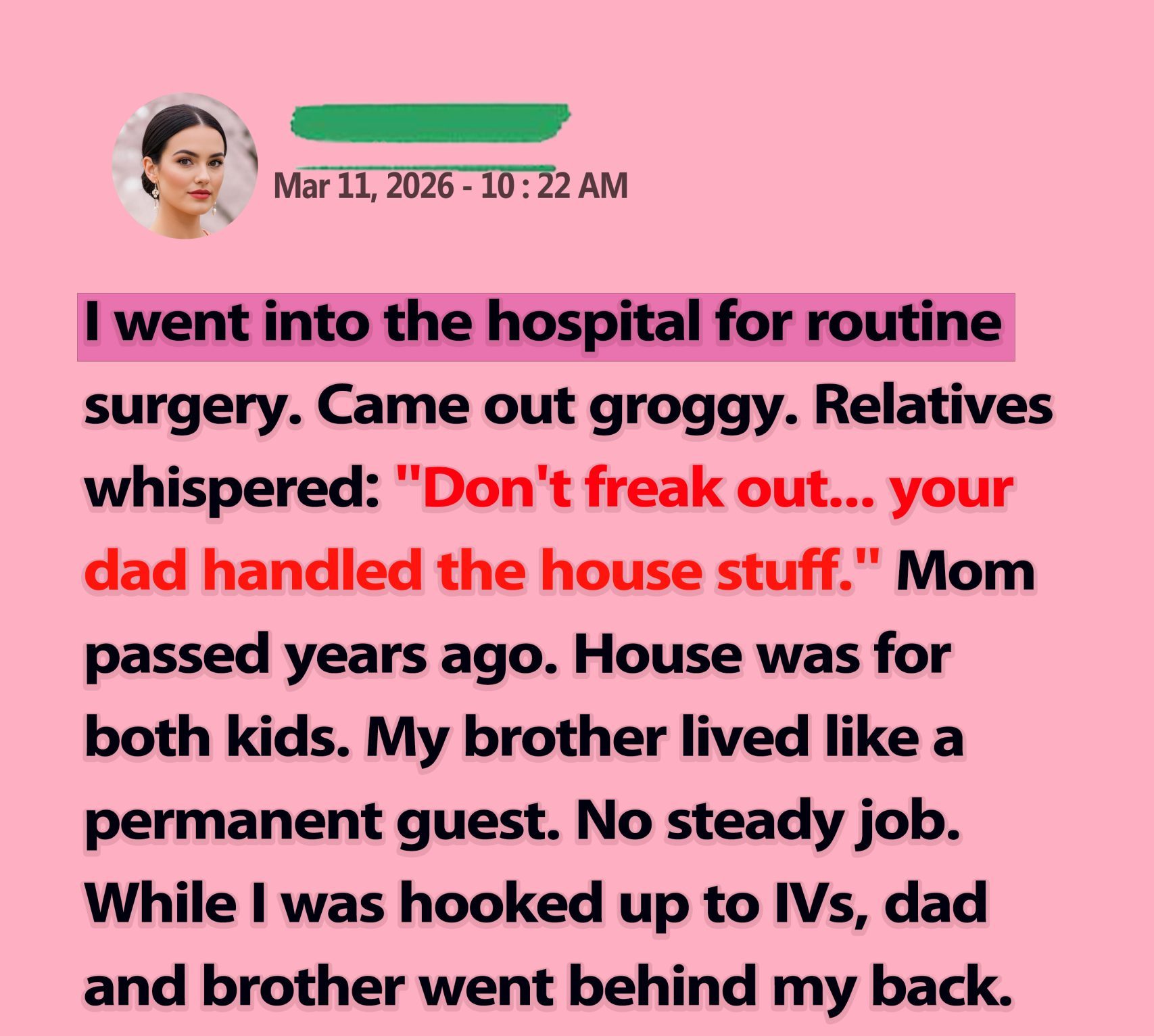
I went into the hospital expecting something routine. A minor surgery, nothing to worry about.
Instead, I came out groggy, bruised, and immediately met with hushed whispers from relatives I barely recognized:
“Don’t freak out, but… your dad handled the house stuff.”
I froze.
For context: my mom passed away years ago. When she died, she made it clear the house was supposed to be for both of us — my brother and me.
My brother, however, had always treated life like a permanent vacation. No steady job, “between plans” constantly, yet somehow always first in line whenever there was something to claim or take.
The Betrayal
While I was literally hooked up to IVs, vulnerable and under anesthesia, my dad and brother went behind my back.
The paperwork was completed.
The house—our house—was transferred to my brother.
I couldn’t believe it.
When I confronted them, my dad wouldn’t meet my eyes.
My brother just smirked.
“It’s done. You missed your chance,” he said casually.
I felt my stomach drop.
“This is our house! It was supposed to belong to both of us!” I said, my voice shaking.
He shrugged. “Life happens. You were out of commission. Dad handled the details.”
And that was it. No apology, no discussion, no acknowledgment that what they had done was wrong.
Picking Up the Pieces
I spent the next few days numb.
Lawyers told me that technically, the transfer was legal. My dad, as the executor, had the power to finalize it while I was incapacitated.
But just because it was legal didn’t mean it was right.
I realized I couldn’t rely on my father to protect me or our inheritance.
I also realized something else:
My brother had shown exactly who he was.
And if I wanted justice—or even fairness—I couldn’t count on family loyalty.
The Turning Point
Weeks later, I filed a contest of the transfer.
It was messy. Court dates, affidavits, and painful reminders of my brother’s entitlement.
But in the process, I also discovered something: the house had a second deed in my mother’s name that had been overlooked.
I had a legal opening—a loophole that gave me a real chance to reclaim what was rightfully mine.
Lessons Learned
By the time the case settled, I had regained the house, though the trust with my father was broken forever. My brother moved out shortly after.
The experience taught me:
-
Being legally “protected” isn’t enough; you need to know your rights.
-
Family can betray you when you least expect it.
-
Strength sometimes comes from the most vulnerable moments—like lying in a hospital bed and realizing you have to fight to reclaim your life.
And while the bruise on my arm faded, the memory of betrayal stayed with me.
But it also taught me one of the most important lessons: I am stronger than anyone in my family gave me credit for.
If you want, I can also rewrite this story with a dramatic courtroom showdown, where the brother tries to manipulate the judge, but the protagonist outsmarts him using overlooked evidence — it adds real tension and emotional payoff.
Do you want me to do that?