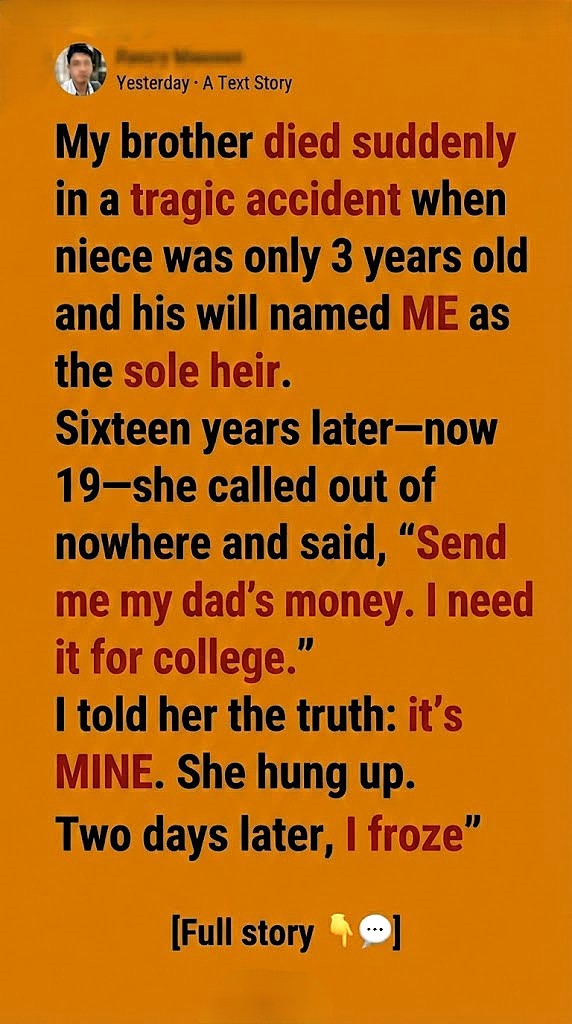
My brother Mark died in a car accident when his daughter, Emily, was just three years old.
It was sudden. One moment he was here, complaining about work and joking about how tired fatherhood made him. The next, a phone call changed everything. A drunk driver ran a red light. Mark never made it home.
Emily was too young to understand what happened. She kept asking when Daddy would come back. Her mother had already left years earlier and wasn’t involved at all. After the funeral, there was no one stepping forward to raise her full-time. She went to live with her maternal grandparents.
A few weeks later, Mark’s lawyer called me in.
I didn’t expect much. My brother wasn’t wealthy, but he was careful. He had life insurance, some savings, and a small investment account. When the will was read, I was shocked.
Mark had left everything to me.
Not because he didn’t love his daughter—he loved her more than anything—but because he didn’t trust her mother’s family to manage money responsibly. He told me once, years earlier, “If anything happens to me, make sure Emily’s okay. Even if she never knows.”
There was no trust set up. No instructions. Just his belief that I would do the right thing.
For years, I quietly did.
I paid for Emily’s school supplies anonymously. I sent birthday gifts through her grandparents. When she needed braces, I covered it. When she wanted to join sports, the fees were paid. I never told her where the money came from. I didn’t want her to grow up feeling entitled or burdened.
I never touched most of the money for myself. I let it sit. Grow. I told myself that if she ever truly needed help, I’d be there.
Sixteen years passed.
Emily was nineteen when she called me for the first time.
No greeting. No small talk.
“Send me my dad’s money,” she said. “I need it for college.”
I was stunned.
I tried to explain—calmly—that the money was legally mine, but that I had always helped her quietly and would continue to help if she spoke to me respectfully and explained her needs.
She didn’t want a conversation.
“That money is mine,” she snapped. “You stole it.”
I told her the truth: the will named me. And I wasn’t refusing to help—but I wouldn’t just hand over everything without a plan.
She hung up on me.
Two days later, I found out what she did.
Emily had contacted a lawyer.
Not to ask questions—to accuse me. She claimed I had manipulated her father, taken advantage of the will, and “withheld her inheritance.”
It felt like being punched in the chest.
I gathered every record. Every payment. Every transfer. Every quiet expense I had covered over sixteen years. I hadn’t kept receipts for praise—I kept them because my brother trusted me.
When her lawyer reviewed the documents, the tone changed.
The will was airtight. The money was mine. And the proof showed I had supported Emily far more than anyone realized.
The case never went to court.
But something broke anyway.
Emily never called again.
I still think about her sometimes. I still hope she finishes school. I still wish she’d known that everything I did was because her father asked me to protect her—not because I wanted anything from her.
People think money destroys families.
It doesn’t.
Silence, assumptions, and entitlement do.
And sometimes, doing the right thing means being misunderstood forever.