For Ryan, the rose pot on his windowsill was sacred. He’d blended his mother’s ashes into its soil, creating a living memorial. Each May, crimson roses unfurled, and he tended them with reverence—as if the flowers held his mother’s breath. But then came the day his estranged father’s clumsy hands sent the cherished pot shattering to the floor.

The roses always blossomed in May. Not during the month his mother, Rose, had passed—that was November—but in May, the season she had first planted them in the garden of his childhood home. At twenty-six, Ryan thought there was something beautifully poetic in the way life continued its cycles despite death’s finality.
He watered the plant on his windowsill, testing the soil with his finger the way she’d taught him. Not too wet, not too dry—a perfect balance.
The single pot didn’t demand much. Just the right blend of water and sunlight to coax the deep crimson buds into unfurling. A new bud was appearing now, small and green yet full of promise.
“Look, Mom,” he whispered as he touched it gently. “Another one’s coming.”
Salem, his black cat, brushed against his ankles, purring as if echoing the sentiment. Ryan leaned down to scratch behind her ears, rewarded with an appreciative meow.
Then his phone vibrated on the nightstand. He ignored it at first, but when it buzzed again, he exhaled sharply and picked it up. His father’s name lit up the screen.
Ryan’s thumb hovered over the decline button, but something—guilt, obligation, or perhaps the echo of his mother’s voice urging him toward kindness—made him answer.
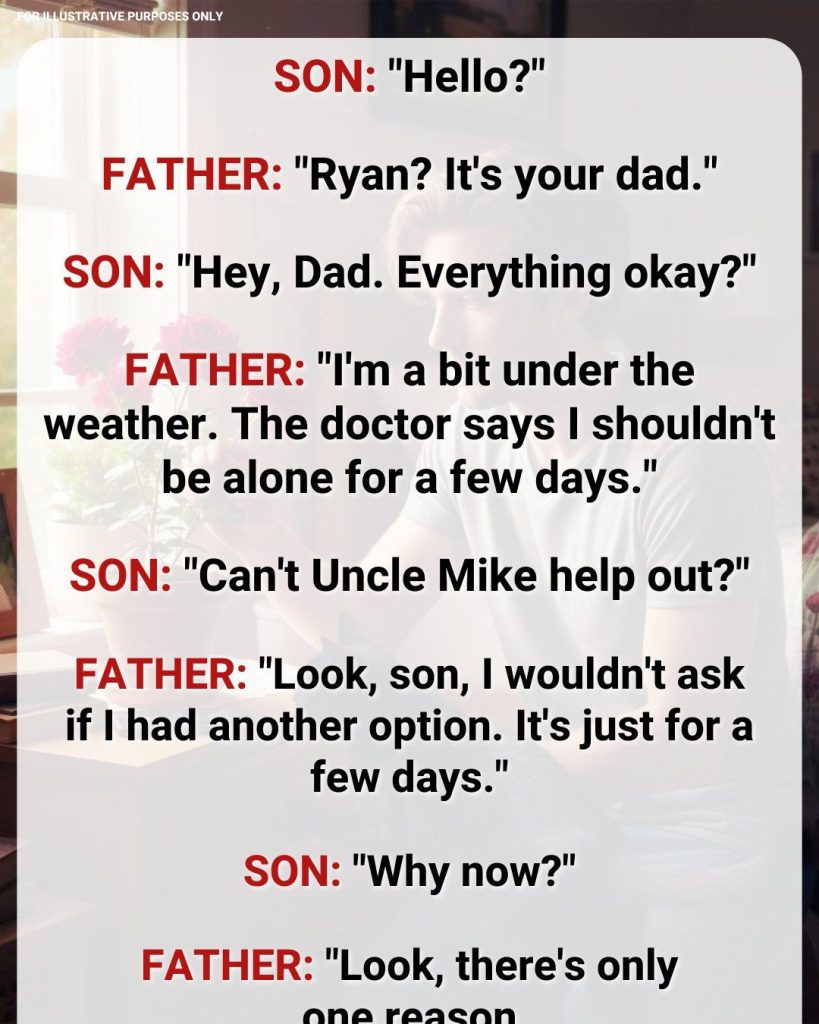
“Hello?” His voice was flat, devoid of emotion.
“Ryan? It’s your dad.”
Six years had passed since Rose’s death, yet father and son still spoke like strangers.
She had been the bridge between them, translating their different languages of love. Without her, silence had formed between them, broken only by obligatory holiday calls and occasional terse texts.
They were truly estranged now. Ryan kept his father at a distance, screened his calls, and responded minimally whenever contact became unavoidable.
Anger still simmered whenever Ryan remembered the empty chair beside his mother’s hospital bed during those final weeks—his father choosing the comfort of a bar stool over the pain of saying goodbye. Some betrayals, Ryan believed, were unforgivable.
“Hey, Dad.” Ryan leaned against the windowsill, staring at the cityscape. “Everything okay?”
“Not really,” his father, Larry, answered, and something in his tone made Ryan straighten. “I’m a bit under the weather. Nothing serious,” he rushed to add, “but the doctor says I shouldn’t be alone for a few days.”
Ryan closed his eyes. The library where he worked was entering finals week—the busiest time of year. He’d hoped to spend his evenings working on his novel, the one he’d been revising for nearly two years.
“Can’t Uncle Mike help out?”
“He’s away on some fishing trip. Look, son, I wouldn’t ask if I had another option. It’s just for a few days.”
Ryan glanced at the rose plant—its soil dark, sacred, infused with his mother’s ashes. What would she want him to do?
“Fine,” he said at last. “But Dad, my place is small, and I have routines. And personal boundaries. I need you to respect that.”
“Of course,” Larry said, relief obvious. “I’ll catch the afternoon bus. And a taxi to your place. Thank you, Ryan.”
Ryan hung up, already regretting it. Salem hopped onto the windowsill, nudging his hand.
“Well,” he told her, “looks like we’re having a visitor.”

When Larry arrived, he looked as if he had aged significantly since Christmas.
The lines around his eyes were deeper, his once-dark hair now completely gray. Or maybe Ryan just hadn’t cared to notice before.
“Nice place,” Larry said, dropping his duffel bag in the small living room. “Cozy.”
Ryan nodded stiffly. “You’ll sleep on the pull-out couch. Bathroom’s down the hall, kitchen’s over there. I work until six most days.”
“Still at the library?”
“Yes.”
An awkward silence settled. Larry cleared his throat. “How’s the writing going?”
Ryan was surprised he remembered. “It’s going… well.”
“Your mom always said you had talent.”
Ryan’s chest tightened at the mention of her. “There’s soup in the fridge if you’re hungry. I need to feed Salem.”
He retreated to his bedroom, where Salem waited on the bed. The rose plant stood sentinel in the window, bathed in the fading sunlight. Ryan touched one of its leaves, needing the connection.
“Just a few days,” he whispered. “Goodnight, Mom.”
Despite supposedly needing supervision, Larry showed impressive energy for a man his age. Ryan returned home the next evening to find his father had gone grocery shopping.
“You didn’t have anything but those microwave meals, son,” Larry complained before cooking a full dinner.
The next day, he mentioned catching a matinee at the theater nearby.
By the third evening, Ryan sensed something was wrong. He came home to an empty apartment and a note on the counter:
“Gone to catch the sunset at the beach. Back by 7. Sorry! :)”
Ryan crushed the note in his hand, jaw tight. He’d rearranged his life, sacrificed his writing time—for what? So his father could enjoy a free city vacation?
When Larry returned, cheeks red from sea air, Ryan confronted him.
“You’re not sick at all, are you?”
Larry had the grace to look embarrassed. “I may have exaggerated a bit.”
“Why would you lie to me?” Ryan asked sharply.
Larry sank onto the couch. “Because you wouldn’t have said yes otherwise. And I… I wanted to see you, spend some time together… and have a good few days in the city.”
“So you manipulated me instead of just asking? You could have just said you wanted to visit.”
“Would you have agreed?”
Ryan’s silence spoke for him.
He looked away, jaw tight, as if holding something back. Then he scoffed.
“You want honesty? Fine. When Mom was hooked up to chemo and couldn’t even keep water down, I was the one dragging her to appointments, holding her hair when she threw up… and lying to her that everything was going to be fine.”
His father opened his mouth, but Ryan continued.
“And you? You were off chasing your good time. Casinos, bars, late-night poker—like nothing back home was falling apart. She kept asking where you were, you know that? Even when she could barely breathe.”
Ryan drew a shaky breath, eyes bright though dry.
“So no… I wouldn’t have agreed. Because after she died, there was nothing left to say to you.”
Larry exhaled deeply. “I’m lonely, Ryan. The house is so empty now. The village is quiet. Everyone calls me ‘Rose’s husband’ or ‘Ryan’s dad.’ Sometimes I just need to be somewhere else, be someone else. I’m sorry for everything.”
For a split second, Ryan felt pity. Then he remembered the deceit. “You should have been honest. I’m going to bed. You can leave tomorrow.”
“Ryan—”
“Good night, Dad.”
The next day Ryan worked a late shift at the library. He left before his father woke, still smoldering with resentment. Throughout the day, he struggled to concentrate, snapping at a student who returned books stained with coffee and nearly shelving a biography in the fiction section.

By the time he climbed the stairs to his apartment, exhaustion had carved him hollow, leaving only the dull pulse of anger.
He wanted his space back—his quiet routine, his solitude with Salem and the rose plant, the two living beings who never asked for more than he could give.
The apartment was silent when he entered. Perhaps his father had already left. Relief washed through him, quickly followed by guilt. But as he hung his jacket, he heard movement in his bedroom.
“Dad?” he called.
“In here,” Larry replied, his voice subdued.
Ryan walked in—and froze.
His father stood beside the trash can, broom in hand, sweeping up shards of terracotta. Among tissues and torn receipts lay the stems and leaves of his rose plant.
His knees nearly buckled, a cold rush flooding his body.
“WHAT DID YOU DO?”
Larry looked up, guilt stark in his eyes. “I’m so sorry, Ryan. I was trying to open the window. Your room felt stuffy… and my elbow knocked the pot over. I cleaned up as best I could.”
Ryan shoved past him, hands shaking as he dug through the trash. His fingers closed around broken roots, torn leaves—and then the soil.
The soil containing his mother’s ashes—now mixed with wrappers, tissues, and filth.
“Do you even know what you’ve done? How could you?”
Larry frowned. “It’s just a plant. We can get another—”
“It had Mom’s ashes in it!” Ryan’s voice exploded, fueled by years of grief and anger. “When we scattered her ashes at the lake, I kept some. I mixed them in the soil. Every time it bloomed, it was like she was still here… still with me.”
The color drained from Larry’s face. “What?? Ryan, son, I didn’t know—”
“How could you? You never asked about my life, never cared enough to notice what mattered to me.” Tears blurred Ryan’s vision. “She was all I had, and now you’ve thrown her away like trash.”
“That’s not fair,” Larry insisted. “I loved your mother more than anything in this world.”
“Did you? Then where were you when she was gasping for air at three in the morning? When nurses couldn’t calm her and she cried out for you? Because after she died, you just checked out. Left me to handle everything alone. And now this.”
Ryan cradled the broken stems. “I want you gone. Now.”
Larry stood motionless for a moment before nodding. “I’ll pack my things.”
Ryan didn’t watch him leave. Instead, he gently collected whatever soil he could salvage, picking out bits of garbage.
He found a small pot in the back of a cabinet, filled it with the rescued soil, and carefully replanted the broken stems—though he knew they probably wouldn’t survive.
His trembling fingers hovered over the wilted petals.
“I’m sorry, Mom,” he whispered. Tears soaked the soil as he held the broken stems. “I should’ve protected this… protected you.”
Three years passed.
Ryan finished his novel—a story about loss, forgiveness, and the ties that bind families even beyond death. A small publishing house accepted it. Not enough to let him quit his library job, but a beginning.
He moved to a slightly bigger apartment with a small balcony where he kept a garden of potted plants. The salvaged rose had died, as he’d expected, but he planted new ones, mixing the remaining special soil with fresh earth. They weren’t the same, but they bloomed beautifully each May.
The call came on a Tuesday evening. Uncle Mike’s voice was tired and grave as he told him Larry had suffered a massive heart attack. He hadn’t survived.
“The funeral’s on Saturday,” Uncle Mike said. “Everyone’s hoping you’ll come.”
Ryan thanked him mechanically before hanging up, feeling only an empty hollowness. Salem jumped into his lap, sensing his distress, and he stroked her absently.
Saturday morning, Ryan sat at his desk, staring at his laptop instead of putting on the dark suit hanging in his closet.
Relatives’ texts buzzed on his phone, asking where he was. He ignored them.
He opened a new document and began to type:
“Dear Dad,
I’m not at your funeral today. I should be, but I’m not. Maybe that makes me a terrible son, but I think we both know I learned how to be absent from the best.
I’ve spent three years angry with you. Three years holding onto the memory of that day when you broke something precious to me. Three years of not returning your calls or reading your letters.
But today, I realized something. You didn’t just break Mom’s rose pot that day. You broke something else… the wall I’d built around her memory, the shrine I’d made that kept her separate from the messy reality of life going on.
Mom wasn’t in that soil, not really. She’s in the way I arrange my books by color because it made her smile. She’s in how I always keep fresh flowers on the table. She’s in my love of thunderstorms and chocolate for breakfast and a thousand other small things.
And hard as it is to admit, she’s in you too. In your hands that look just like hers. In your laugh that sometimes catches me off guard because it sounds so familiar.
I didn’t come today because I’m still learning how to forgive. But I am trying, Dad. I’m trying.
Your son, Ryan.”
He leaned back as tears streamed down his cheeks. Outside, a gentle spring rain tapped against the budding roses. Ryan watched them quietly, then picked up his phone and dialed Uncle Mike.
“I can’t make it today,” he said when Mike answered. “But tell everyone I’ll visit soon. I’d like to see where they buried him.”
After ending the call, Ryan stepped out to his balcony garden. On the windowsill sat a potted rose—a new home for the remnants of his mother’s ashes he’d managed to save. Beside it, he placed a framed photo he’d found that morning: his parents on their wedding day, young, smiling, full of hope.
“I’m working on it, Mom,” he whispered into the rain. “I’m working on it.”