I was eighteen when my mom sat me down at the kitchen table—the same table where I used to do puzzles as a kid, where she once cut the crusts off my sandwiches—and handed me a small, folded piece of paper. I thought it was a note, maybe a reminder to clean the garage or pick up my sister after school.
But when I opened it, I blinked twice.
It was a bill.
Rent: $150 a month.
Due the first week.
For a moment, I thought it was a joke. My mom was strict, but never cruel. She wasn’t the type to suddenly flip into drill-sergeant mode.
When I looked up, she was watching me, calm but serious.
“Mom… what is this?”
“Rent,” she said simply. “You have a job now. You’re an adult. It’s time to start taking responsibility.”
The words hit me harder than I expected. I felt blindsided. Angry, even. Most of my friends were still living at home for free, eating their parents’ groceries, getting help with gas money. And now my own mother—the person who raised me, who worked double shifts for years—wanted rent from me?
I didn’t argue.
But I went to my room feeling betrayed.
For months, I paid that rent. I’d fold the money and leave it on the counter every first week of the month. Mom never missed a payment reminder, either. She wasn’t harsh about it—just consistent. Unshakeable.
Still, every time I handed over that cash, a tiny part of me resented her. I didn’t say it out loud, but I thought it:
Why would a parent charge their own kid to live at home? Doesn’t she care? Doesn’t she want to help me?
I almost moved out several times just to prove a point. But rent in the real world was triple what she asked for, and I knew I wasn’t ready.
Life kept moving. I learned to budget. I learned that if I wasted money on nonsense, the first week of the month was going to hurt. I learned responsibility—though I didn’t admit that to her.
Months passed. Then a year. Our relationship stayed the same, but there was a small, silent distance between us, one I didn’t know how to close.
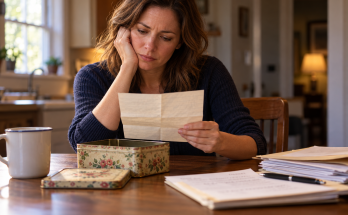
Everything changed on the night I came home from work and found her sitting at the table with a shoebox in front of her.
“Sit,” she said softly.
I did.
She opened the shoebox and pulled out a stack of envelopes—messy, rubber-banded together, some with my handwriting on them.
“What’s that?” I asked.
“Your rent,” she said.
My breath caught.
“What do you mean, my rent?”
She pushed the envelopes toward me.
“I didn’t spend a single dollar of it,” she said. “I saved every payment. I wanted you to learn to be responsible—but I wasn’t going to take anything from you.”
I stared at the envelopes. There must have been over a thousand dollars there. Maybe more.
“I charged you rent,” she continued, “because when I was your age, no one taught me how to handle money. I didn’t want you to start adulthood unprepared. I wanted you to build the habit now, while you still had a safety net.”
She took a deep breath, her voice trembling just slightly.
“And I saved it… because someday you’ll need it. First apartment. Car trouble. College. Anything. I wanted you to have something to fall back on.”
My throat tightened. Suddenly, the resentment I had been carrying for so long felt childish and small.
She wasn’t charging me rent to punish me.
She was teaching me.
Protecting me.
Preparing me.
I realized something then—something that changed the way I saw her forever:
Parents don’t always show love in the ways we expect.
Sometimes love looks like discipline.
Sometimes love looks like sacrifice.
Sometimes love looks like a stack of envelopes saved quietly in a shoebox.
I looked at my mom—not as the strict woman who demanded rent from her teenage kid, but as the parent who had always found a way to guide me, even when I didn’t understand.
“Thank you,” I whispered. It was all I could manage.
She smiled, not with pride, but with relief.
“I just wanted you to be ready,” she said. “Life is easier when you learn early.”
And she was right.
To this day, that shoebox sits in my closet—not for the money, but as a reminder of what I finally discovered:
Love isn’t always comfortable. But real love prepares you for the world—and stays with you long after you step into it alone.