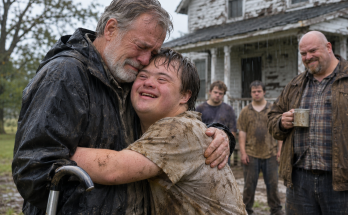
I thought I knew who I could trust.
At sixty-two years old, I should have known better than to take something like that for granted.
My name was Walter.
For thirty years, I coached wrestling at a high school in Springfield, Missouri.
I understood hard work.
I understood what it meant to lose something you had worked for and have to start again.
What I didn't understand was how completely a person could misunderstand someone they loved.
My son Tucker was nineteen.
He had Down syndrome, and he was the best part of my life.
There wasn't a day that passed when I didn't find some reason to be grateful that I was his father.
Tucker enjoyed the things that a lot of people were too busy to appreciate.
Country songs.
A familiar face at work.
An afternoon with our old dog, Duke.
He worked at a supermarket, putting customers' groceries into bags.
Having that job meant something to him.
It meant something to me, too.
I wanted him to experience the satisfaction of doing something useful, earning his own money, and belonging somewhere outside our home.
Being his father had never meant deciding that he couldn't have those things.
It meant helping him find his own way toward them.
There were plenty of things Tucker could do without my help.
There were others where he needed somebody beside him.
I understood the difference.
Or at least I believed I did.
I'd had years to learn.
Tucker was only five when his mother died.
Five years old.
There was no preparation for becoming the only parent of a little boy who had just lost his mother.
I was grieving my wife while trying to make sure that my son still felt secure in the world.
Some days, those two responsibilities seemed impossible to carry together.
But Tucker needed me.
That was enough to get me through them.
I spent the next ten years raising him without a wife beside me.
It wasn't always easy, and I won't pretend that I handled everything perfectly.
I made mistakes.
I worried too much about certain things and not enough about others.
But I never questioned whether Tucker belonged with me.
He was my son.
Our home was his home.
There wasn't anything complicated about that.
When people talked about the sacrifices involved in raising a child with a disability, I sometimes struggled to find the right response.
I didn't see Tucker as a sacrifice.
He was a person who had brought happiness into my life when I thought happiness might be gone for good.
He had his own interests.
His own opinions.
His own reasons for smiling.
I loved watching him become more independent.
I also knew that independence didn't mean leaving somebody without support.
That distinction mattered.
Much more than I understood at the time.
For years, it had been Tucker and me.
Then Brenda came into our lives.
She attended church and had lost her husband.
There was something comforting about knowing that she understood what it was like to lose a spouse.
I didn't have to explain every difficult feeling.
There were things about grief that we both recognized without having to find words for them.
What mattered most to me, though, was how she treated Tucker.
I wasn't looking for a woman who would merely tolerate my son.
I couldn't imagine sharing my life with somebody who thought of him as an inconvenience.
Brenda appeared to understand that.
She seemed gentle with him.
Patient.
Willing to accept him as part of the life we would share.
She told me that her affection for him was no different from the love she would have felt for her own child.
I believed her.
Looking back, I sometimes wonder how much of that belief came from wanting it to be true.
I'd spent a decade being responsible for everything.
There was something deeply reassuring about the idea that another adult cared about Tucker as much as I did.
It made the future seem less frightening.
I wasn't getting younger.
Thirty years of coaching had taught me that strength didn't last forever.
Neither did good health.
I wanted to believe there would always be somebody who understood how precious my son's happiness was.
Brenda seemed like that person.
We got married four years before the stroke.
I believed I was giving Tucker and myself a larger family.
Not replacing his mother.
Nobody could do that.
I simply thought there was room in our lives for another person who loved us.
For the first time in years, I allowed myself to imagine that I didn't have to carry every responsibility alone.
That was a tremendous relief.
I didn't realize how much trust I was placing in that feeling.
Click here to continue reading: PART 2: When My Body Suddenly Stopped Cooperating, I Had to Place My Son’s Well-Being in the Hands of the Woman I Had Married
I Had Spent Thirty Years Teaching Boys How to Get Back on Their Feet, but Nothing Prepared Me for What Happened to My Own Family
Part 1 of 10