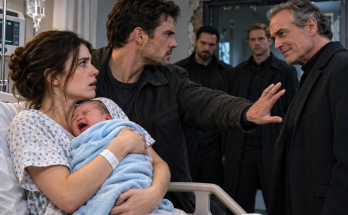
On Noah's first birthday, I baked a chocolate cake.
It wasn't particularly beautiful.
The frosting leaned slightly to one side, and Logan insisted that the decorations looked like they had been applied by somebody wearing winter gloves.
I told him he was welcome to make the next one.
He stopped criticizing it.
Noah sat in his high chair, banging a plastic spoon against the tray.
Every few seconds, he looked at us and laughed.
I watched him.
One year.
An entire year of little moments that nobody had been permitted to turn into an experiment.
His first smile.
His first tooth.
His first attempts to crawl.
His first word, which Logan insisted was Daddy even though it sounded considerably more like random noise.
I had written those milestones in a small notebook.
Not because anybody required me to.
Because I wanted to remember them.
There was an important difference.
A year earlier, I had walked into a hospital carrying one suitcase.
I had expected to bring my baby home a couple of days later.
Instead, I had discovered that strangers had maintained records about me for nearly three decades.
I had learned that the man I loved carried my subject number beside his ear.
And I had watched people attempt to claim an authority over our child that they had never possessed.
Much had happened since then.
The investigation had expanded.
Former subjects had been located and interviewed.
Documents that had remained concealed for years had been examined.
Some records had been permanently lost.
Others had survived in places the original administrators apparently hadn't expected anyone to search.
The truth hadn't appeared all at once.
It had emerged page by page.
Witness by witness.
Sometimes a single document explained something I had wondered about my entire life.
Other times, an entire folder left me with more questions than answers.
I learned to live with that.
The criminal proceedings had taken months.
Dr. Mercer maintained that his work had been motivated by scientific advancement.
He argued that the research had the potential to produce important medical discoveries.
He described the original children as participants in a pioneering program.
That word bothered me.
Participants.
It suggested we had volunteered.
It suggested somebody had explained what would happen and given us the opportunity to refuse.
I remembered the photograph.
Children standing against a wall.
Identical clothes.
A little girl with her foot turned inward.
A little boy who would spend decades carrying somebody else's number.
We hadn't volunteered.
We had been children.
When I was asked to provide testimony, I brought a copy of my mother's letter.
Rachel had explained what I should expect.
Still, sitting inside that courtroom was harder than I had imagined.
Dr. Mercer was there.
He looked much as he had when he entered my hospital room.
Older.
Neatly dressed.
Composed.
I remembered the way he had examined Noah.
The questions he had asked about conception.
The word he had used.
Interesting.
I had hated that word ever since.
During my testimony, I was asked whether I understood the potential scientific significance of Noah's birth.
I answered as plainly as I could.
"No."
I was asked whether Dr. Mercer had attempted to explain that significance to me.
"No."
I was asked whether I had consented to my newborn becoming part of the Continuity Research Initiative.
"No."
Then I was asked whether I would have agreed to participate had the proposed research been explained differently.
I looked toward the attorney questioning me.
"No."
He asked why.
I thought the answer was obvious.
But apparently, it needed to be said aloud.
"Because my baby wasn't born to finish somebody else's work."
The courtroom became quiet.
I continued.
"He was born because two people loved each other and had a child."
Nobody interrupted me.
"He didn't owe anybody anything."
When I finished speaking, I returned to my seat.
Logan reached for my hand.
I held it tightly.
Evelyn testified during the proceedings.
She spoke about the original facility.
She described the children.
She explained how concerns had been ignored and information concealed.
She acknowledged her own failures.
There were moments when she struggled to continue.
But she did.
I watched her accept questions that were uncomfortable.
Questions about why she had stayed.
Why she had remained silent.
Why she had taken so long to speak.
She didn't try to present herself as a hero.
That mattered to me.
Eventually, the evidence established that serious unlawful activities had occurred within the program and its associated operations.
Dr. Mercer was convicted on charges supported by the documented evidence.
Several other individuals were also held criminally accountable.
Not everybody involved received the same outcome.
Some cases remained unresolved.
Some individuals had died before investigators could question them.
Some evidence was too incomplete to establish individual responsibility.
I found those limitations frustrating.
But I understood that justice required proof.
I didn't want anybody condemned merely because their name appeared on a page.
I knew better than most people how dangerous that could be.
The surviving research records were placed under appropriate legal controls.
The remaining operations connected to the unauthorized program were brought to an end.
Former subjects were offered opportunities to obtain information about their histories and pursue appropriate remedies.
For the first time, many of us could ask questions without being treated as the property of the people holding the answers.
Noah's records were protected from unauthorized research use.
His ongoing medical care remained with independent physicians.
He was growing normally.
Whatever the program's administrators believed his birth represented, they had no established basis for treating him as anything other than a child entitled to ordinary care and protection.
That was enough for me.
There were also discoveries concerning our biological families.
Some brought answers.
Others brought grief.
Daniel eventually located additional information about Margaret.
My biological mother.
She had died several years before I began searching for her.
I read the message alone in our bedroom.
For a long time, I sat on the edge of the bed without moving.
I had known that finding her alive wasn't guaranteed.
Still, some foolish part of me had already imagined meeting her.
I imagined sitting across from her in a coffee shop.
I imagined studying her face for familiar features.
I imagined asking whether she had thought about me.
Now those conversations would never happen.
Daniel had found surviving correspondence indicating that questions had been raised about the circumstances surrounding my placement.
The documents didn't answer everything.
But they suggested Margaret had sought information about me after we were separated.
I cried when I read that.
I had spent years wondering whether my biological mother had simply forgotten me.
Now I knew she had at least tried to learn something about what happened to her daughter.
I couldn't prove what she felt.
I couldn't recover the relationship we had lost.
But I no longer believed her silence necessarily meant she hadn't cared.
I placed a copy of the correspondence beside my adoptive mother's letter.
Two women.
Different circumstances.
Both connected to the beginning of my life.
Neither had been given the complete truth.
I wished I could have thanked them.
Instead, I decided that Noah would grow up knowing about both of them when he was old enough to understand.
Logan's discoveries were different.
Some information about his biological family remained unavailable.
He recovered his original recorded birth date and several documents concerning his early childhood.
He began using the correct date for his birthday.
The first time we celebrated it, I bought a small cake.
No candles shaped like numbers.
Just ordinary candles.
He stood beside the kitchen counter looking embarrassed.
"You didn't have to do all this."
"I know."
He looked at the cake.
Then at me.
"Nobody's ever celebrated this date with me."
I took his hand.
"We're starting now."
He cried before blowing out the candles.
I pretended to be busy cutting the cake.
Some feelings deserved a little privacy.
A few months after the investigation began, Logan asked me what I thought about removing the marking beside his ear.
I looked at it.
C-17.
My old designation.
His lifelong burden.
"What do you want?"
He thought about it.
"I don't know."
"Then you don't have to decide today."
He nodded.
Eventually, after the marking had been properly documented for the legal proceedings, he consulted a qualified professional about his options.
He chose to have it gradually removed.
There was still a faint trace afterward.
He didn't mind.
"It's not about pretending it never happened."
I understood.
He wanted his body to feel like his own.
He wanted to look in the mirror without seeing an identifier somebody else had selected for him.
One evening, I noticed that he had cut his hair shorter.
The little area beside his ear was visible.
He caught me looking.
"What?"
"Nothing."
He smiled.
For years, he had hidden that spot from everyone.
Now he no longer felt obligated to.
We still had difficult days.
Sometimes Logan woke from a nightmare.
Sometimes an unexpected telephone call made my stomach tighten.
The sound of somebody moving a door handle could bring me back to that hospital room before I had time to think.
We both sought professional support.
We talked about things that were easier to avoid.
His disappearance.
My fear of being abandoned.
His fear of losing Noah.
The anger we carried toward people whose decisions had shaped our lives.
Healing wasn't something that happened because the courtroom proceedings ended.
It happened slowly.
Through honest conversations.
Through difficult mornings.
Through ordinary evenings when nothing frightening occurred.
Logan kept his promise about not making important decisions for me.
Sometimes we disagreed.
Sometimes we argued.
But we talked.
And neither of us disappeared.
Evelyn remained part of our lives, although our relationship changed.
She cooperated with the investigations and accepted the consequences of her involvement.
I never told her that helping us escape had erased her earlier silence.
It hadn't.
But I also never forgot the nurse who had held my hand while I gave birth.
The woman who had tied my shoes when I was trembling.
The person who had finally decided to tell the truth, even when doing so exposed her own mistakes.
One afternoon, she visited us.
Noah was beginning to walk while holding onto furniture.
She watched him move along the sofa.
"Look at him."
I smiled.
"He's getting braver."
She nodded.
Then she looked at me.
"Do you think you'll ever forgive me?"
I considered the question.
"I don't know if forgiveness means the same thing to both of us."
She waited.
"I don't want you spending the rest of your life pretending you can't do anything good because you once did something wrong."
Her eyes filled.
"But I don't want you forgetting what happened, either."
"I won't."
I believed her.
She stayed for tea.
Noah eventually fell asleep against her shoulder.
I watched her hold him.
There was sadness in her expression.
But there was affection, too.
Real affection.
The kind that didn't require a file or a medical justification.
Daniel continued helping former subjects locate surviving records.
Some of them contacted us.
Others preferred to maintain their privacy.
We respected that.
We didn't all need to become friends simply because we had experienced similar things.
Everybody deserved the freedom to decide how much of the past they wanted to revisit.
Rachel remained available whenever another legal question arose.
Thomas occasionally provided information through the appropriate channels as unresolved matters progressed.
There was no single day when every question disappeared.
Life simply began containing more things that had nothing to do with the investigation.
Noah's first birthday was one of those days.
Evelyn brought a small wooden toy.
Daniel brought a children's picture book.
Rachel sent a card.
Logan spent far too much money on balloons.
I told him Noah would probably enjoy the empty boxes more than the presents.
He insisted that birthdays required balloons.
I didn't argue.
We placed the chocolate cake in front of Noah.
One candle stood in the center.
He stared at it.
Logan held him while I helped blow it out.
Everyone applauded.
Noah laughed.
Then he reached toward the frosting.
Within seconds, chocolate covered his fingers, his cheeks, and part of Logan's shirt.
I laughed harder than I had in months.
Nobody measured his reaction.
Nobody recorded his behavior for scientific analysis.
Daniel took a photograph after asking whether I minded.
I said yes.
Yes, he could take the picture.
Yes, we could keep the memory.
Yes, ordinary happiness belonged in our lives.
That evening, after everyone left, I carried Noah into his bedroom.
I changed him into clean pajamas.
Then I sat beside his crib and rocked him until his eyes closed.
The pale blue blanket was folded nearby.
He had outgrown the first little clothes I packed before his birth.
I had kept one pair of socks.
They were tucked inside the brown suitcase beneath our bed.
After putting Noah down, I retrieved that suitcase.
Logan came into the bedroom while I was opening it.
"What are you looking for?"
"Nothing in particular."
I lifted the old photograph.
The eighteen children stood together beneath the printed date.
I touched the little girl.
Then the boy.
For so long, I had looked at them and seen everything that had been taken away.
That evening, I saw something different.
They had survived.
They had grown up.
They had fallen in love without knowing how much history they shared.
And when somebody tried to claim their child, they had refused.
I showed Logan the photograph.
He sat beside me.
"Hard to believe that's us."
"I know."
I returned it to the suitcase.
Then I placed Noah's birthday photograph beside it.
The difference between the two pictures made me cry.
In the first, children stood where adults had instructed them to stand.
In the second, a little boy was covered in chocolate while everyone around him laughed.
No identification numbers.
No identical clothing.
No frightened faces.
Just a family celebrating a birthday.
I closed the suitcase.
Logan reached for my hand.
From Noah's bedroom came a small sound.
We both stood.
He went to check on him while I turned off the bedroom light.
When I joined them, Logan was standing beside the crib.
Noah had already settled again.
We watched him sleeping.
I remembered the stranger in the hospital calling him the first naturally born child.
At the time, those words had terrified me.
Now I understood that the most important thing about Noah had nothing to do with being first.
He was a little boy.
He would grow.
He would make mistakes.
He would discover things about himself that neither Logan nor I could predict.
And those discoveries would belong to him.
When he was older, we would tell him the truth about his beginning.
Not to frighten him.
Not to burden him with our history.
Because nobody should have to spend twenty-nine years searching for information that belonged to them from birth.
I bent down and kissed his forehead.
"Good night, Noah."
Logan placed his arm around my shoulders.
We stood there a little longer.
I thought about my adoptive mother.
My father.
Margaret.
The children in the photograph.
The nurse who finally spoke.
And the frightened woman who had entered a hospital alone carrying a brown suitcase.
I wished I could tell that woman how her story would end.
Not with every question answered.
Not with every wound healed.
But with a home filled with ordinary things.
A grocery list.
A changing table.
A chocolate cake.
A little boy sleeping peacefully in his own room.
For twenty-nine years, people had tried to define my life using a number.
They had done the same thing to Logan.
They had intended to continue with Noah.
They never got that chance.
My son's name was Noah.
His life was his own.
And that was the ending those people had never planned for.
It was the only one I had ever wanted.
The End
Read more original stories on Feel Every Story.
I Arrived at the Hospital With Nobody Beside Me, but the Nurse Who Read My Admission Papers Already Knew My Name
Part 10 of 10