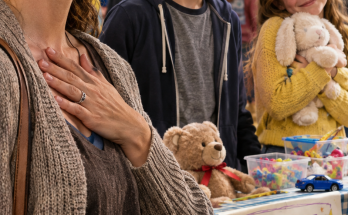
The first time Gavin told me that nobody had approached a child on the blue bench, I didn't know what to say.
I had grown used to hearing good news about it.
A younger student finding a playmate.
Two children inviting somebody into a game.
A quiet child making a friend.
Those were the stories Gavin liked bringing home.
But this time, he came through the front door without much to say.
He dropped his backpack beside the stairs.
I reminded him where it belonged.
He picked it up without arguing.
That alone told me something was bothering him.
I was cutting vegetables for dinner.
He came into the kitchen and sat at the table.
For several minutes, he watched me work.
Then he asked a question.
"Mom, what if nobody comes?"
I turned around.
"Nobody comes where?"
"To the bench."
I put down the knife.
"Has that happened?"
He nodded.
I pulled out a chair.
"Tell me."
He said a boy named Oliver had been sitting on the blue bench during recess.
Oliver was new to the school.
He was in Gavin's grade but had been assigned to a different classroom.
Gavin didn't know much about him.
Only that he had moved during the middle of the school year.
And that he didn't seem to know many children yet.
I asked whether Oliver had been sitting there alone.
Gavin nodded.
"Yesterday and today."
"Did anyone invite him to play?"
"Not yesterday."
"What about today?"
Gavin shook his head.
I waited.
He looked down at his hands.
"I went over, but he said he didn't want to."
I nodded.
"Maybe he wanted to be by himself."
"That's what I thought."
Gavin paused.
"But then he went back again."
I understood what was troubling him.
The bench was supposed to help children who wanted company.
But it couldn't make somebody accept an invitation.
And it couldn't guarantee that friendship would happen.
I told Gavin that.
He didn't look satisfied.
"What if he wants someone to ask again?"
I thought about it.
"Then you could ask again."
"What if that bothers him?"
"Then listen when he tells you."
Gavin stared at the table.
I could see him working through the problem.
He wanted a clear answer.
I didn't have one.
Most adult problems aren't solved by a single good rule.
Friendship isn't either.
I knew that.
But I was only beginning to realize how much Gavin needed to learn it.
The next afternoon, he came home with the same worried expression.
Oliver had sat on the bench again.
This time, Gavin hadn't approached immediately.
He had waited for another child to notice.
Nobody did.
So he sat down beside Oliver.
I asked what happened.
Gavin told me they sat quietly for several minutes.
Then he asked whether Oliver liked basketball.
Oliver said no.
He asked about soccer.
Another no.
Gavin tried video games.
Oliver shrugged.
I smiled a little.
"That sounds like a difficult conversation."
Gavin nodded.
"Really difficult."
I asked what he did next.
He said he stopped asking questions.
He just sat there.
After a while, Oliver took a small notebook out of his pocket.
It had a drawing of a dragon on the cover.
Gavin asked whether he could see it.
Oliver opened the notebook.
Inside were drawings of strange creatures, castles, and imaginary animals.
Gavin described them while I listened.
One creature had four wings.
Another had a tail covered in spikes.
There was a dragon that seemed to be made entirely of smoke.
Gavin looked impressed just talking about it.
"He's really good, Mom."
I smiled.
"Did you tell him?"
"Yeah."
"What did he say?"
"Thanks."
I waited.
Gavin smiled a little.
"Then he showed me another drawing."
I asked whether they had talked after that.
He nodded.
For the rest of recess.
I thought that was the end of the problem.
But Gavin wasn't smiling the way I expected.
He looked at me.
"Then he said something."
I set aside the dish towel I was holding.
"What?"
Gavin said Oliver had asked whether he was sitting there because the teachers told him to.
That surprised me.
I asked what Gavin had said.
He told Oliver no.
Then Oliver asked whether Gavin was doing it because of the bench.
Gavin said he hadn't known how to answer.
I could understand why.
The bench had brought them together.
But he hadn't stayed because he felt obligated.
He had stayed because Oliver's drawings were interesting.
I asked Gavin whether he had explained that.
He shook his head.
"Not very well."
I leaned back.
"What did you say?"
He looked embarrassed.
"I told him his dragon was cool."
I smiled.
"That sounds like a good answer."
He considered it.
Then he nodded.
"Maybe."
The following morning, I drove Gavin to school.
He was quieter than usual.
I asked whether he was worried about Oliver.
He said a little.
Then he looked out the window.
"I don't want him thinking he's some kind of project."
Those words stayed with me.
A project.
I knew exactly what he meant.
The school had praised the Second Chance Table.
The teachers had supported the blue bench.
The adults had been pleased to see children showing kindness.
But kindness could become uncomfortable when the person receiving it felt watched.
I had seen how quickly people congratulated Gavin for helping Chloe.
And I remembered how embarrassed he had been.
Now I wondered how Chloe had felt.
Had we given her enough privacy?
Had we remembered that she was more than the shy girl with the white rabbit?
I hadn't thought about it carefully enough.
I reached over and touched Gavin's shoulder.
"You don't have to fix Oliver's life."
He looked at me.
"I know."
"You can just be his friend."
He was quiet.
Then he nodded.
"That's what I want."
At the school entrance, he grabbed his backpack.
Before getting out, he leaned toward me.
He gave me a quick hug.
Then he looked toward the sidewalk to make sure nobody had seen.
I pretended not to notice.
He ran toward the building.
I watched him disappear inside.
That afternoon, I received a message from Mrs. Gallagher.
She wanted to speak briefly when I came to collect Gavin.
I felt the familiar tightening in my stomach.
The school's number still made me nervous.
Even after everything that had happened.
When I arrived, Mrs. Gallagher was waiting near the office.
She smiled when she saw me.
I felt relieved.
She explained that the blue bench had been working well.
But there were a few things the teachers wanted to improve.
Some students were treating it like an organized activity.
Others believed children who sat there always needed help.
And a few had begun approaching classmates just to receive praise from adults.
I listened carefully.
Mrs. Gallagher didn't sound angry.
She sounded thoughtful.
She said the teachers were going to explain the purpose of the bench again.
The idea was simple.
Anyone could use it.
Nobody had to explain why.
And no child was responsible for making another child happy.
I nodded.
That sounded right.
Then she mentioned Oliver.
She said he had been having a difficult time settling into his new school.
His family had recently moved.
He was still learning the routines.
And he missed the friends he had known before.
I asked whether Gavin had done something wrong.
She shook her head.
"Quite the opposite."
I felt my shoulders relax.
She told me Gavin had been sitting with Oliver during recess.
They had been talking about drawing.
And that afternoon, Oliver had joined a small group of students who were working on a classroom art project.
Mrs. Gallagher smiled.
"He seems more comfortable."
I thought about Gavin describing the dragons.
I remembered how pleased he had been.
Then Mrs. Gallagher said something I didn't expect.
"Oliver asked me whether Gavin was always that patient."
I smiled.
"What did you tell him?"
She laughed.
"That he has his moments."
I laughed, too.
She knew my son.
Not just the boy from the fair.
The actual boy.
The one who could be impatient.
The one who made jokes during serious conversations.
The one who forgot his homework folder and then tried to explain why the folder was the problem.
That made her praise mean more.
Mrs. Gallagher said Gavin had invited Oliver to join a group drawing project after school.
The invitation had been accepted.
But she wanted to make sure I knew about it because the project would sometimes require staying an extra half hour.
I told her that was fine.
As long as I knew the schedule.
She thanked me.
Then she headed back toward her classroom.
I went to find Gavin.
He was waiting near the front entrance.
Oliver stood beside him.
The two boys were looking at a notebook.
Gavin noticed me first.
"Mom."
I smiled.
"Ready?"
He nodded.
Then he turned toward Oliver.
"This is my mom."
Oliver looked up.
He had dark hair and serious eyes.
He held the notebook close to his chest.
"Hello."
I smiled.
"Nice to meet you."
He nodded politely.
Gavin pointed at the notebook.
"Show her the dragon."
Oliver hesitated.
I could see it.
The same uncertainty I remembered from Chloe.
That moment when a child tries to decide whether an adult actually wants to see something.
I didn't reach for the notebook.
I waited.
Then Oliver opened it.
He showed me a drawing of a dragon curled around a tower.
The lines were detailed.
The creature's wings stretched across two pages.
I leaned closer.
"Did you draw all of that?"
He nodded.
I looked carefully at the picture.
I asked how he had made the scales look so real.
His expression changed.
He turned the page and showed me how he practiced the pattern.
He used small overlapping shapes.
Then he shaded one side.
I listened.
For several minutes, he explained different parts of the drawing.
Gavin stood beside him, smiling.
When Oliver finished, I thanked him.
He closed the notebook.
Then he said something quietly.
"Most people just say it's nice."
I looked at him.
I wasn't sure how to answer.
So I told him the truth.
"It is nice. But I wanted to understand how you made it."
He nodded.
A small smile appeared.
Then he said goodbye and walked toward the pickup area.
Gavin watched him go.
I looked at my son.
"You were right."
He frowned.
"About what?"
"He's a very good artist."
Gavin grinned.
"I told you."
We drove home.
He talked about the drawing project.
The children were creating an imaginary town.
Ethan was designing roads and buildings.
Oliver was drawing creatures.
Chloe was helping with signs and labels.
Gavin had been assigned to organize the different sections.
I raised an eyebrow.
"You're organizing again?"
He sighed.
"Apparently."
I laughed.
He explained that he hadn't wanted to be in charge.
But the others said he was good at keeping track of things.
So he agreed.
I asked whether he liked the project.
He nodded.
"Yeah."
Then he became quiet.
I waited.
He looked toward the window.
"Oliver said he misses his old school."
I nodded.
"That makes sense."
"He had friends there."
"Of course."
Gavin looked at his hands.
"Sometimes I forget people had lives before they got here."
I glanced at him.
He sounded older than twelve.
But I knew what he meant.
When somebody entered our world, it was easy to imagine their story began when we met them.
We didn't see what they had left behind.
The people.
The places.
The routines they missed.
I told Gavin that moving could be hard.
He nodded.
Then he said he didn't want Oliver to feel like he had to forget his old friends.
I smiled.
"He doesn't."
Gavin looked relieved.
That evening, he took out his own notebook.
He started drawing a map.
I watched him work at the kitchen table.
He made streets.
A school.
A park.
A small building labeled ART SHOP.
I asked what it was for.
He said the group needed a place where Oliver's imaginary creatures could be displayed.
I smiled.
"An art gallery?"
He nodded.
"Exactly."
He drew another building.
Then another.
Before long, the map covered most of the page.
I brought him a glass of water.
He thanked me without looking up.
I returned to my own work.
Every now and then, I glanced across the table.
He was concentrating.
His tongue pressed against his upper lip.
The same expression he used when counting money or planning a school project.
I thought about the first fair.
I had given him fifty dollars because I wanted him to have a carefree afternoon.
I hadn't expected the decision to become part of our lives.
But here he was.
Still making room.
Not by buying things.
By drawing an extra building on a piece of paper.
The following Friday, the art group stayed after school.
I arrived a little early to collect Gavin.
Mrs. Gallagher let me look into the classroom.
Several children sat around a large sheet of paper.
Colored pencils were scattered across the desks.
Ethan was pointing toward a bridge.
Chloe was writing names on little paper signs.
Oliver was carefully drawing a creature beside a pond.
And Gavin was sitting between them.
He wasn't speaking.
He was listening.
I watched for a moment.
Then Oliver held up his drawing.
The others leaned closer.
Chloe smiled.
Ethan suggested adding a path.
Gavin nodded.
They began discussing where it should go.
I stood quietly in the doorway.
Nobody noticed me.
That was fine.
I didn't want to interrupt.
When the session ended, Gavin came over.
He carried a folder.
Inside was the beginning of their imaginary town.
He wanted to show me everything.
I told him we could look at it at home.
Then Oliver approached.
He was holding his notebook.
He looked at Gavin.
"See you Monday?"
Gavin nodded.
"Yeah."
Oliver smiled.
Then he walked away.
I watched him go.
Gavin looked at me.
"What?"
I shook my head.
"Nothing."
He narrowed his eyes.
"You're doing the face."
"What face?"
"The proud face."
I laughed.
"I have a proud face?"
"Definitely."
I tried to look serious.
He didn't believe me.
We walked toward the parking lot.
The late afternoon sun was bright.
Gavin held the folder carefully beneath one arm.
As we reached the car, he stopped.
He looked back toward the school.
I asked what was wrong.
He shook his head.
"Nothing."
Then he smiled.
"Oliver didn't sit on the bench today."
I looked at him.
"Where was he?"
Gavin opened the car door.
"With us."
That was all he said.
I didn't need anything else.
Because I finally understood something the blue bench had been teaching us.
It wasn't supposed to be a permanent place for lonely children.
It was supposed to help them find a reason to leave it.
And on that Friday afternoon, Oliver had found one.
Click here to continue reading: PART 7: When Gavin’s Class Prepared to Show Their Imaginary Town, an Argument Between Friends Taught Him Something Fifty Dollars Never Could
I Gave My Eleven-Year-Old Son Fifty Dollars for a School Fair, Then His Teacher Called Me in Tears and Asked Me to Come
Part 6 of 10