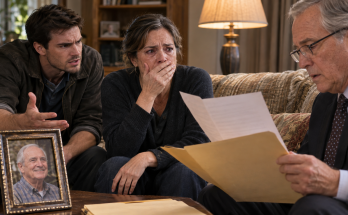
The attorney had said something that neither Kevin nor I could ignore.
My father-in-law had kept something under my name.
That much was clear.
What it involved was not.
I had asked for the meaning.
Kevin had asked for the value.
We were sitting in the same room, hearing the same statement, and responding as though two different subjects were being discussed.
I found that difficult to forget.
For Kevin, the possibility of money was the obvious issue.
For me, the issue was that my father-in-law had known what I believed about him.
I couldn't separate the two.
The statement itself had joined them.
It connected my treatment of him with whatever he had hidden.
That connection felt deliberate.
I wanted to understand it before hearing anything about distribution.
But I also knew the attorney could not explain the meaning without telling us more.
So I waited.
I tried to hold on to the words as they had been read.
My father-in-law believed I saw him as someone who contributed nothing.
He remembered the food I had provided.
And because of those meals, he said, he had kept something in my name.
There were no figures in the portion I had heard.
No description of the hidden property or money.
No explanation of how the arrangement worked.
Only that strange connection between an ordinary act and a secret decision.
I had wanted the story of his death to be uncomplicated.
I had expected to understand what he left behind through the same assumptions I had carried during his life.
He had depended on the household.
He had been a burden.
There was nothing important I had failed to notice.
But now I couldn't defend the last part.
I had missed something.
Possibly something substantial.
And it concerned me personally.
I looked down for a moment because the attorney's words were becoming harder to bear.
My father-in-law had never stopped being a person simply because I thought of him as an obligation.
He had his own understanding of the years.
His own reasons for what he did.
His own decisions.
I had rarely allowed room for those things in the way I thought about him.
Looking back, I realized how unfair that was.
I had treated my interpretation as the only one that mattered.
And now the person I had judged was no longer alive to speak for himself.
He had left the statement instead.
I wondered whether he had expected me to hear it with regret.
Or whether he simply wanted the truth, whatever it was, to be explained.
I did not know.
That uncertainty made me careful.
I didn't want to turn his words into an accusation he hadn't made.
He had not called me cruel in the portion the attorney read.
He had not said that I was ungrateful.
He had described what he knew I thought of him.
And he had mentioned the meals.
That was enough to make me examine myself.
Kevin's impatience still bothered me.
I understood that an inheritance question could be urgent.
When someone dies, practical matters don't disappear.
Documents need explaining.
Property, if there is any, has to be accounted for.
And people naturally want to know where they stand.
But the question Kevin asked had come immediately after the attorney read words that left me shaken.
It made me feel alone in my reaction.
I wondered whether Kevin understood why I was so quiet.
He had no way of knowing everything I was thinking.
I hadn't explained it.
I could barely explain it to myself.
All I knew was that the words about food had reached somewhere I didn't expect.
I could not treat them as a small detail before the important financial information.
They were important to me.
Perhaps more important than the money itself.
I thought about the twenty years mentioned in my own judgment.
Twenty years was too long to excuse with a quick change of heart.
I couldn't undo what I had thought.
I couldn't go back and listen differently.
I couldn't ask my father-in-law why he had chosen to keep the arrangement secret.
Death had closed off those possibilities.
The attorney's statement was what remained.
I had to hear it properly.
I had to be willing to accept whatever it revealed.
Even if the explanation made me ashamed.
Even if it proved that my confidence had been misplaced.
Even if the hidden arrangement turned out to be nothing like Kevin expected.
I realized then that I did not want to begin by asking what I was entitled to receive.
I wanted to know what my father-in-law had been trying to tell me.
That was a different question.
And it was the question I had already asked aloud.
I looked toward the attorney.
The answer was still beyond the words he had read.
Kevin remained interested in the financial consequences.
I remained caught by the personal meaning.
Neither of us yet knew what had been hidden.
I couldn't pretend otherwise.
But I no longer believed the most important question was whether my father-in-law had left something valuable.
The more difficult question was whether I had spent twenty years failing to recognize the value of the man himself.
I could not settle that question with an amount of money.
I knew that now.
For the first time, I wasn't waiting to find out what my father-in-law owed us.
I was waiting to understand what I had never known about him.
Click here to continue reading: PART 5: Kevin Was Waiting to Hear How Much Money There Was, While I Was Still Trying to Understand What My Father-in-Law Had Left Unsaid
I Had Spent Twenty Years Believing My Father-in-Law Gave Us Nothing, Until His Attorney Read Words I Could Barely Understand
Part 4 of 8