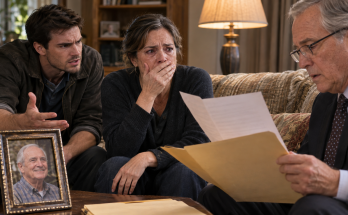
The attorney's statement had left me with an uncomfortable truth.
For twenty years, I believed my father-in-law gave nothing back.
I had been certain of it.
I had used that belief to explain why I called him a burden.
But the words read after his death showed me that there had been something I did not know.
He had made a private decision involving my name.
He had connected that decision to the meals I provided.
And he had known exactly how I regarded him.
Those were the facts I had heard.
I wanted more.
I wanted to know what had been hidden.
I wanted to know how it had been placed under my name.
I wanted to know whether Kevin was right to expect something that could be divided.
Most of all, I wanted to understand why my father-in-law had chosen to tell me about the arrangement in that particular way.
The portion of the statement I had heard did not answer those questions.
I couldn't pretend it did.
For once, I had to accept that I didn't know everything.
That might sound like a small admission.
For me, it wasn't.
My opinion of my father-in-law had been built on certainty.
I knew what he needed.
I knew what I provided.
I believed I knew what he contributed.
And because of those beliefs, I had decided what kind of place he occupied in our household.
I didn't leave much room for him to be anything else.
Now I could see the problem with that.
I had turned part of a relationship into the whole relationship.
I had counted the meals.
I had considered the dependence.
I had repeated the word burden.
But I hadn't considered how much of his life might exist outside what I could see.
The statement forced me to confront that omission.
Something had been hidden.
Whatever it was, my father-in-law had made a choice about it.
He hadn't told me while he was alive.
The attorney's reading was the first indication I had that such an arrangement existed.
And the fact that my name was involved made it impossible to dismiss.
I looked at Kevin.
His concern had been direct.
If there was money, he wanted the details.
I understood that there might be a practical answer to his question.
But I also knew there was another answer I needed.
One that couldn't be reduced to a figure.
My father-in-law had lived with my judgment for twenty years.
The attorney's words made that clear.
I couldn't undo it by receiving something.
I couldn't undo it by discovering that he had owned something valuable.
And I couldn't undo it by feeling sorry after he was gone.
The regret was real.
But regret wasn't the same as repair.
I understood that more clearly than I wanted to.
The most painful part was not knowing what I would have said to him if I had learned the truth sooner.
I wanted to believe I would have apologized.
I wanted to believe I would have listened.
I wanted to believe I would have changed the way I spoke about him.
But I had lived through twenty years without doing those things.
I couldn't give myself credit for choices I never made.
That was another uncomfortable truth.
I thought about the meals again.
They were ordinary.
They were necessary.
They had become so familiar that I stopped seeing them as individual acts.
I treated them as evidence of an unequal relationship.
My father-in-law's statement gave those same acts a different importance.
They had influenced something he chose to keep private.
I did not know exactly how.
I did not know whether the arrangement was large or small.
I did not know what legal consequences the attorney would eventually explain.
The words read in our living room had not established those details.
And I refused to invent them merely because I wanted the story to have a satisfying answer.
I had already spent too much time deciding what was true without asking enough questions.
I couldn't continue doing that now.
What I could acknowledge was the change in myself.
When the attorney began reading, I thought I understood my father-in-law's place in our lives.
After hearing those words, I no longer did.
I had once believed his value could be measured by what he contributed to the household.
Now I wasn't certain I had ever understood the full measure of that contribution.
That didn't mean the responsibilities had been imaginary.
They were real.
The meals were real.
The years were real.
But my interpretation of them had been incomplete.
I had confused what I knew with all there was to know.
The difference mattered.
It mattered because the man I judged was no longer alive to explain himself.
It mattered because his own statement showed he had understood my opinion.
And it mattered because the possibility of something hidden under my name revealed how little I knew about his decisions.
I could no longer look back at those years in the same way.
The word burden had once seemed straightforward.
Now it sounded like a judgment made by someone who had stopped being curious.
Someone who had become so accustomed to providing for another person that he stopped asking who that person was beyond the need for help.
That someone was me.
I did not like admitting it.
But I had no reason to deny it.
I could still remember how certain I had been.
I could still hear Kevin asking about the money.
I could still picture the attorney holding the statement.
And I could still hear the words about the meals.
Those details stayed together in my mind.
A living room.
A statement.
A question about what had been hidden.
And a man who could no longer answer for himself.
I wished the part of the statement I had heard contained the complete explanation.
It didn't.
The arrangement remained unexplained.
Its value remained unknown.
The question of whether anything could be divided remained unanswered.
I couldn't claim that the attorney had revealed a fortune.
I couldn't claim that Kevin received nothing.
I couldn't claim that the hidden arrangement proved my father-in-law had secretly supported the household.
None of those outcomes had been established.
What had been established was more personal.
My father-in-law knew I believed he contributed nothing.
He remembered what I provided.
And he had made a decision involving my name that I did not understand.
That was enough to challenge the story I had told myself for twenty years.
It was not enough to settle every question.
I had to live with both truths.
I still wanted the financial explanation.
I still wanted to know exactly what my father-in-law had arranged.
But I no longer believed the amount of money would determine whether my old judgment was fair.
If there was something valuable, I would need to understand why he had kept it in my name.
If there wasn't, I would still need to face the way I had described him.
The responsibility for that description belonged to me.
Not to Kevin.
Not to the attorney.
Not to my father-in-law.
Me.
I had chosen the word burden.
I had repeated it.
I had believed it.
And now, after his death, I finally understood that I might have been judging a man I never fully knew.
I couldn't go back and change the twenty years.
I couldn't ask him to forgive me.
I couldn't tell him I was sorry and expect an answer.
All I could do was stop pretending that my version of those years was the only one.
The attorney's words had left the financial question unresolved.
But they had changed something I could no longer ignore.
I had spent twenty years asking what my father-in-law contributed.
I had never asked whether I understood him.
That was the question I should have asked while he was alive.
And it was the one I could no longer put aside.
The End
Read more original stories on Feel Every Story.
I Had Spent Twenty Years Believing My Father-in-Law Gave Us Nothing, Until His Attorney Read Words I Could Barely Understand
Part 8 of 8