I woke before my alarm the next morning.
For a few seconds, I did not remember why I was awake.
Then I saw the handbag beside the bedroom door.
I had packed it the night before.
Inside were my wallet, the folder of bills, my notebook, and a small bottle of water.
The winning ticket was not in the bag.
I had left it in the drawer at home.
I did not want to carry the ticket into the hospital and let it become the center of the conversation before I had spoken to Spencer about what I had heard.
The money would still be there when I returned.
I made coffee and drank half of it standing at the kitchen counter.
Then I sat down and looked at the notebook one last time.
Find out what is true before deciding what to give.*
I had written that sentence because I needed a reminder.
I read it now because I needed to believe it.
There was no guarantee that Spencer would answer me honestly.
There was no guarantee that I would know what to do with his answer.
But I could ask.
That was the part I had been avoiding.
I put the notebook in my handbag and left the house.
The drive to St. Jude Community Hospital was familiar enough that I hardly noticed the turns.
I had made that trip so many times over the past months that my hands seemed to know the road without help from me.
I remembered arriving with food he barely touched.
I remembered sitting beside his bed while he talked about how long everything was taking.
I remembered looking at the clock and trying to decide whether I had enough time to stop at the pharmacy before going home.
Most of those memories were ordinary.
That was what made the situation so difficult.
My life with Spencer had not suddenly become a lie because I had overheard a cruel conversation.
There had been real worry.
There had been real sacrifice.
There had been moments when I was glad simply to sit with him.
I did not want to lose those memories by turning every one of them into evidence against him.
But I did not want to use the good memories to excuse what I had heard, either.
Both things could be true.
I could remember loving him through difficult days and still ask whether he had been using that love against me.
When I reached the hospital, I parked and sat in the car.
The engine ticked as it cooled.
I looked at the entrance.
For a moment, I considered turning around.
I could tell myself that Spencer needed rest.
I could tell myself that I needed more time.
I could call him and say something had come up.
Those excuses would be easy to make.
I had made similar excuses before, whenever a conversation seemed likely to upset someone I loved.
But I was not going to find out anything by staying in the car.
I took my handbag and went inside.
The lobby smelled of cleaning products and coffee.
A person at the reception desk spoke quietly to someone beside the counter.
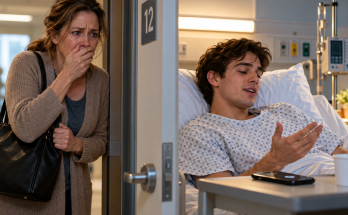
I walked past them and followed the hallway toward room 12.
Each step brought back the morning when I had first heard Spencer's voice through the partly open door.
I remembered the ticket in my purse.
I remembered the feeling of hope I had carried into the building.
I remembered hearing him say that if he made me think he was worse, I would give him every last penny.
I stopped outside the room.
The door was closed this time.
I could hear a faint sound from inside, but I could not make out any words.
I put my hand on the handle.
I did not know whether I was ready.
I knew only that waiting had become another way of letting fear decide for me.
So I opened the door.
Spencer looked up.
“Hey, Mom.”
“Hey, sweetheart.”
He shifted slightly against his pillow.
“I thought you were coming later.”
“I finished what I needed to do.”
He looked at the handbag on my arm.
“Did you bring the papers?”
“I brought some of them.”
“Did you figure anything out?”
I pulled the chair closer to the bed and sat down.
“I've been looking at everything.”
“And?”
“I have a better idea of where things stand.”
He waited for me to continue.
I set my handbag on the floor beside my feet.
“But I don't want to talk only about bills today.”
His expression changed slightly.
“What else is there?”
I looked at him.
He was my son.
I knew the shape of his face better than I knew the faces of most people I passed on the street.
I had watched him grow up.
I had worried about him long before the hospital and the bills became part of our lives.
That history did not make the conversation easier.
It made it more important.
“There is something I need to ask you,” I said.
“Okay.”
I took a breath.
“I need you to listen before you answer.”
He frowned.
“Mom, what is this about?”
I could feel my hands tightening together in my lap.
I loosened them.
“I heard something when I came to see you the other morning.”
He looked at me without speaking.
“I was outside your door,” I continued. “It wasn't fully closed, and I could hear your conversation.”
His eyes moved away from mine for a moment.
It was a small movement.
I could not say what it meant.
But I noticed it.
“I heard you talking to someone on speakerphone,” I said.
He stayed quiet.
“I heard you say that if I thought you were getting worse, I'd give you every last penny.”
The room seemed to become very still.
I had imagined this moment so many times that I expected to feel either anger or relief.
Instead, I felt the ache of saying something I had wished I never needed to say.
I looked at my son and waited.
He did not answer immediately.
I did not rush to fill the silence.
For once, I let the question remain between us.
Click here to continue reading: PART 17: My Son Looked Away When I Repeated His Words, and for the First Time, I Refused to Make the Silence Easier for Him
I Thought Twenty Million Dollars Would Finally Give My Son His Life Back, Until I Heard the Conversation Behind His Hospital Door
Part 16 of 20