The weeks that followed were not dramatic.
There was no single conversation that repaired every hurt.
There was no moment when Liam suddenly understood everything I had learned.
Instead, things changed gradually.
He called more often without needing anything.
Sometimes he told me about work.
Sometimes he asked whether I had watched a particular program.
Sometimes he called simply to say hello.
I began to trust those calls for what they were.
Not every conversation was perfect.
We still had moments when one of us misunderstood the other.
But we had started to pause instead of rushing toward an argument.
When Liam asked for advice, I gave it if I had something useful to say.
When he wanted to make his own decision, I let him.
When I needed help, I tried to ask directly instead of hoping someone would notice.
It was not a completely new relationship.
It was the old relationship being asked to grow up in a different way.
My wrist healed slowly.
I stopped wearing the brace when the doctor said I could.
The first morning I woke without it, I stood beside the bed and moved my hand carefully.
There was still a little stiffness.
But I could turn my wrist without the sharp ache I had felt before.
I went downstairs and made coffee.
The kitchen looked the same as it had on the day of the argument.
The counters were clean.
The chair stood beside the table.
The small scratch remained near the cabinets.
I no longer avoided looking at it.
It was simply a mark on the floor.
It did not have to become the story of the room.
That afternoon, Liam came over to help me move a few things in the garage.
I had been putting off the job because some of the boxes were too heavy for me to lift safely.
He arrived carrying a pair of work gloves.
“You ready?” he asked.
“I am.”
We worked together for an hour.
He carried the heavy boxes while I sorted the smaller ones.
At one point, he found an old tin filled with buttons and pieces of ribbon.
“Do you still need all this?”
I looked inside.
“Probably not.”
“Do you want to throw it away?”
I smiled.
“Let's not get carried away.”
He laughed and set the tin aside.
We kept a few things and discarded the rest.
When we finished, the garage looked less crowded.
Liam wiped his hands on a cloth.
“That feels good.”
“It does.”
He glanced toward the house.
“Do you want to get something to eat?”
I checked the time.
“Where were you thinking?”
“There's that little café you like.”
I smiled.
“Then yes.”
We drove there together.
I ordered soup and a sandwich.
Liam ordered a burger.
We talked about the postponed house purchase.
They had found another apartment option that would give them more time to save.
It wasn't the future they had originally imagined, but it was workable.
“It's not ideal,” he said.
“No plan is perfect.”
He smiled.
“You always say that.”
“Because it's true.”
He took a sip of water.
“Chloe's been thinking about taking on some extra work for a while. I may be able to pick up a few more hours, too.”
“That could help.”
“We're trying to be more realistic about what we can afford.”
I nodded.
“That's a good thing to learn before taking on a mortgage.”
He looked at me.
“I suppose it is.”
There was no accusation in his voice.
No attempt to turn the conversation into another request for help.
We finished lunch and drove home.
At my door, Liam paused.
“Mom, can I ask you something?”
“Of course.”
“Do you think things will ever be exactly the way they were before?”
I thought about the question.
I could have told him yes.
I could have promised that everything would eventually return to normal.
But I had learned that comfort built on promises I couldn't guarantee was not the same as honesty.
“I don't think they will be exactly the same,” I said.
He looked down.
“Is that bad?”
“Not necessarily.”
I rested my hand on the doorframe.
“I hope we can build something better in some ways. I hope we can be more honest with each other. I hope you can tell me when you're struggling, and I can tell you when I need something different.”
He listened quietly.
“I don't want you to feel you can't come to me,” I continued. “You can. I love you. But I want you to come because you want a relationship with me, not because you think I have to solve a problem.”
He nodded.
“I understand.”
“I hope you do.”
He smiled a little.
“I think I'm learning.”
I reached up and touched his cheek.
“That's all any of us can do.”
He hugged me.
Then he left.
I closed the door and stood in the entryway for a moment.
The house was quiet again.
But the silence no longer felt like punishment.
It was simply the quiet of my own home.
I walked into the kitchen and took the green notebook from the drawer.
I opened it to the first page.
*I can love my son.**
*I can be sorry that he is struggling.**
*I can still say no.**
I read the sentences slowly.
When I first wrote them, I had been trying to convince myself that they were true.
Now they felt less like a warning and more like a description of the life I was beginning to live.
I turned to the next page.
There were notes about the mortgage, the conversations with Liam, and the things I had learned about asking for help.
I found the sentence about small actions repeated over time.
I found the sentence about leaving the future open without promising what I could not promise.
I added one final note.
*Love is not measured by how much I sacrifice. It is measured, in part, by whether we can care for each other without making one person's needs disappear.**
I closed the notebook.
Then I put it back in the drawer.
I didn't need to read the words every day anymore.
I had started to practice them.
The next Sunday, Liam and Chloe invited me to dinner at their apartment.
I accepted.
I was nervous before I left home.
I wondered whether Chloe and I would be able to talk comfortably.
I wondered whether the evening would become another discussion about the mortgage.
I wondered whether I was ready.
Then I reminded myself that I did not have to solve every possible problem before walking through the door.
I could simply go to dinner.
Chloe greeted me when I arrived.
“Hello, Mrs. Bennett.”
“Hello, Chloe.”
She took my coat and showed me where to put my handbag.
Liam was in the kitchen finishing the meal.
The table was set for three.
We ate together.
At first, the conversation was careful.
We talked about work, the weather, and the apartment they were considering.
Then Liam told a story about something that had happened at work, and Chloe laughed so hard she nearly spilled her water.
I laughed, too.
The tension eased.
After dinner, Chloe brought out tea.
She sat across from me at the table.
“I wanted to say something,” she began.
I looked at her.
“All right.”
She folded her hands in front of her.
“I've been thinking about what happened at your house.”
I waited.
“I was angry that day, and I let the argument get out of hand. I didn't handle it well.”
Her voice was quiet.
“I am sorry that you were hurt.”
I felt the words land gently between us.
They were not delivered with a demand that I forgive her immediately.
She did not mention the mortgage.
She did not ask whether I would reconsider helping them in the future.
She simply apologized.
“Thank you for saying that,” I told her.
She nodded.
“I should have said it sooner.”
“Yes,” I said. “You should have.”
I didn't pretend the apology had erased the memory.
I didn't need to.
It was enough that she had finally acknowledged what happened without making me argue for the right to be hurt.
We talked a little longer.
I told her that I wanted us to be able to disagree without things becoming personal or frightening.
She said she wanted that, too.
We did not resolve every difference between us.
We did not need to resolve everything in one evening.
When I left, Chloe hugged me.
It was a little awkward.
But it was sincere enough for that moment.
On the drive home, I thought about the house I had almost helped Liam buy.
I thought about the money I had withdrawn from the application.
I thought about the plans that had changed, the furniture delivery that had been postponed, and the apartment arrangements they had needed to revisit.
I was sorry those things had been difficult.
I was not sorry that I had listened to myself.
There was a difference.
I could regret the pain surrounding a decision without regretting the decision itself.
I could wish the argument had never happened without wishing I had ignored it.
I could love my son without making my financial support the condition that held our relationship together.
When I reached home, I parked in the driveway and sat for a moment before going inside.
The porch light was on.
The front door opened easily.
I stepped into the house and hung up my coat.
In the kitchen, the blue-rimmed glass stood in the cupboard beside the others.
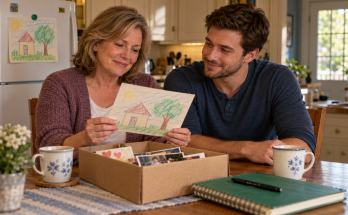
The drawing Liam had made as a child was still on the refrigerator.
The green notebook was in the drawer.
The house was quiet, familiar, and mine.
I made myself a cup of tea.
Then I sat at the kitchen table, in the same chair where I had read the mortgage papers and written down the questions I was afraid to ask.
I thought about the woman I had been before the argument.
She had believed that being a good mother meant being available whenever her son needed her.
She had believed that refusing help might damage the relationship.
She had believed that if she could keep everyone comfortable, the family would remain close.
I still believed in helping my children.
I still believed in forgiveness.
I still believed that family mattered.
But I no longer believed that love required me to ignore my own needs.
A mother could be generous without surrendering every boundary.
A son could be loved without being rescued from every consequence.
And a relationship could survive a difficult season without returning to the exact arrangement that had existed before it.
I finished my tea and washed the cup.
Then I turned off the kitchen light.
The scratch on the floor was still there.
I didn't need to cover it.
I didn't need to pretend it had never happened.
I only needed to know that it no longer controlled the way I lived in my own home.
As I walked upstairs, I thought about Liam's drawing on the refrigerator.
The crooked roof.
The oversized door.
The tree that looked like a green cloud.
It had been made by a little boy who believed his mother could do almost anything.
I loved that boy.
I loved the man he had become.
And I hoped that, in time, he would understand that my love had never been the problem.
The problem had been the belief that love meant I could never say no.
That belief had cost us something.
It had also forced us to look at what we needed to change.
I could not know whether we would always get it right.
I could not promise that we would never hurt each other again.
But I could keep my door open without handing over the keys to my life.
I could offer help when I chose to offer it.
I could receive help without feeling weak.
And I could say no when the answer needed to be no.
I went to bed that night with my wrist healed and my heart still carrying a few tender places.
For the first time in weeks, I did not feel the need to rehearse the next conversation with my son.
I didn't know what he would need tomorrow.
I didn't know what I would be able to give.
I only knew that I loved him, and that I was allowed to love myself, too.
That was enough for one night.
The End
Read more original stories on Feel Every Story.
My Son Asked Me to Stay Out of His Life, but by the Next Morning, His First Concern Was the House He Could No Longer Afford
Part 20 of 20