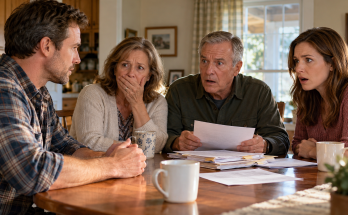
For several seconds, I said nothing.
I was still trying to understand what my mother had told me.
Brooke had said I was not celebrating Christmas.
My parents had believed her.
And neither of them had thought to ask me directly.
I looked down at the phone in my hand.
It seemed absurd that a conversation so important to me could be happening in such an ordinary way.
No dramatic music.
No argument echoing through the house.
Just my mother on the phone and the sound of my friends enjoying the holiday below me.
I had imagined many reasons my parents might not come.
I had thought they were busy.
I had thought they had decided Brooke's plans mattered more.
I had even wondered whether they simply did not want to make the trip.
I had not imagined that they believed there was nothing for them to attend.
The difference should have been simple.
If they thought I had no plans, they could have called.
If they wanted to know whether I was celebrating, they could have asked.
If they were unsure what I had arranged, they could have let me explain.
They had done none of those things.
Instead, they accepted Brooke's version and carried on.
I could feel myself beginning to make excuses for them.
I stopped.
That was the habit I was finally trying to break.
My mother waited on the line.
I could tell she expected me to say something.
Perhaps she wanted me to reassure her that everything had been a misunderstanding.
Perhaps she was hoping I would explain why I had not made the situation clearer.
Maybe she did not know what she wanted.
I could not speak for her.
I could only decide what I was willing to say.
“So you didn't ask me?”
My voice sounded calmer than I felt.
My mother took a breath.
She started to answer, then stopped.
That hesitation told me more than a long explanation might have.
I did not need her to confess that she had made a mistake.
I needed her to recognize that she had made a choice.
She had heard something about my plans.
She had accepted it.
She had not checked with me.
My father had apparently done the same.
And I was the person left out of a decision that directly involved me.
I rubbed my thumb against the edge of the phone.
I remembered the message I had sent when they chose Brooke.
“All good.”
I had used those words because I did not want to beg.
I had used them because I wanted to preserve my dignity.
I had used them because I believed my parents knew I would be spending Christmas without them and had decided that was acceptable.
Now I wondered what they had thought my response meant.
Perhaps they had taken my calmness as proof that I did not care.
Perhaps they had believed I was content to be alone.
Perhaps they had never considered that my silence might be the only way I knew to protect myself.
I could not know which explanation was true.
But I knew what I had done.
I had made it easy for them to avoid asking another question.
That did not make their choice my fault.
Still, I had to be honest about my part in the pattern.
I had spent years telling people I was fine when I was not.
I had taught my family that I could absorb disappointment without making them uncomfortable.
I had let my independence become a wall.
And then I had wondered why nobody looked over it.
The realization did not make me feel better.
It made me tired.
I wanted a family where I did not have to explain every hurt before it counted.
I wanted my parents to be curious about my life without needing proof that it was impressive.
I wanted them to ask how I was doing because they cared about the answer.
Not because a television program had given them a reason to reconsider what they thought they knew about me.
I looked toward the window again.
The lights from inside the house shimmered across the glass.
Beyond them, the mountain landscape was dark.
For a moment, I remembered the first time I had imagined bringing my parents here.
I had thought about where they might sit.
I had wondered what my father would notice first.
I had pictured my mother walking through the rooms and asking how I had managed everything.
I had made room for them in my imagination long before I had any reason to believe they would visit.
That was the part I found hardest to admit.
I had built a life I was proud of, but some part of me had still been waiting for my parents to arrive and tell me I had done well.
I had not needed their money.
I had not needed them to solve my problems.
I had wanted them to see me.
And when they finally saw something worth noticing, it had happened from a distance.
My mother spoke again.
She sounded uncomfortable.
She tried to explain that they had taken Brooke's words at face value.
I listened.
I did not interrupt her, but I also did not rush to make the explanation sound reasonable.
There was a difference between understanding why someone had done something and deciding it did not matter.
I could understand that my mother had believed my sister.
I could understand that she had thought she was acting on the information she had.
But none of that changed the fact that she had not asked me.
I had been available.
My phone had worked.
They knew how to reach me.
They had chosen not to check.
I finally said that I had made plans for Christmas.
My mother was quiet.
I told her that my friends were at the house.
I did not list their names or describe every detail of the evening.
I did not need to prove that the holiday was real.
The people downstairs were proof enough.
I could hear them moving around, talking, laughing, and calling to one another.
Their presence reminded me that my life did not depend on my parents believing in it.
I had built something beyond the family pattern I grew up with.
I had people who showed up.
I had a home that felt like mine.
I had a business I had worked hard to create.
None of those things erased the hurt I felt toward my parents.
But they meant I did not have to surrender the entire holiday to it.
My mother said she had not known.
I believed that she had not known the full truth.
But I could not ignore the way she had arrived at that ignorance.
She had not known because she had not asked.
For years, I had wanted my parents to understand how much I had accomplished.
Now I was beginning to see that the deeper problem was not whether they understood the house or the business.
It was whether they were willing to know me beyond the role they had assigned me.
The reliable daughter.
The one who could handle things.
The one who would not complain.
The one who would always be all right.
I had been living inside those descriptions for so long that I had started using them on myself.
When I needed help, I told myself I could manage.
When I felt left out, I told myself I was being childish.
When my parents chose Brooke, I told them there was no problem.
Then I wondered why the problem never changed.
I did not want to keep doing that.
I did not want to spend the rest of my life waiting for someone else to recognize that I had feelings, too.
The thought was not a grand declaration.
It was simply a truth I had grown too tired to avoid.
My mother was still on the phone.
I could hear the uncertainty in her voice.
I knew she wanted the conversation to become easier.
Part of me wanted that, too.
It would have been simple to tell her that I understood.
It would have been familiar to say that she should not worry.
It would have been easy to return to the old arrangement in which I carried the hurt quietly and everyone else carried on.
But I had already spent one Christmas telling my parents that their decision was fine.
I did not need to repeat the same answer now.
I took a slow breath.
Then I told her that I wished they had asked me themselves.
That was all.
I did not accuse Brooke of anything beyond what my mother had told me.
I did not pretend to know why she had said it.
I did not turn a single revelation into a whole story I could not yet prove.
I only told my mother what I knew.
She had believed someone else instead of speaking to me.
And that had hurt.
For once, I allowed the sentence to stand without softening it.
The silence that followed was different from the earlier ones.
It was not a pause while my mother searched for an explanation.
It was the quiet that comes when a person has finally heard something they cannot easily talk around.
I sat there, listening.
Downstairs, my friends were still enjoying Christmas.
The fire continued to burn.
The house remained exactly what it had been before the phone rang.
Yet I felt as if something inside me had shifted.
I had spent years believing that if I became successful enough, independent enough, and strong enough, my family would eventually understand that I deserved the same consideration Brooke received.
Now I could see that success had not solved the problem.
It had only made the difference impossible to ignore.
My parents had needed to see the house on television before they began asking questions.
They had needed to discover what I had built before they reconsidered what they thought they knew.
And they had believed I was spending Christmas alone without ever asking me what I wanted.
I could not change any of that in one conversation.
I could not make my mother understand everything I had carried since childhood.
I could not decide what Brooke had intended or what my father would say when he learned how the call had gone.
But I could stop pretending the hurt was insignificant.
I could stop telling myself that being independent meant never needing anyone.
And I could stop treating my parents' attention as the final measure of whether my life mattered.
I looked down at my phone.
My mother's call had forced me to face something I had avoided for years.
I had wanted them to come because I loved them.
I had wanted them to see my home because I was proud of what I had built.
I had wanted them to choose me without requiring me to prove that I was worth choosing.
None of those wishes made me weak.
They made me their daughter.
And for the first time that Christmas, I was willing to admit how much their decision had hurt me.
Click here to continue reading: PART 5: After My Mother Admitted What Brooke Had Told Them, I Had to Decide Whether I Would Keep Making Their Choices Easier
I Told My Family Their Decision Was Fine, Then Spent Christmas Surrounded by Everything They Had Never Bothered to Understand
Part 4 of 20