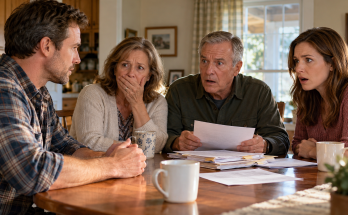
I used to believe that family was the one place where I didn't have to prove I deserved to be protected.
I was wrong.
I learned that at Thanksgiving, sitting across from my grandmother while a plate of untouched food cooled in front of me.
The question she asked was simple.
The answer should have been simple, too.
But when she mentioned the one hundred and eighty thousand dollars my late husband had arranged for me to receive, nobody seemed to know where to look.
Not my mother.
Not the relatives sitting beside her.
And especially not the person who had always insisted that our family had nothing to hide.
My name is Natalie Bennett.
For a long time, I thought the worst thing that could happen to me had already happened.
Then I found out that losing someone could leave you vulnerable in ways you never expected.
My husband had died after an accident that changed everything about my life.
I was left trying to recover while learning how to raise our newborn daughter with a body that no longer worked the way it once had.
There were hospital rooms.
Appointments.
Medication bottles lined up beside my bed.
And nights when I woke up reaching for someone who wasn't there.
I didn't have much energy left for anything beyond surviving.
People told me to be strong.
They said my husband would have wanted me to keep going.
I nodded because it was easier than explaining that sometimes getting through an ordinary morning felt like work nobody else could see.
My daughter needed me.
That was the one thing I understood without question.
Everything else seemed to happen around me while I tried to catch up.
Money was one of those things.
My husband had made arrangements before his death, and I knew he wanted to leave something behind for our daughter and me.
I knew he had thought about our future.
He had always been that kind of man.
Practical about things I preferred not to discuss.
He kept records.
He saved documents.
He believed that loving somebody meant preparing for the days when you couldn't be there to help them.
I used to tease him about it.
He would put another paper into a folder, label it, and return it to the drawer.
I would tell him that not everything in life needed a file.
He would smile and say that some things were worth keeping safe.
I understood what he meant after he was gone.
But understanding his intentions didn't mean I knew what had happened to the money.
At the time, I assumed the arrangements were being handled properly.
I had enough going on without chasing paperwork.
My mother, Laura, was around during those early months.
She called to check on me.
She offered advice.
She reminded me to eat when I forgot and asked whether I had slept whenever my voice sounded tired.
I wanted to believe that having her nearby meant I could let my guard down.
She was my mother.
I didn't think I needed to question her motives.
My grandmother was different.
She had a way of asking questions that made people answer more honestly than they intended.
She noticed things.
She remembered dates.
And when somebody gave her an explanation that didn't make sense, she didn't always pretend to accept it.
Still, I never imagined she would be the person to bring the money into the open.
Thanksgiving had always been a family occasion.
We gathered around the table, passed dishes from one person to another, and tried to make the afternoon feel familiar.
That year, I was tired before the meal even began.
My daughter was still little enough to need constant attention, and I spent much of the afternoon checking on her between conversations.
I wanted a quiet holiday.
Nothing special.
Just a few hours when I didn't have to think about hospitals, recovery, or the future I hadn't planned to face alone.
My grandmother sat near the end of the table.
She watched me for a while before she spoke.
Then she asked about the money.
At first, I thought I had misunderstood her.
She mentioned the amount my husband had left for me.
One hundred and eighty thousand dollars.
The number sounded unreal in that room.
I knew he had made financial arrangements, but I hadn't realized that Grandma expected the money to have reached me already.
She looked directly at me.
Her expression wasn't accusing.
It was confused.
She wanted to know why I hadn't received it.
I didn't answer immediately.
I was trying to understand what she meant.
"What money are you talking about?"
My grandmother set down what she was holding.
"The money your husband arranged for you."
I looked at her.
She looked back at me.
Neither of us smiled.
She explained that she had believed the funds were supposed to go to me after my husband's death.
She had assumed I had received them and used them to get settled.
That was what she had been told to expect.
I felt a strange pressure in my chest.
Not panic exactly.
Something closer to the feeling of realizing that everybody else might know something about your life that you don't.
"I never received anything like that," I told her.
The conversation around us began to fade.
Someone stopped moving a serving spoon.
A chair shifted against the floor.
My mother lowered her eyes toward her plate.
It was a small movement.
I might not have noticed it on another day.
But I noticed it then.
Grandma asked whether I was certain.
I said I was.
I had checked my accounts.
I had paid attention to the money coming in because I had a baby to care for and bills that wouldn't wait for me to feel ready.
There had been no payment of that size.
No letter explaining that it was delayed.
Nothing that suggested the money had ever reached me.
My grandmother's face changed.
She had expected confusion, perhaps.
She hadn't expected my answer.
Across the table, my mother finally spoke.
She said financial matters could become complicated after a death.
She suggested that the arrangements might have taken longer than expected.
Her voice was calm.
Too calm for the question that had just been asked.
I wanted to believe her explanation.
Part of me was desperate for it to be true.
If the money had simply been delayed, then there was no betrayal to confront and no family relationship to reconsider.
There would only be paperwork.
A mistake.
Something ordinary.
But Grandma didn't seem satisfied.
She asked whether anyone had contacted me about the funds.
I told her no.
She asked whether I had signed anything.
I started to say that I didn't remember, then stopped.
My recovery had been difficult.
There were periods when I was exhausted and medicated, barely able to concentrate on what people were saying to me.
I hated admitting that.
It made me feel as if I were handing someone an excuse to dismiss my own memories.
My mother took a sip of wine.
She didn't look at me.
That bothered me more than her explanation.
I had spent months depending on her in ways I never expected.
Now I was sitting at a Thanksgiving table wondering whether she had known something about my husband's final arrangements that I hadn't.
I didn't want to make that leap.
I didn't want to look at my mother and see a stranger.
So I asked the question that seemed safest.
"Who was supposed to handle it?"
Grandma said she had understood that the arrangements had already been made.
She didn't claim to know every detail.
She only knew that the money was intended for me.
That was enough to make the silence around the table feel different.
People began finding reasons to look elsewhere.
Somebody asked whether anyone wanted more potatoes.
Nobody answered right away.
I glanced toward my mother.
She was still holding her glass.
Her fingers had tightened around it.
I had seen her nervous before.
I had never connected that expression to money.
My grandmother leaned back in her chair.
She said she didn't want to accuse anyone without knowing the facts.
I appreciated that.
I also knew she would not let the question disappear simply because it made the family uncomfortable.
For the first time that afternoon, I understood that she wasn't asking me to explain where the money had gone.
She was trying to understand why I had never received it.
And she intended to find out.
Click here to continue reading: PART 2: The Name on the Bank Records Looked Like Mine, but the Signature Beneath It Belonged to Someone I Couldn’t Recognize
The Thanksgiving Question That Turned a Family Gathering Into Something None of Us Could Pretend Was Ordinary Anymore
Part 1 of 20