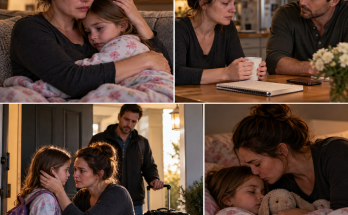
I had arrived in Knoxville desperate for answers.
I wanted to know why Maggie had stopped answering her phone.
I wanted to know whether she was safe.
I wanted someone to explain how a woman who had left home for an ordinary family visit had ended up needing medical care.
I still wanted those answers.
But I had learned that wanting them didn't mean I could force them to appear.
I sat beside Maggie and looked at the folded paper in my pocket.
The words on the back were still there.
Listen first.
I had written them because I knew how quickly fear could make me impatient.
I didn't want to turn my wife into a list of questions.
I wanted her to be able to speak when she was ready, in whatever way she could manage.
I wanted to hear her.
That was the point of everything.
The doctor had explained what the medical team knew.
A significant amount of a prescription sedative had been found in Maggie's blood.
The medication could cause confusion, weakness, and long periods of unconsciousness.
Repeated exposure could be dangerous.
Maggie was also dehydrated.
Those facts were enough to explain why her condition concerned the medical team.
They were not enough to explain every part of what had happened.
I had to accept that distinction.
I had spent days trying to fit the pieces together before I had them all.
I had imagined explanations, rejected them, and imagined new ones.
I had wondered whether Maggie had been too busy to call.
I had wondered whether she was upset with me.
I had wondered whether our son knew more than he had told me.
I had even wondered whether I should have insisted on driving her to Knoxville.
None of those thoughts had given me an answer.
Some had only made me feel worse.
I couldn't change the fact that I had let four days pass before deciding I needed to act.
But I could stop treating those four days as proof that I had failed my wife.
I had called her.
I had left messages.
I had tried our son.
When I understood that the silence was no longer something I could reasonably explain away, I had come to Knoxville.
I had found her in need of care.
Now I was staying beside her.
That was what I could do with the present.
I couldn't repair the past by punishing myself.
I couldn't protect Maggie by imagining every possible danger.
I could listen to the medical team and provide whatever information might help.
I could ask our son what he knew when I had the opportunity.
And I could wait for Maggie to tell me what she remembered.
I looked at her.
I had never understood how much I depended on the sound of her voice until it was absent.
The house had felt wrong without her.
The phone had seemed louder every time it rang for someone else.
Even the coffee I made each morning had tasted different because there was nobody beside me to complain that I had made too much.
Those things had seemed insignificant while they were happening.
Now I understood that they were part of the life we had built.
I wanted that life back.
I wanted Maggie home.
I wanted her sitting at the kitchen table, telling me what she needed from the store.
I wanted to hear her say that I was worrying too much.
I wanted to argue about something so ordinary that neither of us would remember it the next day.
I wanted the freedom to be careless with time again.
But I knew I couldn't simply return to the way things had been.
Something serious had happened.
We needed to understand it.
That would take honesty.
It would take patience.
And it would require me to accept that some answers might come slowly.
I thought about our son.
Maggie had gone to Knoxville because she wanted to help him.
I understood that choice.
I might have made the same one.
I still needed to speak with him and learn what he knew about the days before Maggie became unwell.
I couldn't pretend his unanswered calls were unimportant.
But I couldn't treat them as proof of guilt either.
I had to leave room for the facts.
That was something I would need to remember when the conversation finally happened.
I would ask what he knew.
I would tell him what the doctors had explained.
I would listen to his answers.
If something didn't make sense, I would ask again.
I would not begin by accusing him of something I couldn't establish.
I had made enough mistakes by allowing fear to speak before I had all the information.
I didn't want to make another.
I sat quietly beside Maggie.
The room had become familiar, though I still wished I had never needed to enter it.
I had learned the sound of footsteps in the corridor.
I had learned where to place my phone so it wouldn't slide off the table.
I had learned how quickly a cup of coffee could grow cold when I forgot it was there.
I had learned that a person could be surrounded by medical staff and still feel helpless.
Most of all, I had learned that love did not automatically provide understanding.
I loved Maggie.
That love had made me worry.
It had brought me to Knoxville.
It had kept me beside her.
But it could not tell me how the sedative had entered her system.
It could not tell me what she remembered.
It could not explain why she had stopped answering.
For those things, I needed information.
I needed honest conversations.
I needed time.
I placed my hand gently over hers.
“I don't have all the answers,” I said.
I paused and looked at her face.
“But I'm here.”
I let the silence remain.
I wasn't trying to make it mean anything.
I wasn't treating it as rejection or as a sign that I had been forgotten.
It was simply silence.
For once, I could let it be what it was without building a story around it.
I stayed beside Maggie, waiting for the next piece of information, the next conversation, and the chance to hear her voice again.
I didn't know exactly how the days ahead would unfold.
I didn't know what Maggie would remember when she was able to tell me about her experience.
I didn't know what our son would say when we finally spoke.
And I didn't know whether every question would have a clear answer.
But I knew what mattered most.
Maggie needed care.
She needed time.
And she needed me to approach what had happened with patience rather than fear.
I could do that.
I could keep asking questions without pretending I already knew the answers.
I could protect her privacy while helping the people caring for her understand what they needed to know.
I could be honest about my concerns without turning them into accusations.
And I could remember that the woman in the hospital bed was not a mystery to solve.
She was my wife.
I had spent years beside her without fully understanding how much I relied on the ordinary parts of our life.
I would never again mistake those ordinary moments for something unimportant.
I thought of the coffee cup waiting beside the sink at home.
I thought of the charger tucked into Maggie's travel bag.
I thought of the last message she had sent me, telling me she had arrived safely.
Those small details had once belonged to a normal day.
Now they reminded me how little we sometimes know about what comes next.
I couldn't control that.
I could only decide how I would respond.
I would not let fear make decisions for me.
I would not blame Maggie for a silence she might not have been able to break.
I would not decide what our son had done before hearing what he knew.
And I would not stop asking the questions that mattered simply because the answers frightened me.
I took a breath and settled back into the chair.
My phone remained on the table.
The folded paper stayed in my pocket.
Maggie's hand rested beneath mine.
For the moment, that was enough.
I had come to Knoxville because my wife had stopped answering.
I had found her, and I had learned that she was facing something far more serious than I had imagined.
The questions were still there.
So was my fear.
But I no longer needed to pretend I could solve everything at once.
I would take the next step when it came.
I would listen.
I would learn what I could.
And I would stay beside Maggie while we found our way through what we knew, what we didn't know, and everything we still needed to understand.
The End
Read more original stories on Feel Every Story.
I Thought My Wife Was Simply Busy Helping Our Son Until Four Days of Silence Turned an Ordinary Family Visit Into Something I Couldn’t Ignore
Part 16 of 16