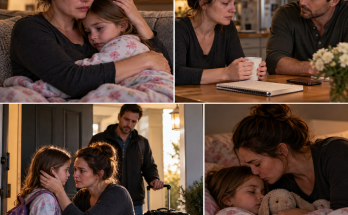
I woke with a stiff neck and my cheek pressed against the back of the hospital chair.
For a moment, I didn't know where I was.
Then I saw Maggie.
The blanket was still pulled up around her, and the room was quiet except for the sounds coming from the corridor.
I sat upright and rubbed my face.
My phone lay on my lap.
The screen was dark.
I checked it anyway.
There was nothing from our son.
I slipped the phone into my pocket and stood beside the bed.
“Maggie, it's me.”
I had started saying that every time I returned to her side.
It gave me something familiar to do.
I didn't know whether she recognized my voice, but I hoped she did.
A nurse came in a little later and checked on her.
I asked whether there had been any change.
She explained that the team was continuing to monitor Maggie and that they would let me know if there was anything important to discuss.
I thanked her.
I was learning to accept that the people caring for my wife could tell me what they knew without being able to tell me everything I wanted to know.
That morning, the doctor spoke with me again.
I stood near the bed while she explained that Maggie still needed observation and careful assessment.
I asked whether the sedative could account for the periods when Maggie hadn't been responsive.
The doctor said it could contribute to that condition.
She also reminded me that they needed to consider the full picture rather than assume one test result explained every detail.
I nodded.
I was trying to learn the difference between an explanation and a conclusion.
The medication was there.
The dehydration was there.
Those were facts.
How Maggie had come into contact with the medication remained unanswered.
I asked whether she might have been given it without knowing.
The doctor said the results alone couldn't establish that.
I appreciated her honesty, even though I wished she could give me something more definite.
When she left, I sat down and thought about the word she had used.
Repeatedly.
The medication had been present in a significant amount, and the doctor had explained that repeated exposure could be dangerous.
I couldn't stop thinking about that.
An accidental mistake was one possibility I had considered.
But I couldn't make myself assume that a single mistake explained everything.
I also couldn't turn that concern into an accusation.
I had no evidence to support one.
I looked at Maggie's face and tried to imagine what she might say when she was able to talk.
Perhaps she would remember taking something.
Perhaps she would explain that she had been given medicine for a legitimate reason.
Perhaps she would have no clear memory of those hours.
I didn't know.
I had to stop treating my imagination as if it could fill the gaps.
I reached for the phone.
I called our son again.
The call rang.
I waited until it ended.
No answer.
I stared at the screen for several seconds.
Then I put the phone down.
I had spent days hoping that the next call would settle everything.
Now I understood that I couldn't build my entire understanding of Maggie's condition around whether our son answered.
His silence was troubling.
It wasn't proof of anything.
I needed to remember that.
Still, I wanted to hear his voice.
I wanted him to tell me that he knew where his mother was and that he understood what had happened.
I wanted to know whether he had been with her when she became unwell.
I wanted to know whether he had seen anything that could help the medical team.
Those were reasonable questions.
I could not answer them by sitting beside the phone.
I looked toward the window.
The daylight had changed while I was thinking.
I had no idea how long I had been sitting there.
For the first time that morning, I felt hungry.
I left the room long enough to get something to eat.
When I returned, I carried a cup of coffee.
I set it on the small table and looked at Maggie.
The smell reminded me of home.
I thought of her cup beside the sink and the way she always insisted that coffee tasted better when it had cooled just enough to drink without burning your mouth.
I wondered when I would see her standing in our kitchen again.
I didn't let myself answer.
Instead, I pulled the chair closer to the bed.
I wanted to be there when she became more aware of what was happening around her.
I wanted to hear whatever she could tell me in her own words.
And I wanted to be able to say that I had listened.
That had become more important than finding an answer quickly.
I had spent much of my life believing that being a good husband meant solving problems and keeping things steady.
When Maggie worried about something, I tried to find a practical answer.
When our son needed help, I wanted to know what needed to be done.
I had always believed that action was better than sitting helplessly with a question.
But I couldn't solve this by making a list or placing a few calls.
I couldn't even be certain what the problem was beyond the medical facts the doctor had explained.
I had to wait for more information.
And I had to resist the temptation to turn uncertainty into a story that made sense to me.
I took a sip of coffee.
It had already begun to cool.
I set it down and reached for Maggie's hand.
“I don't know what happened,” I told her.
My voice was quiet.
“But I'm going to listen when you can tell me.”
I sat back in the chair.
For once, I wasn't waiting for my own fear to give me an answer.
I was waiting for Maggie.
Click here to continue reading: PART 10: The Longer I Sat Beside Her, the More I Realized That Love Could Not Tell Me What Happened, Only Why I Needed to Know
I Thought My Wife Was Simply Busy Helping Our Son Until Four Days of Silence Turned an Ordinary Family Visit Into Something I Couldn’t Ignore
Part 9 of 16