The ownership transfer happened on a Tuesday morning.
No gala.
No champagne tower.
No donor wall.
Bellmont House opened at eleven, so the closing took place at eight-thirty around three pushed-together dining tables.
Luis signed first.
Then Emily.
Then staff representatives from kitchen, service, hosting, cleaning, and management.
Daniel signed for Bellmont Hospitality.
The final document shifted majority ownership to the employee cooperative.
Bellmont retained a temporary minority interest.
Luis looked at the papers.
“That’s it?”
Richard nodded.
“That is generally how ownership works when no one hides a succession clause in a mausoleum.”
Luis looked at Daniel.
“Your lawyer is getting sarcastic.”
“He’s recovering.”
Emily stared around the dining room.
“So we own this?”
Luis answered.
“We owe a bank a lot of money.”
“That feels more realistic.”
They laughed.
Daniel looked toward booth seventeen.
The table had not been turned into a memorial.
He had specifically asked them not to.
It was a booth.
Customers sat there.
Children spilled drinks there.
Servers cleared plates.
Good.
The story did not need a shrine.
The cooperative had made several changes already.
The “premium” section disappeared.
Reservation profiles were stripped down.
No hidden scoring.
Servers rotated sections rather than competing for high-spend tables.
Bonuses included customer complaints resolved, employee retention, food-quality standards, and team performance.
Not perfect.
But visible.
Daniel handed Luis a small folder.
“What’s this?”
“Three-year transition agreement.”
“We already signed that.”
“Operational independence schedule.”
Luis opened it.
Bellmont central management lost the right to dictate most local staffing and customer-service policies after twelve months if the cooperative met financial and safety benchmarks.
Luis looked up.
“You’re actually leaving us alone.”
“Within reason.”
“That phrase sounds corporate.”
“It is.”
Emily hugged Daniel unexpectedly.
He stiffened.
Then returned it.
“Thank you,” she said.
He looked at her.
“For what?”
“For believing us after you finally heard us.”
Daniel thought about that wording.
After.
Not before.
“Should’ve happened earlier.”
“Yes.”
Again.
No need to turn accountability into gratitude.
The doors opened at eleven.
The first customers were an elderly couple who clearly had no idea a transfer had occurred.
Perfect.
They were seated near the window.
No one checked their watch brands.
No one scored their car.
A host simply asked whether the table worked for them.
Daniel left before lunch.
Bellmont did not need its former controlling owner standing around watching people prove they could run it.
His family shares in the parent company had begun conversion into the new governance structure.
The final plan was not complete.
But its direction was.
Independent board majority.
Two employee-elected directors immediately, increasing to three.
No hereditary chairmanship.
Employee ownership trust increasing over time.
Mercer family noncontrolling economic stake.
River-property historical trust jointly governed by independent trustees, employees, and public representatives.
Customer-data oversight outside marketing and finance.
No executive allowed unilateral archive access.
Every exceptional access logged to multiple independent custodians.
No secret guardian.
No ADMIN-S replacement.
Sophie would inherit ordinary family assets someday if Daniel chose.
Not a job.
Not a kingdom.
Not a surveillance system.
Richard met him at headquarters that afternoon.
“Something arrived.”
Daniel sighed.
“Do I want to know?”
“Yes.”
“That is suspicious.”
Richard handed him a small evidence pouch.
Inside was a memory card.
“Where from?”
“Reserve archive release.”
“Anna?”
“Yes.”
Daniel stopped.
“What is it?”
“A video.”
He had never seen a video file in Anna’s records.
“Date?”
“Day before the crash.”
Daniel looked at Richard.
“Why now?”
“Metadata says release condition was Bellmont governance transition.”
Daniel almost laughed.
“She attached conditions to everything.”
“This one is simple.”
“What condition?”
“Mercer family ceases unilateral control.”
Daniel stared.
Anna had expected, or hoped, that one day the company would reach this point.
“Have you watched it?”
“No.”
“Good.”
Daniel took it home.
He waited until Sophie went to bed.
Claire offered to stay.
Daniel asked her not to.
He sat in the living room with the lights low.
No lawyers.
No investigators.
No witnesses.
He inserted the card into an offline device.
Anna appeared.
Alive.
Healthy.
Sitting at their kitchen table.
The sight hit him physically.
He paused the video immediately.
For several minutes he could not continue.
Then he pressed play.
Anna looked irritated.
That helped.
“If you are seeing this, you apparently did something I have been trying to convince you to consider for years.”
Daniel laughed softly.
She continued.
“Or everything went badly and someone found the wrong file.”
A pause.
“Let’s hope for the first.”
She looked toward something off-camera.
Probably Sophie.
Daniel remembered that kitchen.
The yellow mug.
The old lamp.
The sweater Anna wore.
“I have been thinking about Bellmont.”
“Dangerous, I know.”
Daniel smiled through tears.
“We keep calling it a family company.”
“I don’t think that phrase means what we think it means.”
“If the family means the people doing the work, serving customers, washing dishes, negotiating leases, fixing broken ovens, answering complaints, making payroll, and showing up when things are difficult, then yes.”
“But if ‘family company’ means Sophie is supposed to inherit control because we happened to have her, then I think we are confusing love with governance.”
Daniel covered his mouth.
Anna continued.
“I want Sophie to inherit stories.”
“Some money, if we don’t spend it badly.”
“A ridiculous number of photographs.”
“My blue casserole dish even though you hate it.”
He laughed.
“But not responsibility for people she never chose to employ.”
Anna leaned closer to the camera.
“And Daniel, if you are watching because something happened to me, do not turn this into the last instruction from your dead wife.”
Daniel stopped breathing.
She knew him.
“That would be exactly the kind of thing I’m complaining about.”
He laughed and cried at the same time.
Anna smiled on-screen as though she had expected the reaction years in advance.
“You get to disagree.”
“You get to change things.”
“You get to decide I was wrong.”
“That is what being alive is for.”
Daniel stared.
No command.
No final wish.
Permission.
Not even permission, really.
Recognition.
The living decide.
Anna looked away again.
A small child’s voice came from off-screen.
“Mommy?”
Sophie.
Three years younger.
Daniel froze.
“One minute,” Anna called.
She turned back.
“I should go.”
Then she paused.
“One more thing.”
Daniel waited.
“If Bellmont ever becomes the kind of place where someone is treated badly because people think they have no power, then we failed.”
Daniel closed his eyes.
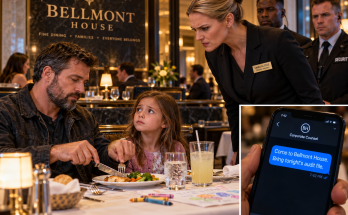
Booth seventeen.
Vanessa.
Mud on his boots.
Sophie asking whether they had done something wrong.
Anna continued.
“Not because the powerless person might secretly be important.”
Daniel opened his eyes.
“Because they already are.”
The video ended.
Daniel sat without moving.
For three years, he had imagined what Anna might have wanted.
He had let other people invoke her.
Gregory.
Margaret.
Thomas.
Peter.
Whitmore indirectly.
Everyone claimed to know what protected her legacy.
Anna’s final message asked for none of it.
Not revenge.
Not control.
Not even obedience.
Just that living people be treated as though their value did not depend on hidden power.
Daniel replayed the last thirty seconds.
Then stopped.
Once was enough.
He saved the file in the family archive.
Not the corporate one.
He removed the release condition.
No hidden trigger.
When Sophie was older, she could watch it if she wanted.
Or not.
The next morning, Daniel drove to Bellmont headquarters.
Construction crews were removing the executive-floor access gates.
Not all security.
Only the ceremonial barriers that made ordinary employees pass through three checkpoints while senior executives used private elevators.
Daniel had never noticed how absurd that was.
The restructuring office occupied the old board suite now.
Employee representatives sat at the same table where Thomas, Harold, and others once hid meeting minutes.
One seat remained empty.
Daniel sat in it temporarily.
The independent board search was underway.
His role would shrink over two years.
Possibly faster.
Richard entered carrying coffee.
“No emergency?”
Daniel asked.
“Not yet.”
“Good.”
“What did Anna say?”
Daniel looked at him.
“A lot.”
“Anything for Bellmont?”
Daniel thought.
Then smiled faintly.
“Yes.”
He handed Richard a single sentence he had written down.
Not because Anna commanded it.
Because Daniel agreed.
No person’s dignity depends on whether we recognize their power.
Richard read it.
“Company value statement?”
“No.”
Daniel shook his head.
“Too easy to turn into a poster.”
Richard smiled.
“What then?”
“Training.”
“Policies.”
“Metrics.”
“Complaint reviews.”
“Compensation.”
“Hiring.”
“Actual decisions.”
Richard nodded.
“That is harder.”
“Good.”
Daniel looked through the glass wall.
Employees moved through the floor.
Nobody lowered their voice because the owner walked past.
Maybe some still did.
Culture took longer than documents.
That was fine.
At lunch, Daniel received a photograph from Emily.
Booth seventeen.
A family of five squeezed into it.
Three children.
Crayons everywhere.
Caption:
Highest-value table in the room.
Daniel laughed.
Then he noticed the second line.
Spend score: none of your business.
He sent a thumbs-up.
No executive directive.
No ownership symbol.
Just a joke.
That evening Sophie asked whether Bellmont House still belonged to him.
“Partly.”
“Does it belong to Emily?”
“Partly.”
“Luis?”
“Partly.”
“Other people?”
“Yes.”
She thought about it.
“So when I said it belonged with the people who eat there, I was kind of wrong.”
Daniel smiled.
“No.”
“How?”
“Ownership and belonging aren’t always the same thing.”
Sophie frowned.
“That sounds like grown-up nonsense.”
“It might be.”
She leaned against him.
“Can we go there Saturday?”
“For cake?”
“Yes.”
“Green beans first.”
She groaned.
Daniel smiled.
The company was still restructuring.
Trials still lay ahead.
Some restaurants would close.
Some people would lose jobs despite transition support.
Some customers would never trust Bellmont again.
Some employees would decide the reforms came too late.
They were allowed.
Repair was not a transaction where apology purchased forgiveness.
Daniel had learned that too.
He looked toward Anna’s old photograph on the shelf.
For years he had thought preserving Bellmont meant preserving what his father built.
Then he thought justice meant discovering exactly who had destroyed Anna.
Now he understood both goals had been too small.
Bellmont did not need preservation.
It needed the freedom to become something the dead had not already decided.
So did Sophie.
So did Daniel.
And for the first time since the night a manager looked at his muddy boots and decided he did not belong in the premium section, Daniel no longer cared whether anyone entering Bellmont House knew who he was.
That had never been the point.
Click here to continue reading: PART 45: The First Criminal Judgments Arrive as Daniel Learns Accountability Will Never Produce the Simple Ending He Once Expected
A Quiet Dinner With His Daughter Turns Into the Exact Kind of Test Daniel Mercer Came to Investigate
Part 44 of 47