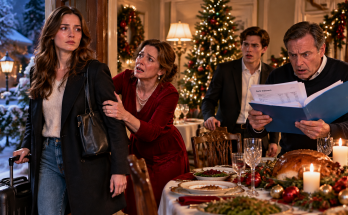
Maple Drive closed on a Friday in March.
There was no ceremony.
No final family dinner.
No neighbors.
No banner.
A title company transferred money into escrow, recorded documents, paid liens according to court-approved priorities, and handed my mother a folder thicker than the one she had once planned to make me sign on Christmas Eve.
That seemed appropriate.
Paper had caused enough damage.
It could do some repair too.
The valid refinance lender was paid through the agreed settlement.
Denny remained responsible for a reduced portion connected to obligations he had knowingly signed, though fraud findings eliminated several disputed charges.
He and Addison chose a repayment plan.
They did not ask me for help.
I did not offer.
That was harder than it should have been.
Good practice.
The restitution lien recovered a substantial amount from sale proceeds.
Not everything owed.
Enough that Evelyn’s trust, combined with recovered policy value and other surrendered assets, could make Addison and me far closer to whole than either of us expected.
We did not take the money immediately.
Independent advisers helped establish clear distributions.
Separate accounts.
Separate signatures.
Separate tax advice.
No family pool.
No “we’ll figure it out later.”
No one’s emergency automatically became anyone else’s obligation.
Addison called hers the least romantic victory of her life.
“I have a boring account.”
“Congratulations.”
“No one else can touch it.”
“Beautiful.”
“I check it twice a day.”
“That part is unhealthy.”
She laughed.
My portion went into an account I could see without seeing Mom’s face.
That mattered.
Some of it represented money Dad tried to restore.
Some came from assets recovered from Paul.
Some from Maple Drive’s lien.
Some would arrive later under restitution schedules.
None of it felt like a prize.
It felt like returned agency.
The other six families entered settlements too.
Not identical.
Not all complete.
Some chose litigation.
Some accepted negotiated restitution.
One family had lost money so long ago the legal recovery was limited, but Paul’s broader asset surrender created a fund that provided partial compensation.
Dad’s ledgers gave them evidence.
His failure to finish the process no longer erased the attempt.
Paul eventually entered a plea agreement covering financial fraud, document falsification, and related offenses tied to multiple transactions.
I did not attend every hearing.
I did not need to.
His consequences were not my closure.
Clara also faced professional and legal consequences for the false notarizations and altered compliance records.
Her cooperation mattered.
So did what she had done.
Both remained true.
Noah stayed with her.
Paul’s legal relationship with him changed through separate proceedings.
That process was private, as it should have been.
To Noah, Paul remained part of his history whether biology agreed or not.
I learned quickly not to ask him what he called Paul.
Some questions belonged to the person answering them.
Mom’s case was more complicated.
Investigators found evidence that she knowingly used false documents, authorized certain improper transfers, concealed beneficiary information, and continued relying on forgery after learning the truth.
They also found acts she had not committed.
Paul’s fabricated sole-responsibility affidavit.
The false Ruth subordination.
The life policy manipulation.
Several transfers made without Mom’s knowledge.
Accuracy protected her too.
Eventually she accepted a negotiated resolution involving financial penalties, restitution cooperation, and probationary conditions rather than the worst outcome we had feared.
I did not argue for leniency.
I did not argue against it.
People made that decision based on evidence.
That felt right.
Mom moved into a rented townhouse with two bedrooms and no formal dining room.
The first time I visited, she apologized because the guest room contained unpacked boxes.
Then she stopped herself.
“You’re not staying tonight, are you?”
“No.”
“Okay.”
Progress.
She had hung Dad’s old sweatshirt over the back of a chair instead of wearing it.
Maple Drive’s sale left her less money than she once imagined the house represented.
But enough for rent, ordinary living expenses, and time to choose what came next.
She started seeing a therapist.
She told me once.
Only once.
I did not ask for details.
Her work was hers.
Our relationship changed slowly.
There was no scene where I announced forgiveness.
I still did not know what full forgiveness meant.
Some weeks we spoke twice.
Some months once.
If she asked a question and I said no, she practiced saying, “Okay.”
Sometimes badly.
Sometimes with a pause long enough to reveal the old response fighting to return.
But she said it.
Addison changed too.
She and Denny stayed married.
Not because everything became fine.
They spent months dealing with what he had failed to disclose around the refinance and what she had failed to question about Mom.
They went to counseling.
Again, not my business unless they chose to share.
What I saw was simpler.
Denny stopped answering financial questions with “Sylvia said.”
Addison stopped calling Mom before making every difficult choice.
Mom stopped interpreting that as rejection.
Mostly.
Ruth retired from being everyone’s emergency trustee before she ever began.
She framed one of the formal declination letters.
When I asked why, she said, “It’s the first family document I signed that says I am responsible for absolutely nothing.”
Fair.
The cabin transfer closed three months after Maple Drive sold.
Dad’s reopened estate recovered title through settlement.
North River released its disputed lien for a reduced amount.
The first lender accepted payoff from foundation assets Paul surrendered.
The math worked.
Not perfectly.
Enough.
Addison and I received equal title temporarily, exactly as Dad intended.
Then we each hired separate lawyers.
Marianne insisted.
I understood why.
Addison chose to transfer her interest to me in exchange for a cash amount based on an independent appraisal.
Not zero.
Not a symbolic dollar.
Not “because family.”
Fair market consideration adjusted for the settlement costs I assumed.
At first I objected.
She stared at me across a conference table.
“You are literally trying to stop me from making an informed decision after independent advice.”
I stopped.
She was right.
Again.
So I paid her.
She signed.
I signed.
Every page explained.
Every amount listed.
No guilt.
No urgency.
No witnesses invited to apply emotional pressure.
The most boring transaction of my life.
Perfect.
The first weekend I stayed alone at the cabin, rain struck the green metal roof.
I woke before dawn.
For several minutes I did not know where I was.
Then I saw Dad’s red thermos on the shelf.
Greer had released the personal items after the investigation ended.
I had cleaned it myself.
The smell of old coffee never completely left.
Dad’s watch sat in the wooden case.
I did not wear it.
Not yet.
The cabin had been repaired.
Roof flashing.
Mildew.
Plumbing.
Nothing dramatic.
I paid for repairs from my own account.
Not restitution money I had mentally assigned to another purpose.
Not family money.
Mine.
That distinction felt almost absurdly satisfying.
Addison visited in early summer.
She brought Denny.
They carried Dad’s old workbench only as far as her own garage, exactly as promised.
She did not want it at the cabin.
“I claimed my artifact.”
“Your artifact weighs four hundred pounds.”
“Worth it.”
Noah visited later with Clara.
His first opinion of the cabin was that the internet was terrible.
Dad would have approved.
We showed him the height marks on the porch.
He stood beside them.
“You should add yours,” Addison said.
He hesitated.
“Is that weird?”
“Only if you don’t want to.”
He thought.
Then nodded.
I found a pencil.
He stood against the rail.
I marked his height.
NOAH, 12.
No date tied to paternity.
No explanation.
Just a boy’s name beside two sisters who had been there decades earlier without knowing he would exist.
He read Dad’s letter privately.
He never showed it to us.
That was right.
Eventually he told me one sentence.
Dad had written:
If I turn out to be your father, I’m sorry the truth arrived before I did.
That was enough.
Mom met Noah months later.
Not at Maple Drive.
Not at the cabin.
A park.
Clara stayed.
So did a counselor Noah trusted.
I did not attend.
Neither did Addison.
The meeting belonged to them.
Afterward Mom called.
“How did it go?”
“I don’t know.”
She laughed softly.
“Fair.”
Then she said Noah had asked whether she hated him.
My chest tightened.
“What did you say?”
“The truth.”
“What truth?”
“That I hated what happened, not him.”
Good.
“And?”
“He asked whether Daniel would have stayed married to me if he lived.”
“What did you say?”
“I don’t know.”
Also good.
Some questions deserved uncertainty.
The final accounting of Dad’s estate arrived near the end of summer.
It was not romantic.
Forty-three pages.
Assets.
Claims.
Settlement credits.
Professional fees.
Recovered property.
Tax adjustments.
Distributions.
I read every line.
Of course I did.
Near the end sat a schedule titled Beneficiary Restoration.
My name.
Addison’s.
Noah’s separate provision noted elsewhere.
For once, the numbers did not hide anything.
They showed exactly what belonged to whom.
I closed the document and cried.
Not because the amount was large.
Because nobody had to infer.
Dad’s original intention was finally visible.
Addison received what she was entitled to after adjustments for earlier support.
I received restored funds and the cabin transaction separately.
Noah retained his custodial benefit, supplemented through recovered assets connected to Paul’s misuse.
Mom received what remained hers after valid obligations.
No one got everything they wanted.
Everyone got clearer boundaries.
That felt closer to justice than any dramatic victory could have.
On the anniversary of Dad’s death, Mom asked whether I wanted to meet at his grave.
I almost said yes automatically.
Then I stopped.
“What does it cost you before you say yes?”
Dad’s note.
I asked myself.
I did not want the cemetery.
Not that day.
“No.”
The old pause came.
Then Mom said, “Okay.”
I waited.
“That’s it?”
“Yes.”
“What will you do?”
“Go to the cabin.”
“Okay.”
Another pause.
“Can I send flowers?”
“No.”
She laughed.
“Okay.”
I smiled.
“Maybe call me Sunday.”
“I’d like that.”
“Good.”
That was our relationship now.
Not effortless.
Negotiated in the healthiest sense.
Asked.
Answered.
Adjusted.
On Sunday she called.
We talked about nothing important for twenty minutes.
A broken dishwasher.
Addison’s new job.
Noah’s soccer game.
Ruth’s insistence that retirement meant refusing every committee.
Then Mom said, “I miss the house.”
“I know.”
“I don’t regret selling.”
Both.
Good.
“I miss Daniel there.”
“I understand.”
“I used to think if I kept Maple Drive, I was keeping the family from ending.”
I waited.
“I think I almost ended the family trying.”
“Yes.”
She accepted it.
Then she asked, “Are you happy?”
The question felt dangerous only because of history.
I answered honestly.
“Sometimes.”
She laughed.
“That sounds like you.”
“Accurate.”
“Are you happy at the cabin?”
“Yes.”
“Good.”
No claim.
No reminder Dad bought it.
No request to visit.
I appreciated that enough to offer something.
“You can come sometime.”
Silence.
“Are you sure?”
“Yes.”
“Addison too?”
“If we plan it.”
“Not Christmas.”
I laughed.
“Definitely not Christmas.”
By December, a full year had passed since the invitation.
I did not return to Maple Drive.
There was no Maple Drive to return to.
A young family owned it now.
I drove past once.
New curtains.
Bicycles in the driveway.
Someone had painted the front door blue.
It hurt.
Then it didn’t.
The crack in Dad’s walkway was still there.
They had not repaired it.
I smiled.
Everyone would still know somebody made it imperfectly.
Christmas happened at the cabin.
Not because Dad instructed us to gather there.
Because we chose it.
Addison and Denny came.
Ruth came.
Noah and Clara came for the afternoon.
Mom came last.
She stood on the porch carrying a pie.
No camera.
No paperwork.
No witnesses.
Just pie.
I opened the door.
She looked nervous.
“Hi.”
“Hi.”
“Can I come in?”
Even after a year, she still asked.
“Yes.”
She entered.
No one made a speech.
We ate.
Noah cheated at cards and blamed genetics.
Addison accused him of learning it from Dad through spiritual transmission.
Ruth drank too much coffee.
Denny burned garlic bread.
Mom washed dishes until Addison told her she was making herself useful to avoid sitting with people.
Mom turned off the water.
“You’re annoying.”
“I learned from Ren.”
“Unfair.”
I laughed.
Later, I found Mom standing on the porch alone.
Snow had begun.
Not much.
Thin white dust between trees.
She looked at the height marks.
Ren.
Addison.
Noah.
“Daniel would have loved this.”
“Probably.”
She looked at me.
“I’m sorry.”
I could have told her I knew.
Instead I asked, “For which part?”
She laughed softly.
“Still an accountant.”
“Yes.”
She thought.
“For deciding your answer before asking you the question.”
That was precise enough.
“I accept the apology.”
Her face changed.
Not absolution.
Not erasure.
An apology accepted.
That was what I could honestly give.
“Thank you.”
We stood quietly.
Then she asked something she had avoided all year.
“Do you forgive me?”
I looked through the window.
Addison was arguing with Noah over cards.
Denny pretended not to help him cheat.
Ruth had fallen asleep in Dad’s old chair.
Clara was reading.
Family.
Not restored to what it was.
Built into something else.
“I forgive some things.”
Mom nodded.
“And some?”
“I’m still working on.”
She swallowed.
“Okay.”
No demand for completion.
No deadline.
No accusation that partial forgiveness meant I loved her less.
That might have been the strongest evidence she had changed.
I looked at the snow.
“I don’t want what happened to define every conversation we have.”
“Neither do I.”
“But I’m not pretending it didn’t happen.”
“I know.”
“That has to be enough.”
“It is.”
Inside, Noah shouted that Addison was cheating.
She shouted that he had started it.
Mom smiled.
“Should we intervene?”
“No.”
“Why?”
“They’ll figure it out.”
She considered.
Then nodded.
“Okay.”
We went inside.
A year earlier, I had walked into Christmas carrying fifteen years of bank records because I suspected my family had lied about money.
I found something worse.
And something better.
The worse was how many decisions had been made in the name of love without consent.
The better was discovering that love did not require surrender.
Dad had not left us a perfect plan.
He left protections because he knew we were imperfect.
Some failed.
Some survived.
A letter in Ruth’s purse.
A ledger in a cabin.
An amendment in bank custody.
A note in an old wallet.
Enough pieces endured for us to reconstruct what mattered.
Money could be repaid.
Documents could be corrected.
Not everything else could.
Eleven years were still gone.
Dad would never meet Noah.
Evelyn would never explain herself in person.
Martin never learned how useful his file became.
The old version of my relationship with Mom did not return.
Neither did the old version of Addison and me.
Good.
Some things should not be restored.
They should be replaced.
When dinner ended, Mom offered to help clean.
Then stopped herself.
“Do you want help?”
I smiled.
“Yes.”
She washed.
I dried.
Addison carried plates.
No one assigned roles permanently.
No one kept score.
When Mom left, she hugged Addison.
Then turned toward me.
She did not open her arms automatically.
Another question without words.
I stepped forward.
We hugged.
Briefly.
Real.
She whispered, “Merry Christmas.”
“Merry Christmas.”
After everyone drove away, I stood alone on the porch.
The cabin settled around me.
Dad’s cabin once.
Then Hart-Mercer’s collateral.
Paul’s asset.
Evidence storage.
A disputed estate claim.
Now mine.
Not because I was the daughter who left.
Not because Addison surrendered under pressure.
Not because Mom needed anything.
Because documents were read.
Values established.
Independent advice received.
Choices made.
The house at Maple Drive had never been the proof that we were family.
Neither was the cabin.
The proof was simpler.
We could tell one another no and remain.
We could disagree and return.
We could help without being volunteered.
We could leave without abandoning.
And after eleven years of people deciding for one another, we finally learned the lesson Dad had been trying to build into every failed plan he left behind.
Love was not the right to choose for someone.
Love was making room for their answer.
The End
Read more original stories on Feel Every Story.
The Christmas Invitation Arrived After Five Silent Years, but One Line Made Me Wonder What My Mother Really Wanted
Part 35 of 35