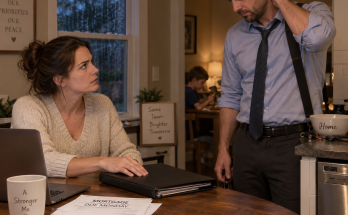
Emma flew in the following Friday despite my insistence that I was perfectly capable of dealing with Sarah myself. She arrived after midnight, dragging a suitcase through the front door and muttering about a toddler who had screamed through the entire flight. I had made up the smaller bedroom for her, but we remained in the kitchen until nearly two, talking quietly while rain tapped against the windows.
“You understand why this bothers me,” she said.
“I understand why it bothers both of us.”
“No, Mom. I mean really bothers me.”
She leaned forward, elbows on the table.
“Sarah isn’t asking what you want. She’s asking what you have.”
I stirred tea that no longer needed stirring.
“Maybe she thinks those things are connected.”
“They aren’t.”
“I know.”
“And David?”
I sighed.
“I don’t know what David thinks.”
“That’s part of the problem.”
She was right.
I had defended my son by imagining thoughts he had never expressed. David must feel trapped. David probably disagrees with Sarah privately. David wouldn’t actually let anything happen.
Those explanations had one weakness.
They required me to invent the best version of him while ignoring the version standing silently in front of me.
Saturday morning was cool and bright after the rain. Emma helped me clear fallen branches from the edge of the drive. Around eleven we drove into town, bought groceries and stopped for coffee. I deliberately did not mention Sarah for almost three hours.
It felt wonderful.
On the way home, Emma pointed toward the hills.
“I get why you bought this place.”
“I thought you already did.”
“I understood the idea. Now I understand the feeling.”
“What feeling?”
“That nobody can just happen to be here.”
I smiled.
Wild Fern Road was not the sort of road people used by accident.
The cottage sat near its end, beyond two sharp turns and a narrow bridge. Anyone pulling into my driveway had chosen to come.
That observation returned to me Sunday morning.
I was on the porch with Emma, each of us holding coffee, when an unfamiliar gray sedan appeared beyond the trees.
It slowed at the mailbox.
Then it turned into my drive.
Emma lowered her mug.
“Expecting someone?”
“No.”
The sedan stopped beside the cottage.
A middle-aged man climbed out carrying a hard black case and a tripod-like instrument. He wore khaki pants, a pale blue shirt and an identification badge clipped to his belt.
Before he reached us, a second vehicle appeared.
A black SUV.
I recognized it immediately.
David was driving.
Sarah sat beside him.
My coffee went cold in my hand.
Emma stood.
“What is this?”
“I don’t know.”
The gray-haired man approached the porch wearing the uncertain smile of someone who suspected he had arrived in the middle of a family problem without receiving advance notice.
“Mrs. Hale?”
“Yes.”
He offered his hand.
“Daniel Peterson. Peterson Property Services.”
I shook it.
“What can I do for you, Mr. Peterson?”
He glanced over his shoulder as David and Sarah got out of the SUV.
“I’m here regarding the valuation.”
I did not move.
“What valuation?”
His smile vanished.
Sarah shut the passenger door with unnecessary force.
“Mom, please don’t start.”
Emma turned toward her.
“Start what?”
Sarah looked genuinely surprised to see her.
“What are you doing here?”
Emma laughed once.
“Visiting my mother. At her house. Usually people consider that normal.”
David came around the SUV.
“Can everybody just calm down?”
Nobody had raised a voice.
That was one of David’s habits when conflict made him uncomfortable. He declared the room overheated and then behaved as though lowering the temperature was more important than discussing who had lit the match.
I looked at Mr. Peterson.
“You said valuation.”
He nodded cautiously.
“I was asked to provide an estimated market value for the residence and acreage.”
“By whom?”
He glanced toward Sarah.
I followed his gaze.
She lifted her chin.
“I contacted him.”
The answer was so direct that for a moment I had nothing to say.
Emma did.
“You hired someone to value Mom’s house?”
Sarah crossed her arms.
“It’s not what you think.”
“That would be reassuring if I knew what I thought.”
“Emma, stay out of this.”
“My mother’s standing on her porch while a stranger you hired prepares to measure her property. I think we passed ‘stay out of it’ about three exits ago.”
David rubbed the back of his neck.
“Sarah was only trying to get information.”
I looked at him.
“For whom?”
“For us.”
That answer landed differently.
Not Sarah.
Us.
Mr. Peterson shifted his case from one hand to the other.
“If this is a bad time, I can reschedule.”
“You won’t need to,” I said.
Sarah stepped forward.
“Mom.”
I ignored her.
“Mr. Peterson, who did you understand owned this property?”
He looked increasingly unhappy.
“I was told it was a family property.”
“It is not.”
Sarah exhaled loudly.
“Oh, come on.”
I turned to her.
“No. I would like to hear his answer.”
Mr. Peterson looked down at a tablet he had taken from the case.
“My work order lists the contact as Sarah Hale.”
“And owner?”
He scrolled.
“There isn’t an owner identified.”
“Did anyone tell you that Sarah Hale had authority to order an assessment?”
He hesitated.
“No, ma’am.”
“Did anyone tell you she didn’t?”
Another pause.
“No.”
I nodded.
That was enough.
Sarah stepped onto the porch.
“You are deliberately making this embarrassing.”
“I didn’t invite an assessor.”
“We’re trying to plan.”
There it was.
Not worry.
Not curiosity.
Plan.
I looked at David.
“What are you planning?”
He glanced at Sarah.
She answered first.
“The future.”
“Mine?”
“Ours.”
Emma made a low sound of disbelief.
Sarah turned on her.
“This has nothing to do with you.”
Emma’s face became very still.
“That’s an interesting thing to say about our mother’s property.”
“You live three states away.”
“So?”
“You have your own life.”
“So does Mom.”
Sarah’s cheeks flushed.
“That is not what I meant.”
“Then explain what you meant.”
David finally stepped between them.
“Enough.”
I had been watching him carefully.
Not once since arriving had he asked Sarah why she had brought an assessor.
He already knew.
That realization hurt more than her behavior did.
“David.”
He turned.
“Did you know he was coming?”
His expression answered first.
Then his voice.
“Yes.”
Emma looked at him.
I looked away.
For several seconds the only sound was wind moving through the oak leaves above the drive.
Mr. Peterson took one careful step toward his car.
“I really think I should go.”
“Not yet,” I said.
Sarah stared at me.
“Why are you keeping him here if you’re going to refuse the assessment?”
“Because I want to understand exactly what you told him.”
“I told him we needed to know what the cottage is worth.”
“We?”
“David and me.”
“Why?”
Her mouth tightened.
“We’ve been over this.”
“No. You’ve asked questions. You’ve handed me brochures. You’ve discussed my finances with relatives. You’ve told people David helped pay for a house he contributed nothing toward. But you have never actually told me why you need to know what my property is worth.”
Sarah looked at David again.
He stared at the gravel.
I stepped down from the porch.
“Look at me.”
David did.
He looked tired.
I did not care.
Not then.
“Why do you need an appraisal of my house?”
“We thought it would be smart.”
“For what?”
“In case something happens.”
“To me?”
“Yes.”
“I’m standing right here.”
“Mom—”
“No. If something happened to me tomorrow, an appraisal ordered today would not give you ownership. So what exactly does this accomplish?”
David had no answer.
Sarah did.
“It gives us a realistic idea of the asset.”
Asset.
Not home.
Not Mom’s cottage.
Asset.
Emma’s shoulders stiffened.
I felt strangely calm.
“Mr. Peterson,” I said, “did Sarah tell you why she wanted the valuation?”
He looked uncomfortable.
“She indicated there might be a future transfer.”
I heard Emma inhale sharply.
David closed his eyes.
Sarah’s expression changed from irritation to alarm.
“That isn’t what I said.”
Mr. Peterson looked at her. “You said ownership might be restructured within the family.”
“Eventually.”
“That is a future transfer.”
Sarah’s face reddened.
I turned to David.
“What transfer?”
“Nothing has been decided.”
“By whom?”
“Mom, please.”
“By whom, David?”
His silence was devastating precisely because I already knew the answer.
They had been discussing my property as though my participation would eventually become a formality.
I looked at Sarah.
She squared her shoulders.
“You’re living alone on three acres. You still own another house. At some point somebody has to think practically.”
“I am thinking practically.”
“You’re thinking emotionally.”
The old version of me would have recoiled from that accusation.
I would have wondered whether she was right.
Instead I glanced around at the porch I had repaired, the flower beds I had cleared and the cottage whose mortgage balance was exactly zero because I had bought it with my own savings.
“No,” I said. “I think buying property I can afford and living where I choose is remarkably practical.”
“You know that isn’t what I mean.”
“There’s that sentence again.”
“What sentence?”
“You know what I mean.”
I stepped closer.
“I’m beginning to believe you rely on that phrase because saying exactly what you mean would sound ugly.”
Sarah stared at me.
David whispered, “Mom.”
I held up one hand.
“No.”
For once, I did not need him to protect me from the consequences of speaking.
I looked at Sarah.
“Say it clearly. What do you think should happen to this cottage?”
She remained silent.
Emma stood beside me now.
Not in front of me.
Beside me.
That mattered.
Sarah looked toward the field.
“You don’t need all of this.”
It was the first honest sentence she had given me.
I almost smiled.
“There we are.”
She frowned.
“You have two bedrooms and three acres for one person.”
“One person is allowed two bedrooms.”
“You know what I’m saying.”
“Stop telling me I know. Say it.”
Her frustration finally broke through.
“David has a family.”
“So?”
“He has the twins to think about.”
“Yes.”
“This property could give them security.”
“They have parents.”
“That’s not the point.”
“What is the point?”
Her voice sharpened.
“The point is that eventually this is all going somewhere.”
Something in the way she said all told me the cottage was no longer the only property in her mind.
The city house.
My investments.
Robert’s insurance.
The questions to relatives.
I suddenly saw the whole shape of it.
Not a crime.
Not yet even a concrete scheme.
Something more ordinary and, in its way, more insulting.
An assumption.
They had begun allocating my life while I was still living it.
I looked at my son.
“Did you know Sarah was asking relatives about my finances?”
His head came up.
“What?”
For the first time that morning, he appeared genuinely surprised.
Sarah turned sharply toward him.
“Don’t.”
Emma caught it too.
“Don’t what?”
Sarah ignored her.
David stared at his wife.
“What relatives?”
“It was nothing.”
“What did you ask?”
“I was trying to understand the situation.”
“What situation?”
Sarah’s control slipped.
“Your mother owns two houses, David. She has investments. Your father left insurance money. Somebody has to know what’s going on.”
“No,” I said. “Somebody doesn’t.”
She looked at me.
I felt Robert’s absence with sudden painful clarity.
He had always handled confrontation more easily than I did. He would have asked direct questions hours earlier. He would have recognized what I had spent weeks trying to excuse.
But Robert was gone.
That meant the direct questions belonged to me now.
“Mr. Peterson,” I said, “I’m sorry you were brought into a situation without accurate information.”
He nodded.
“I understand.”
“I am the sole owner of this property. I have not authorized an appraisal, valuation, survey or inspection.”
“Understood.”
“I’d like you to leave.”
“Of course.”
He began packing his equipment.
Sarah stepped after him.
“Wait.”
He stopped.
She turned to me.
“You’re making a mistake.”
“What mistake?”
“Refusing to plan responsibly.”
“I have plans.”
“You never tell us anything.”
“You are not automatically entitled to know.”
Her expression hardened.
“I’m your daughter-in-law.”
“And?”
“And David is your son.”
“I’m aware.”
She gestured toward the cottage.
“This all affects him.”
“No.”
My voice was quiet enough that everyone stopped moving.
“This house affects David only if I decide it does.”
Sarah stared at me.
Something shifted behind her eyes.
The politeness disappeared.
Then she said the sentence that finally explained why every question had felt wrong.
“David was always supposed to have this.”
I turned toward my son.
His face had gone white.
For one suspended second, he and I looked at each other across the gravel driveway.
He did not look confused by what Sarah had said.
He looked exposed.
And that told me the conversation about taking my cottage had begun long before the assessor ever turned into my driveway.
Click here to continue reading: PART 5: My Son Finally Admitted What He Had Promised Sarah, and the Truth Was Worse Than the Appraisal
The Weekend Everyone Called a Family Celebration Was the Weekend I Finally Learned Where They Thought I Belonged
Part 4 of 27