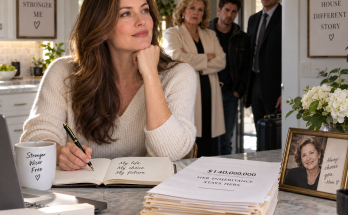
At 6:03 in the morning, Brenda pushed through my front door as though she were entering a house that belonged to her. I had been home from Chicago for less than an hour. My suitcase was still beside the stairs, one wheel turned sideways, and my coat carried the dry, recycled chill of the overnight flight. I was standing at the kitchen island with a thick manila folder pressed beneath one hand when she marched in and said, without greeting me, “Where is the money?”
For several seconds, I honestly thought exhaustion had scrambled the sentence. The refrigerator hummed behind me. Rain tapped lightly against the dark kitchen windows. Somewhere upstairs, a floorboard creaked. Brenda stood in the middle of the room wearing a camel-colored coat over pajamas and expensive leather shoes she had clearly thrown on in a hurry. Her gray-blond hair was uncombed. Her expression, however, was perfectly composed.
“What money?” I asked.
She stared as if I were being deliberately difficult. “Sarah, please. Your mother’s apartment. The sale closed yesterday. You told David yourself.” She glanced at the folder under my hand, then back at my face. “The hundred and forty million dollars. We need to know when it will be available.”
We.
That single word bothered me almost more than the demand.
My mother had been dead for six months. During that time I had flown to Chicago nearly every weekend, slept on a folding mattress in her Gold Coast penthouse, sorted forty years of papers, clothes, photographs and objects that meant nothing to an appraiser and everything to me. I had sat through meetings with probate attorneys. I had signed forms until my wrist hurt. I had paid accountants, movers and maintenance fees. I had decided which china to donate and which cracked coffee mug I could not bring myself to throw away.
Brenda had not helped with any of it.
Neither had her younger son, Jason.
And my husband, David, had found reasons not to come almost every time I asked.
The $140 million was not a pile of cash in my imagination. It was my mother’s handwriting on old tax returns. It was the faint perfume still trapped in her closet. It was the view from the windows where she had stood drinking coffee every morning after surviving illnesses, bad investments, betrayals and a marriage she rarely discussed. It was the final measurable value strangers had assigned to a life I would have traded every dollar to have back.
I tightened my fingers against the folder. “What do you mean, you need to know when it will be available?”
“For Jason,” Brenda said, as if that explained everything. “His situation has become urgent.”
Of course it had.
Jason’s situations were always urgent.
He was forty years old and had spent most of the previous decade announcing that his newest plan would erase the damage caused by the previous one. There had been a software company that collapsed before it launched, a cryptocurrency investment he entered after prices had already soared, a restaurant partnership that ended in litigation, private loans, credit cards, sports bets he called “statistical investing,” and a series of business opportunities whose details grew vaguer every time someone asked where the money had gone.
Each disaster arrived wrapped in the same language.
Temporary problem.
Bad timing.
One last bridge loan.
Fresh start.
Family helps family.
I looked at Brenda. “How much does Jason owe?”
Her mouth tightened. “That isn’t the point.”
“It seems very much like the point.”
“He needs enough to clear the immediate obligations and restructure everything properly.” Her gaze dropped again to the folder. “With what you received, it won’t make any meaningful difference to you.”
There are sentences that expose more than the speaker intends. Brenda had just reduced my mother’s entire estate to an excess large enough to absorb her son’s mistakes. She had done the calculation before walking into my home. She had decided what counted as meaningful to me.
I heard footsteps on the stairs.
David appeared wearing navy sweatpants and the white T-shirt he slept in. He did not look startled to see his mother. He did not ask why she was inside our house before sunrise. He did not look from Brenda to me with confusion.
Instead, he stopped on the last step and rubbed one hand over his face.
That was when I knew.
He had been expecting her.
“Sarah,” he said quietly. “Maybe sit down.”
I looked at him for a long moment. We had been married for nine years. I knew the small movements he made when he was nervous: the tightness along his jaw, the way his right thumb rubbed the side of his index finger, the controlled tone he used whenever he had rehearsed a conversation before having it.
All three were there.
I remained standing.
Brenda exhaled impatiently. “There is no reason to make this dramatic.”
“I haven't said anything dramatic.”
David came into the kitchen and stopped beside his mother rather than beside me.
Another small thing.
Another answer.
He folded his arms. “Mom and I have been talking about Jason.”
“How long?”
“That’s not important.”
“It is to me.”
David glanced at Brenda. She looked away.
“Several weeks,” he admitted.
Several weeks.
While I was in Chicago packing my dead mother’s bedroom, my husband and his mother had been discussing how to spend the proceeds from her home.
Something inside me went very still.
David continued. “Jason’s debts are worse than we realized. If he doesn’t deal with them now, he could lose everything. There could be lawsuits. Maybe criminal allegations depending on what some creditors claim. Mom is scared.”
Brenda lifted her chin. “Any mother would be.”
I almost answered that I knew something about frightened mothers, but I kept the thought to myself.
David stepped closer. “The inheritance gives us an opportunity to solve the problem permanently.”
“Us?”
He hesitated.
There it was again.
I watched my husband choose his next words with extraordinary care.
“We’re married, Sarah.”
“That was not my question.”
He sighed. “We share a life. We make major decisions together.”
“You and your mother made this one.”
Brenda cut in. “Because someone had to think rationally. Jason cannot wait while you spend months deciding what to do with more money than one person could ever possibly need.”
The kitchen clock clicked over to 6:11.
I remember that because I looked directly at it.
Something about seeing the time made the entire scene sharper. I noticed rainwater drying in small dark spots on Brenda’s coat. I noticed the coffee stain near the cuff of David’s shirt. I noticed the folder beneath my hand had a bent corner from where I had gripped it too hard during the flight.
I also noticed that neither of them had asked how the closing went.
Neither had asked whether I was all right.
David reached for my wrist. I moved before he touched me.
His hand stopped in the air.
“Sarah,” he said, softer now, “I know you're grieving.”
The sentence almost made me laugh.
He had used my grief as an explanation for why I might object to giving away my inheritance.
Not as a reason to protect me.
Not as a reason to postpone the conversation.
As a weakness to overcome.
I said, “Did you tell Jason he would get the money?”
Brenda looked at David.
David looked at the floor.
That was enough.
But I wanted the words.
“Did you?”
He inhaled slowly.
“Yes.”
No apology.
No qualification.
Just yes.
For the first time that morning, the exhaustion vanished completely.
“How much did you promise him?”
“We didn’t settle on an exact number.”
“You promised money you don't own without deciding how much?”
“He’s my brother.”
“And she was my mother.”
Brenda slapped one palm against the island. “Your mother would have understood helping family.”
I turned toward her.
She had met my mother perhaps six times in nine years.
Six polite dinners.
One Christmas.
Two birthdays.
A wedding.
A hospital visit during which Brenda spent more time discussing parking fees than my mother’s biopsy.
“You did not know my mother well enough to tell me what she would have wanted.”
Brenda’s cheeks flushed. “I know she loved you.”
“That is true.”
“And people who love their children want them to share their blessings.”
“My mother also believed adults should pay their own debts.”
David groaned. “This is exactly what I wanted to avoid.”
I stared at him. “You wanted to avoid my opinion about my inheritance?”
“I wanted to avoid a fight.”
“No. You wanted to avoid asking.”
Silence stretched across the kitchen.
David’s face changed slightly. He had expected anger he could call unreasonable. He had expected tears he could soothe. He had probably expected me to shout so Brenda could later tell relatives that grief had made me unstable.
Instead, I was asking questions.
Questions are dangerous when someone has built a plan around your confusion.
I moved the manila folder from beneath my hand and set it squarely in the center of the island.
Brenda’s eyes followed it.
David noticed.
For the first time, I almost smiled.
Six months earlier, after my mother’s funeral, I had thought losing her was the worst thing that could happen to me.
I had been wrong.
The worse thing was discovering how quickly people began calculating what her death might be worth.
And the folder between us contained information neither Brenda nor David knew existed.
Information my mother had spent her last months arranging.
Information I had spent six months learning how to understand.
David glanced at it. “Is that from the closing?”
“Some of it.”
Brenda leaned closer. “Then this doesn’t need to become unpleasant.”
I looked at her.
She mistook my silence for surrender.
I let her.
David tried again. “Look, Jason isn't asking for all of it.”
“How generous.”
“He made mistakes.”
“For ten years.”
“He knows that.”
“Does he?”
“He wants a chance to fix things.”
I folded my hands.
“How much do you owe him?”
David froze.
Brenda turned sharply toward him.
“What?” she asked.
David recovered almost immediately. “Nothing.”
I watched his face.
Nine years of marriage teaches you more than the words a person uses. It teaches you the half-second delay before a lie. It teaches you the difference between irritation and fear.
What crossed David’s face was fear.
I had seen the same expression two weeks earlier when I asked why a bank representative had called our home looking for him.
At the time, he had said it was about refinancing options.
I had believed him.
Or rather, I had chosen not to investigate.
There is a difference.
Brenda waved her hand. “You’re changing the subject.”
“No,” I said. “I think I’m finally finding it.”
David stepped forward. “Sarah.”
Something in his tone warned me not to continue.
That warning confirmed more than any confession could have.
My mother used to say that when a person desperately wants you to stop asking questions, the next question is usually the one worth asking.
I could almost hear her voice.
I looked down at the folder.
Then I made my decision.
I softened my expression.
I let my shoulders fall.
And I said, “You know what? Maybe you’re both right.”
Brenda blinked.
David stared at me.
The change in them was immediate.
Brenda’s posture relaxed first. David released a breath he had been holding. The tension went out of his jaw.
They believed they had won.
I touched the folder gently.
“My mother left me more responsibility than I expected,” I said. “Maybe I shouldn't make decisions alone.”
Brenda smiled.
It was a small, satisfied smile, but it told me everything.
David approached and finally stood beside me. “Thank you. That's all I was trying to say.”
I looked at the man I had trusted with nearly a decade of my life.
Then I looked at his mother.
“All right,” I said. “If we're going to make this a family decision, we should probably look at what my mother actually left.”
I opened the folder.
And when David saw the first document inside, every trace of relief disappeared from his face.
Click here to continue reading: PART 2: The First Document Changed the Conversation, but My Mother’s Handwritten Warning Made My Husband Stop Breathing Normally
Before Sunrise, My Mother-in-Law Came for My Mother’s Fortune—and My Husband Was Already Waiting for Her
Part 1 of 26