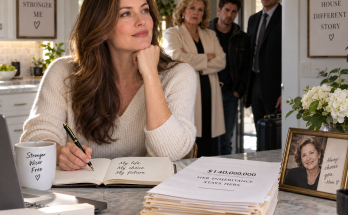
The morning after Valeria received her corrected birth certificate, she placed it on the kitchen table and left it there.
Nobody touched it.
It seemed wrong to handle something that represented so much loss.
For decades, a government document had said she was dead. Now another document said she had never been.
The contradiction was absurd.
The woman sitting beside me was living proof that paperwork could erase a person without actually erasing them.
Valeria finally picked up the certificate.
“I thought this would feel bigger.”
“It does.”
She shook her head.
“No. I mean I thought I'd feel finished.”
Evelyn looked at her.
“Finished with what?”
“Being angry.”
Nobody answered.
Valeria folded the document and placed it inside a protective sleeve.
“I don't think I'm angry at one person anymore.”
“That might be harder,” I said.
She smiled faintly.
“It is.”
The foundation had changed after the court ruling.
Families still came to us, but the purpose was different.
We were no longer trying to uncover our own history.
We were helping others navigate theirs.
We had lawyers.
Records specialists.
Former investigators.
Volunteers who spent hours comparing dates on documents and tracking old addresses.
The work was tedious.
That was exactly what made it useful.
There were no dramatic discoveries every afternoon.
Sometimes the answer to a family's question was simply that the person they had been searching for had changed their name voluntarily and wanted privacy.
Sometimes the person had died years earlier.
Sometimes records had been lost.
And sometimes we found something.
One rainy afternoon, a woman came to the office carrying a newspaper clipping.
She wanted help finding her father.
He had disappeared in 1974.
His photograph looked familiar.
Not because I knew him.
Because I had seen his name.
It was in one of the old files recovered from the Ellis network.
I told her we would investigate.
Valeria took the clipping.
Her expression became serious.
“We won't promise what we can't prove.”
The woman nodded.
“That is all I want.”
After she left, Valeria searched the archive.
We found the man's name.
A notation beside it read:
Transferred north.
No destination.
We followed the trail for six weeks.
Eventually, we found a death record.
The woman cried when we gave her the answer.
It wasn't the answer she wanted.
But it was the truth.
After she left, Valeria sat alone.
“You're thinking about your own mother,” I said.
She nodded.
“I keep wondering what she would have done if she'd lived.”
“Maybe she would have been proud.”
“Maybe.”
“You'll never know.”
“I know.”
She looked toward the archive.
“But I can make sure other children don't spend their whole lives wondering.”
That became the foundation's central project.
Missing identities.
Not just missing people.
People whose names had been altered, hidden, or wrongly recorded.
People who existed between documents.
People whose families had been told one story while another sat in a locked file somewhere.
We began restoring names.
One case at a time.
Months passed.
Then Evelyn brought us a box.
“I found this in the attic.”
Inside were letters.
Some belonged to Clara.
Some to Anna.
Some were written by my grandmother.
But one envelope was addressed to Valeria.
She stared at it.
“Why wasn't this in the archive?”
“Because I never knew it existed.”
The envelope had been sealed for decades.
Valeria opened it carefully.
The letter inside was from Clara.
My dear girl,
If you are reading this, then you survived what I feared most.
Valeria stopped.
She wiped her eyes.
Then she continued.
I know you may hate the people who kept secrets from you. You have every right to. But please remember that fear made cowards of people who once believed they were brave.
Valeria read silently for a while.
Then she handed the letter to me.
The next lines were about Evelyn.
Your mother loved you. She made choices I disagreed with, but never mistake her fear for indifference.
Valeria took the letter back.
At the bottom was a final sentence.
Find Leo when you are ready. He will know what to do with the last record.
She looked at me.
“What last record?”
“I don't know.”
We searched the archive.
Nothing.
We searched the house.
Nothing.
We contacted the investigators.
They had no record of another document.
Then Daniel remembered something.
“My mother used to talk about a red file.”
“What kind?”
“Thin. Leather.”
“Where?”
“She said it belonged to Anna.”
We searched the old photographs.
One showed Anna sitting at a desk.
A red file was visible beside her.
The photograph had been taken inside the coastal house.
We returned there.
The house was empty now.
The court had transferred ownership to Evelyn.
She unlocked the door herself.
We searched the study.
Nothing.
Then Valeria noticed the fireplace.
“There.”
A brick was slightly loose.
Behind it was a narrow cavity.
Inside was a red leather file.
Nobody spoke.
The first document was a handwritten family tree.
It went back five generations.
But the names had been crossed out and rewritten repeatedly.
The second document was a list of properties.
The third was a confession.
Anna had written it.
She described how Arthur Ellis had begun the property scheme.
She described Samuel Ellis taking control.
She described the forged deaths.
She described Evelyn being separated from her real history.
And then she wrote about Clara.
Clara was not merely an investigator.
She was my successor.
Valeria read the sentence twice.
“She planned all of this?”
“Not all of it.”
The final pages explained that Anna had hidden evidence in several locations.
She believed that if one person failed, another might succeed.
The red file was the final surviving record.
At the bottom was a note.
Do not use this to punish the dead. Use it to protect the living.
Valeria closed the file.
“That sounds like her.”
Evelyn nodded.
“She always believed the future mattered more than revenge.”
We took the file to the investigators.
The court had already closed the major cases, but the documents helped resolve several remaining property claims.
Families received land.
Some received compensation.
Others received nothing because the evidence showed their relatives had never owned the disputed property.
Again, truth was not always satisfying.
But it was clean.
A year passed.
The foundation held its first public memorial.
We displayed copies of corrected records.
Photographs.
Names.
Letters.
No sensational stories.
No dramatic reenactments.
Just evidence.
At the center of the room was a blank wall.
Valeria explained why.
“We left this wall empty because there are still people whose names we don't know.”
Visitors added handwritten names.
Some were names of missing relatives.
Some were names of people who had died without identification.
By the end of the evening, the wall was covered.
Evelyn stood before it for a long time.
Then she placed one photograph there.
Anna.
Her real mother.
“I spent my life thinking she abandoned me,” she said.
Valeria stood beside her.
“She didn't.”
“No.”
Evelyn touched the photograph.
“She left me a way back.”
That night, after everyone had gone, I found Valeria outside.
“You okay?”
She nodded.
“I think so.”
“What are you thinking?”
She looked at the building.
“About how everything began.”
“My mother praying.”
“The television broadcast.”
“Your face on the screen.”
She smiled.
“I still remember the first thing I thought when the camera found me.”
“What?”
“I wondered whether anyone would recognize me.”
“You were afraid.”
“I was terrified.”
“And now?”
She looked at the foundation sign.
“Now I know being recognized isn't the same as being known.”
I understood.
For years, our family had known names without knowing people.
Known documents without knowing stories.
Known facts without understanding consequences.
Now we had something different.
We knew each other.
Not perfectly.
Not without scars.
But honestly.
Valeria turned toward me.
“I want to visit Dad.”
I knew immediately whom she meant.
My father was still in prison.
She had visited him only once since the trial.
“Are you sure?”
“No.”
She smiled.
“But I think that's different from not wanting to.”
We went the following week.
My father looked older.
When Valeria sat across from him, he couldn't speak.
She placed the corrected birth certificate on the table.
“I got my name back.”
He nodded.
“You always had it.”
“Not on paper.”
“No.”
She was quiet.
Then she said, “I don't forgive everything.”
“I don't expect you to.”
“But I understand more than I did.”
My father lowered his eyes.
“That is more than I deserve.”
Valeria shook her head.
“This isn't about what you deserve.”
He looked at her.
“What is it about?”
“Ending the part of the story where everyone keeps carrying your choices.”
My father began to cry.
Valeria reached across the table.
She did not embrace him.
She simply placed her hand over his.
It was enough.
Outside, she breathed deeply.
“How do you feel?”
“Sad.”
“Regret it?”
“No.”
The next morning, she returned to the foundation.
The red file was placed in the archive.
The letter from Clara was placed beside it.
Anna's photograph went on the memorial wall.
And the corrected records were stored in a secure collection.
Nothing was hidden anymore.
At least nothing we knew about.
I thought that would be the end.
Then, while reviewing the final property documents, I found a note in the margin of one of Anna's pages.
It contained only six words.
The story ends where the prayer began.
I knew immediately what she meant.
My mother.
The woman who had spent seven years praying for a daughter she believed was dead.
I called Valeria.
“Come home.”
“Why?”
“I found something.”
She arrived with Evelyn.
I showed them the note.
Evelyn read it.
Then she smiled.
“She knew.”
“Knew what?”
“That one day your mother would stop praying.”
Valeria looked at me.
“Then let's make sure she knows.”
We drove home together.
My mother was in the kitchen.
She looked up.
For a moment, nothing happened.
Then Valeria walked toward her.
My mother began to cry.
They embraced.
No speech.
No explanation.
No dramatic declaration.
Just two people who had lost seven years and refused to lose another minute.
I stood in the doorway.
And for the first time, I understood that the real ending had never been about proving Valeria was alive.
It was about giving everyone permission to live after the truth was known.
Click here to continue reading: PART 26: Seven Years of Mourning Ended With One Ordinary Embrace, and the Family Finally Learned What Surviving the Truth Was Supposed to Mean
The Face on the Television Was Supposed to Belong to a Dead Woman, Until She Spoke My Name and Changed Everything
Part 25 of 26