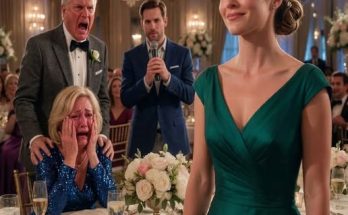
I waited three minutes before following Brenda.
Carol noticed.
“Where are you going?”
“To find her.”
Walter stared at me.
“Why?”
“Because this has gone far enough.”
“She spent fifty-five years being awful.”
“I’m aware.”
“You don’t owe her anything.”
“I know.”
That was exactly why I could go.
I no longer needed anything from Brenda.
Not an apology.
Not defeat.
Not validation.
Freedom made generosity possible in places where fear never had.
I stepped into the hallway.
The hotel corridor was quiet compared with the ballroom.
Soft carpet absorbed my footsteps.
A wall of windows overlooked the city, where headlights moved along the avenue below.
Brenda was not near the elevators.
I found her farther down the hall on a bench beside an arrangement of tall green plants.
She sat rigidly, clutching her handbag with both hands.
When she saw me, her expression closed.
“Come to enjoy it?”
“No.”
“I find that difficult to believe.”
I remained standing.
“May I sit?”
She laughed once.
“You apparently own the evening.”
“That isn’t an answer.”
She moved her bag.
I sat at the opposite end of the bench.
For several seconds, neither of us spoke.
The ballroom music came faintly through the closed doors.
Brenda stared straight ahead.
“You humiliated me.”
There it was.
I looked at her.
“Yes.”
She turned sharply.
“You admit it?”
“I embarrassed you.”
“That’s the same thing.”
“No.”
I thought of my mother.
“Humiliation requires someone to convince you that your worth has been reduced.”
Brenda’s eyes narrowed.
“Please don’t lecture me.”
“I’m not.”
“It certainly sounds like it.”
I folded my hands.
“I’m saying I understand why you’re angry.”
She looked away.
“That must feel wonderful.”
“What?”
“Being gracious.”
There was venom in the word.
“Everyone applauding while you stand there pretending you don’t enjoy it.”
I let that pass.
“I didn’t enjoy watching you walk out.”
“Why not?”
“Because I know what walking out of a room like that feels like.”
She flinched.
Good.
Not because I wanted to wound her.
Because truth had finally reached a place defense couldn’t cover.
Brenda stood.
“This is ridiculous.”
I remained seated.
“You can leave.”
She did not.
After several seconds, she sat again.
“I didn’t ruin your life.”
“No.”
“You had a husband. A child. Obviously a successful business.”
“Yes.”
“So perhaps we can stop pretending some stupid joke at seventeen destroyed you.”
“I never said it did.”
“You made an entire speech about it.”
“I said it affected me.”
She opened her mouth.
I continued.
“And I said my decision to keep avoiding reunions was mine.”
That quieted her.
I looked at her profile.
The sharp line of her nose remained familiar.
So did the habit of pressing her lips together when she was angry.
“What do you want from me, Brenda?”
She gave me a bitter smile.
“You already got what you wanted.”
“I didn’t come here to defeat you.”
“Please.”
“I didn’t.”
“You paid for the reunion anonymously.”
“Yes.”
“You scheduled a contract reveal.”
“I scheduled a contract signing.”
“At nine.”
“Yes.”
“That happened to be in front of everyone.”
“I asked Robert to meet me here because I was already here.”
She turned toward me.
“You expect me to believe none of this was planned?”
“I planned to stop hiding.”
That was the truest answer I had.
“I did not plan your behavior.”
She looked away again.
For almost a minute, nothing happened.
Then Brenda said, “My mother hated that dress.”
I blinked.
“What?”
“Your prom dress.”
I stared at her.
She kept looking ahead.
“She saw it when we arrived.”
I tried to remember.
Brenda’s mother had stood near the gym entrance that evening, wearing a pale coat and holding a small camera.
“I don’t understand.”
Brenda’s mouth twisted.
“She said it was charming.”
The word sounded almost painful.
“She asked where you bought it.”
I felt my skin prickle.
Brenda continued.
“I told her you probably made it.”
“Why would that matter?”
She laughed without humor.
“You didn’t know my mother.”
“I knew she had expensive furniture.”
That surprised a real laugh from Brenda.
It disappeared quickly.
“She could sew.”
I waited.
“She grew up poor.”
That I had not known.
Brenda’s father’s money had been so much part of their family identity that I had never considered what existed before it.
“My grandfather repaired farm equipment,” Brenda said. “They had six children. My mother made her own clothes until she married my father.”
She rubbed one thumb against the clasp of her handbag.
“She hated people knowing.”
I frowned.
“Then why would she admire my dress?”
“Because she knew what it took.”
The hallway seemed to shift around me.
Brenda looked at me for the first time.
“She said your checks lined up beautifully at the bodice.”
I almost laughed.
They didn’t.
Not perfectly.
But my mother had worked hard on them.
I heard her voice again.
Don’t move. You’re breathing.
My throat tightened.
Brenda looked down.
“My mother said she wished I knew how to make something that well.”
There it was.
Not an excuse.
A motive.
Small.
Petty.
Human.
“You were jealous.”
She stiffened.
“I was seventeen.”
“You were jealous.”
She gave me a sharp look.
Then, after a long silence, she said, “Yes.”
The answer stunned me more than any apology could have.
Brenda leaned back against the wall.
“She compared me to other girls constantly.”
“I didn’t know.”
“Why would you?”
She looked tired now.
Not defeated.
Old.
“She liked you.”
“Your mother barely knew me.”
“That didn’t matter.”
Brenda’s voice became quieter.
“She liked girls who were practical. Girls who worked. Girls who didn’t waste money.”
I almost smiled.
“She would have liked my mother.”
“Probably.”
Brenda stared at her hands.
“I hated hearing that.”
“So you came onto the dance floor.”
“Yes.”
“And told everyone my dress was a tablecloth.”
“Yes.”
The word was nearly a whisper.
For fifty-five years, I had imagined Brenda’s cruelty as effortless.
An expression of superiority.
It had never occurred to me that the joke began because she felt threatened by a compliment.
It did not make the cruelty smaller.
But it changed its shape.
“Why keep doing it afterward?” I asked.
She frowned.
“What?”
“The comments. Graduation. The tenth reunion. Tonight.”
Brenda did not answer immediately.
When she did, her voice had changed.
“Because it worked.”
That was the most honest thing she had said all evening.
I nodded.
“Yes.”
She looked at me.
“You got quiet.”
“I did.”
“People laughed.”
“Yes.”
“And once people expect you to be a certain person…”
She stopped.
“Go on.”
She shook her head.
“No.”
“You’ve spent the evening insisting I tell the truth.”
“I never insisted.”
“You certainly created the atmosphere.”
Despite everything, I smiled.
Brenda exhaled.
“I liked being the person people watched.”
There was no pride in the admission.
“After a while, I didn’t know how to stop.”
That I understood more than I wanted to.
Roles can become cages even when they begin as thrones.
I had become the quiet girl.
Brenda had become the powerful one.
We had both continued acting long after high school ended.
“What happened after graduation?” I asked.
“With me?”
“Yes.”
She shrugged.
“I married Richard.”
I remembered the name.
“He was at the tenth reunion.”
“Yes.”
“He died?”
“Seven years ago.”
“I’m sorry.”
She nodded.
“We were married forty-eight years.”
I had not expected that.
“Children?”
“Two daughters.”
“Grandchildren?”
“Five.”
For several minutes, we spoke like ordinary women.
Not former enemies.
Not symbols.
Widows.
Mothers.
Grandmothers.
People who had watched time take more than it asked permission to take.
Then Brenda said, “Richard used to tell me I was mean.”
I looked at her.
“What did you say?”
“That he was too sensitive.”
“Convenient.”
“Yes.”
She smiled faintly.
“He stopped saying it after a while.”
I heard regret there.
Not performative regret.
The kind that arrives too late to be useful.
“My Arthur would have kept saying it.”
“Then perhaps he was braver.”
“He was stubborn.”
“I remember.”
“You met him once.”
“At the tenth reunion.”
“You called our laundromat cute.”
Brenda closed her eyes.
“Oh.”
“Yes.”
“That sounds like me.”
“It sounded exactly like you.”
She rubbed her forehead.
“I suppose I owe you a large number of apologies.”
“I don’t need an inventory.”
“I probably couldn’t finish one tonight.”
“No.”
The ballroom doors opened farther down the corridor.
Tommy stepped out.
He saw us.
Paused.
Then turned around and went back inside.
Brenda noticed.
“He still likes you.”
“No.”
“He does.”
“He feels guilty.”
“That can look similar at our age.”
I laughed.
So did she.
The sound surprised both of us.
Then Brenda became serious.
“I am sorry, Martha.”
I looked at her.
She did not look away.
“I’m sorry about the dress. I’m sorry about Tommy. I’m sorry about the tenth reunion.”
She swallowed.
“And I’m sorry about tonight.”
I listened.
No explanations followed.
No “but.”
No attempt to balance the blame.
“I wanted you to feel small,” she said.
There it was.
The sentence I had never expected to hear.
“And you did.”
Her eyes filled.
Not dramatically.
Just enough that she blinked more often.
“I don’t know why I still do things like that.”
I thought about telling her it was because nobody stopped her.
That would have been partly true.
But age had made me suspicious of simple explanations.
“Maybe you should figure that out.”
She nodded.
“Yes.”
I stood.
Brenda looked up.
“Are you going back in?”
“Yes.”
She hesitated.
“I don’t think I can.”
“That’s your choice.”
“I suppose everyone hates me.”
“Probably not.”
She gave me a skeptical look.
“Some are angry.”
“That’s more likely.”
“You can survive people being angry.”
“You say that confidently.”
“I’ve had practice.”
I began walking toward the ballroom.
“Martha.”
I turned.
Brenda was still seated.
“Did you really like the dress?”
I looked at her.
“I do now.”
Her expression softened.
“My mother really did think it was beautiful.”
That mattered more than I wanted it to.
Not because Brenda’s mother’s approval changed anything.
Because it returned one more piece of the night to me.
My mother and I had made something with care.
Someone had seen that.
Before cruelty rewrote the memory, someone had seen it.
“Thank you for telling me,” I said.
I opened the ballroom door.
Music and conversation spilled into the hall.
Then I heard movement behind me.
Brenda stood.
For a second, she seemed uncertain.
I held the door.
Not as forgiveness.
Not as surrender.
As a choice.
She walked toward me.
Before entering, she stopped.
“I don’t know what to say to them.”
“You don’t need a speech.”
“What, then?”
I looked into the room.
At Carol.
Walter.
Tommy.
Alina moving between tables.
People who had watched us repeat an old pattern and then watched it break.
“Try the truth.”
Brenda took a breath.
Then she stepped back into the ballroom beside me.
Click here to continue reading: PART 9: Brenda Returned to the Ballroom Without Her Armor, and One Classmate Asked the Question None of Us Expected Her to Answer
Fifty-Five Years After I Fled That School in Shame, Brenda Vance Put an Apron Back Into My Hands
Part 8 of 28