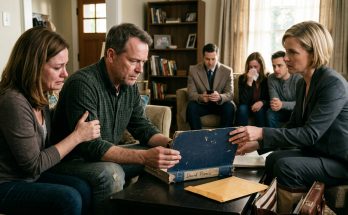
My parents didn’t even pretend to grieve. My father leaned back, smug, as if he’d been waiting his whole life for this moment to arrive and correct itself.
Then Priya slid a folder toward me. Inside was a clause Gideon had written in plain language:
To Trent and Dana Mercer: You abandoned your daughter. You forfeited any claim to her life. You will receive nothing. If you contest this trust, you will receive less than nothing.
My parents didn’t read it like shame. They read it like a challenge.
Two weeks later, I was served.
They were suing—claiming undue influence, fraud, “manipulation of an elderly man,” and that as my “natural parents” they had rights to “family assets.”
They reappeared not to apologize, not to explain, not to ask if I was okay.
They reappeared to take.
Probate court was smaller than I expected. No dramatic chandeliers, no booming gavel every ten seconds. Just wood benches, fluorescent lights, and the quiet hum of people waiting to have their worst moments turned into public record.
My parents sat across the aisle with their attorney, a slick man with a perfect tie knot and a smile that didn’t reach his eyes. My mother kept whispering like she was performing for someone invisible. My father stared at me with a look that said: You don’t get to win.
I sat with Priya Shah and a binder thick enough to stop a bullet. My hands were cold. My stomach felt hollow.
“Remember,” Priya murmured, calm as ever, “they can file anything. That doesn’t mean it survives evidence.”
My mother caught my eye and smirked—small, satisfied. As if court was the place where people like her were finally rewarded for showing up and demanding.
The bailiff called the room to order. “All rise,” he announced. “Court is now in session.”
My parents rose slowly, still smug.
Then the bailiff continued, voice ringing cleanly through the courtroom:
“ALL RISE FOR JUDGE RENEE CALDWELL.”
My mother’s smirk faltered.
My father’s eyebrows twitched like he’d been slapped by a memory.
Judge Caldwell stepped in wearing a black robe that made her look taller than she was. She had silver streaks in her hair and eyes that didn’t waste time. She didn’t glance around like a new judge finding her seat. She moved like she owned the room because she did.
She sat. She looked over the file. Then she lifted her gaze.
It landed on my parents.
And something in her expression sharpened—recognition.
“Mr. and Mrs. Mercer,” she said.
My mother’s voice turned sugary. “Yes, Your Honor.”
Judge Caldwell didn’t return the sweetness. “I’m familiar with your names.”
My father cleared his throat. “We… don’t recall—”
“I do,” the judge cut in, not loud, just decisive. “I presided over the family court matter involving your daughter. The abandonment at O’Hare Airport. The subsequent guardianship petition. The termination of your parental rights.”
The courtroom went very still.
My mother’s mouth opened, then closed. Her attorney shifted, suddenly less confident.
Judge Caldwell looked down at the file again, then back up. “You are here today claiming an interest in the estate of Gideon Kessler, a man who became legal guardian to the child you abandoned.”
My father’s face reddened. “Your Honor, this is probate—”
“This is credibility,” Judge Caldwell replied. “And yours is already compromised.”
My mother tried a different tactic, voice trembling just enough to sound victimized. “We were young. We made mistakes. But we’re still her parents.”
Judge Caldwell’s eyes didn’t soften. “Legally, you are not. That was decided years ago after repeated failures to participate in reunification services and multiple missed court appearances.”
Priya stood. “Your Honor, if I may—”
“Proceed, Ms. Shah,” the judge said, and her tone changed slightly—professional respect.
Priya laid it out cleanly: Gideon’s trust documents. Medical evaluations showing he was competent. Emails and letters showing intent over decades. The no-contest clause. And the most damning piece—Gideon’s recorded statement made a year before his death, notarized and witnessed, where he described the airport abandonment in detail and explained why he structured the trust to protect me.
Then Priya introduced Exhibit 12: the airport incident report.
The opposing attorney stood quickly. “Objection—relevance. The issue is undue influence.”
Judge Caldwell’s stare pinned him. “It is relevant to motive,” she said. “And to standing.”
My father leaned toward his attorney, whispering urgently. My mother’s face tightened like her skin didn’t fit anymore.
The judge turned a page. “You allege undue influence,” she said to my parents. “On what basis?”
Their attorney launched into polished phrases: young woman “isolating” an older man, “controlling access,” “emotional manipulation.” He gestured toward me like I was a con artist.
Judge Caldwell listened without interruption.
Then she asked one question that cracked the whole performance.
“Where were you,” she said to my parents, “during the twenty years Mr. Kessler raised Sofia Mercer?”
My mother swallowed. “We… didn’t know where she was.”
Judge Caldwell lifted an eyebrow. “That is false.” She tapped the file. “You were served. Multiple times. You ignored it. You knew. You chose not to appear.”
My father’s voice rose. “We were dealing with our own problems!”
And Sofia was five years old,” Judge Caldwell replied, flat. “At baggage claim.”
Silence again—thick, ugly.
Priya stood once more. “Your Honor, we also request sanctions for frivolous litigation and harassment. They contacted my client’s employer. They posted online claiming she ‘stole’ money. We have records.”
My mother snapped, “She doesn’t deserve it! She’s not even his real family!”
I flinched—old reflex. But Judge Caldwell’s voice landed like a door slamming.
“She was family,” the judge said, “because he acted like it. You were not, because you did not.”
Then, calmly: “This court finds no evidence of undue influence. The trust is valid. The contest is dismissed with prejudice.”
My father’s face went slack.
My mother’s eyes darted wildly, searching for a new angle, a new victim.
Judge Caldwell continued, “Additionally, given the history and the conduct presented, the court grants the request for sanctions. Mr. and Mrs. Mercer will pay the respondent’s reasonable attorney’s fees. Any further harassment will be met with contempt proceedings.”
My parents didn’t smirk anymore.
They looked small. Exposed. Like the story they’d been telling themselves for decades finally met a judge who remembered the truth.
Outside the courtroom, my mother hissed my name like it was a curse. “You think you’ve won?”
I looked at her, and for the first time, I didn’t feel like a five-year-old waiting for someone to come back.
“I didn’t win,” I said quietly. “I survived. Gideon made sure of it.”
Priya touched my shoulder. “Let’s go,” she said.
In the weeks that followed, I didn’t buy a mansion. I didn’t post a victory online. I paid off my student loans, set up a secure financial plan, and created a small scholarship fund in Gideon’s name for kids aging out of guardianship.
Because the truest inheritance Gideon gave me wasn’t the money.
It was the certainty that being chosen—on purpose, consistently—can rewrite an entire life.
Was a Marine Sniper. 5 Seniors Branded My Son With a Belt Buckle. Principal Called It Tradition
Part 2 of 2